You buy a silk scarf. It looks beautiful. It feels smooth. The label says “100% silk.”
But something feels off.
Maybe the price was too low. Maybe it feels slightly plasticky. Or maybe you just want to be sure before gifting it or reselling it.
Here’s the truth: fake silk is everywhere. Polyester and other synthetics are routinely sold as silk, and to an untrained eye, they look almost identical. The global fabric market is flooded with imitations. Even experienced buyers get fooled.
The good news? You don’t need a lab. You don’t need fancy tools. You just need to know how to tell if silk is real using a few simple, at-home tests. By the end of this guide, you’ll know exactly what to look for.
What Is Real Silk Made Of?
Real silk is a natural protein fibre. It’s produced by silkworms (most commonly Bombyx mori) as they spin their cocoons. Each thread is incredibly fine, and it takes thousands of cocoons to produce a single metre of fabric.
Think of it like a natural version of thread produced by a living creature. That biological origin is exactly what gives silk its unique properties, and it’s also what makes it genuinely hard to fake at the microscopic level.
Real silk contains a protein called fibroin, coated in another protein called sericin. This structure gives it that signature softness and breathability. Polyester is just plastic. It mimics the shine but not the science.
This distinction matters because every test in this guide is essentially asking the same question: does this fabric behave like a protein fibre, or like a synthetic one?
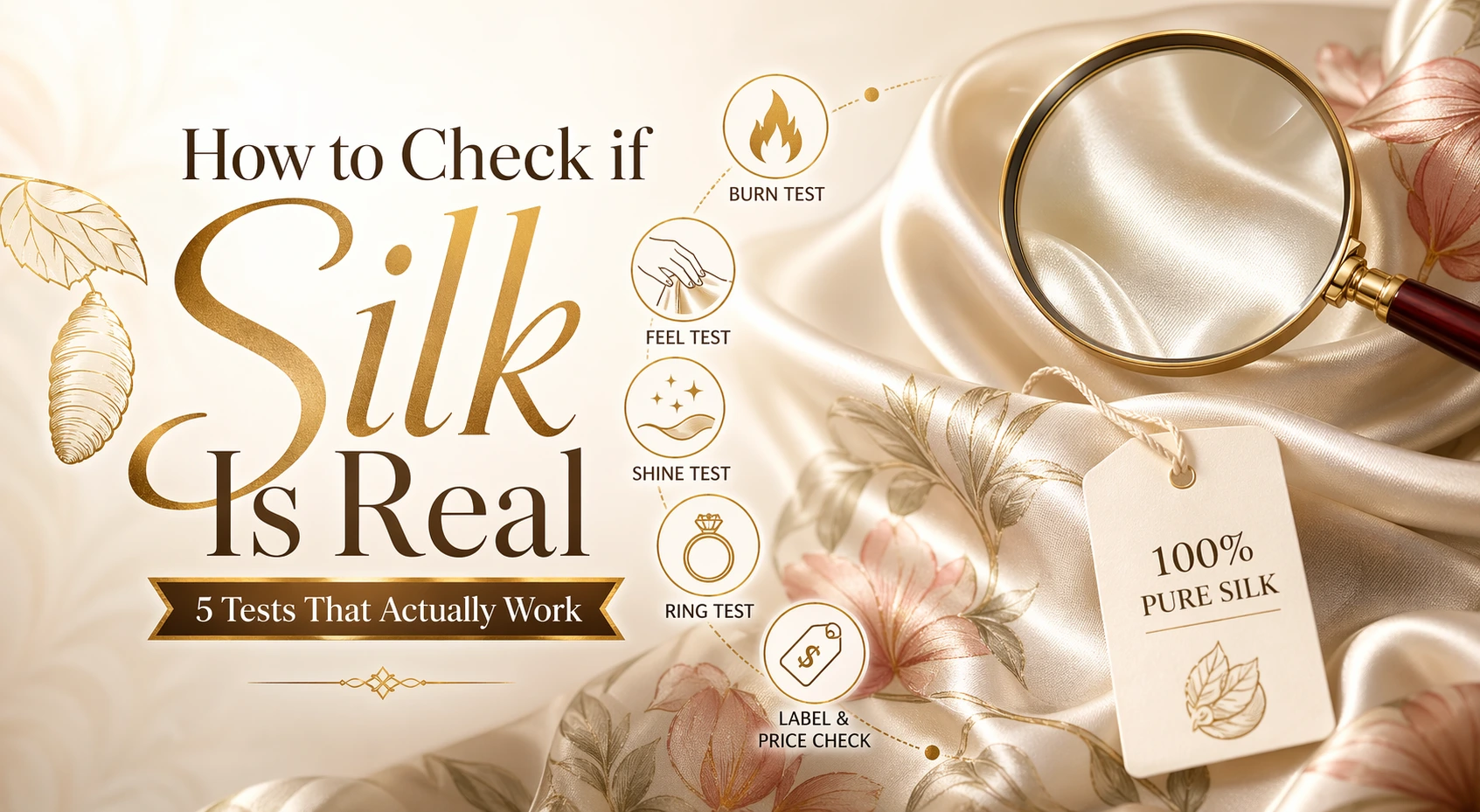
How to Tell if Silk Is Real: 5 Methods
There are several ways to test silk. Some require nothing more than your hands. One requires a lighter. None require you to be a textile expert.
Here are five methods, from the most conclusive to the most convenient.
1. The Burn Test
This is the gold standard. If you can only do one test, do this one.
Real silk behaves like hair or fingernails when burned. That makes sense because both are made of protein. Polyester, on the other hand, is plastic. And plastic melts.
Here’s how to do it:
- Pull a few loose threads from an inside seam or hidden edge of the fabric. Do not cut from a visible area.
- Hold the threads with tweezers (or carefully with your fingers).
- Bring a small flame to the threads.
- Observe what happens. Watch, smell, and check the ash.
What real silk does:
- Burns slowly, almost reluctantly
- Smells exactly like burnt hair (because it is, essentially, a protein burning)
- Produces a small, crushable ash that crumbles easily between your fingers
- The flame self-extinguishes quickly once you remove the source
What fake silk (polyester) does:
- Melts rather than burns, often curling away from the flame
- Smells like burning plastic
- Leaves a hard, dark bead that you cannot crush
- May continue to burn or melt after the flame is removed
The smell alone is usually enough. Burnt hair vs. burnt plastic. You’ll know the difference the moment you experience it.
A word of caution: do this in a ventilated space, over a fireproof surface. Be careful with the flame. The test itself is simple, but basic fire safety still applies.
2. The Feel Test
No equipment needed. Just your hands.
Rub the fabric between your fingers and palms for a few seconds. Then pay attention.
Real silk warms up. It responds to your body heat and starts to feel warm to the touch. There’s a reason people describe silk as “alive” in texture. It interacts with your skin rather than sitting passively against it.
Fake silk stays cool. Or worse, it starts to feel slightly plasticky or slippery in an uncomfortable way. It doesn’t warm up. It just slides around.
Real silk also has a subtle friction to it. Not rough. But not frictionless either. It’s like the difference between touching skin and touching a plastic bag.
This test takes about 10 seconds. If the fabric warms up naturally and feels smooth-but-not-slippery, that’s a good sign.
3. The Visual / Shine Test
Silk has a distinctive sheen. But it’s not the kind of shine you’d expect.
Real silk shimmers differently depending on the angle. As you tilt the fabric under light, the colour and sheen shift. Hold it one way, it looks cream. Tilt it slightly, it glows ivory or gold. This is called lustre, and it happens because of the triangular cross-section of silk fibres, which refracts light like a prism.
Fake silk, however, shines uniformly. It looks the same from every angle. The shine is bright but flat. It doesn’t shift. It just glints.
Think of it like the difference between a diamond and a piece of glass. Both are shiny. But one catches light in multiple directions, and the other just reflects it.
Another thing to check: look at both sides of the fabric. Real silk is often lustrous on both sides. Cheap imitations tend to have a very shiny front and a dull, almost matte back.
If you’re buying a silk scarf and can only look, not touch or burn, the visual test is your best friend.
4. The Ring Test
This one is almost fun to do.
Take the fabric (a scarf works best) and try to gently pull it through a ring, like a finger ring or a curtain ring. A small opening.
Real silk glides through. The fibres are fine, smooth, and tightly woven. A genuine silk scarf will pass through a ring with almost no resistance. It flows.
Synthetic fabric bunches up or catches. It resists. You’ll feel the fabric snagging against the ring rather than gliding through it.
This works because silk’s fibre structure is exceptionally fine and uniform. Polyester fibres, even when woven tightly, don’t have the same smooth flow. They grip and drag.
It’s a quick check. 5 seconds. And it’s particularly satisfying when a silk scarf slides right through and you know you’ve got the real thing.
5. The Price and Label Check
Sometimes the simplest check is the most ignored one.
Look at the label. A genuine silk product should say “100% silk” or “100% pure silk.” Watch out for terms like:
- “Silky”
- “Satin finish”
- “Silk-feel”
- “Silk-like polyester”
These are not silk. They are marketing terms designed to borrow silk’s reputation without actually being silk.
Now look at the price. Real silk is not cheap. It cannot be. The production process is labour-intensive, the raw material is scarce, and quality control is demanding. If a “100% silk” scarf is priced the same as a budget polyester one, something is wrong.
This isn’t a foolproof test on its own. Labels can be misleading or even fraudulent. But if the price is suspiciously low and the label uses vague language, combine it with one of the tactile or burn tests above.
Also worth mentioning: Silk Mark certification. In India, the Silk Mark Organisation of India (affiliated with the Ministry of Textiles) certifies genuine silk products. A Silk Mark label on a product means it has been verified as authentic natural silk. If you’re buying from an Indian manufacturer or retailer, look for this mark. You can verify it through silkmark.in.
Silk vs Polyester: What’s the Actual Difference?
You’ve probably noticed this guide keeps comparing silk to polyester. That’s intentional. Polyester is the most common silk imitation on the market. Here’s a side-by-side look:
| Feature | Real Silk | Polyester |
|---|---|---|
| Origin | Natural (silkworm protein) | Synthetic (petroleum-based plastic) |
| Feel | Soft, warm, slight friction | Smooth, cool, can feel plasticky |
| Shine | Multi-directional lustre | Flat, uniform sheen |
| Breathability | High (regulates temperature) | Low (traps heat) |
| Burn behaviour | Burns like hair, crushable ash | Melts, hard plastic bead |
| Price | Higher due to production cost | Significantly cheaper |
| Durability | Strong but needs gentle care | More resilient to rough handling |
| Eco-impact | Biodegradable | Non-biodegradable |
The core difference is that silk is biological and polyester is industrial. That distinction explains almost every difference in their behaviour, from how they burn to how they breathe.
What to Look for When Buying a Real Silk Scarf or Throw
Once you can identify real silk, the next question is: how do you buy it without getting cheated?
Here are a few things to keep in mind.
Ask about momme weight. Momme (mm) is the unit used to measure silk fabric density, similar to thread count in cotton. The higher the momme, the denser and heavier the silk. For scarves, 12-16 momme is standard. For throws and bed products, 19-25 momme is considered premium. A 25 momme silk throw is noticeably heavier and more durable than a 22 momme one. For everyday scarves, 22 momme strikes a good balance of drape and durability.
Look for a reputable manufacturer. Not just a reseller. A manufacturer who controls the full process, from raw silk to finished product, is more likely to deliver consistent quality. Ask if they can provide fabric composition certificates or certification documentation.
Request samples before large orders. If you’re sourcing silk products for a brand or boutique, always ask for physical samples. Run the feel test and the visual test yourself. It takes 2 minutes and could save you from a bad order.
Be cautious about vague product descriptions. “Premium satin silk” is not the same as “100% pure silk.” Read the fine print. Ask direct questions. A trustworthy manufacturer will give you a direct answer.
Conclusion
Real silk has something synthetics simply cannot replicate. The warmth. The shifting sheen. The way it burns like hair and crumbles to ash. Once you know what to look for, spotting fake silk becomes second nature.
Run the burn test. Trust your fingers. Tilt the fabric under a light. These are simple checks that take minutes, and they work.
If you’re a brand or boutique sourcing silk scarves, throws, or accessories, the source matters as much as the fabric. Working with a manufacturer who specialises in authentic silk products means fewer quality surprises and more consistent deliverables for your customers.
Bright Star has been crafting genuine silk scarves and throws for brands and boutiques across the world. Explore our silk scarf collection and silk throw range, or get in touch if you’re looking to source premium silk products for your label.
FAQs
How do I tell if something is real silk?
Use the burn test. Pull a few threads and hold them to a flame. Real silk smells like burning hair and produces a crushable ash. You can also rub the fabric between your fingers, real silk warms up while polyester stays cool.
How to check if Silk Mark is original?
You can verify a Silk Mark certification through the official portal at silkmark.in. The mark is issued by the Silk Mark Organisation of India and applies to products made from pure natural silk.
What does 100% silk look like?
Real silk has a soft, shifting lustre that changes as light hits it from different angles. It doesn’t have the flat, uniform shine that synthetic fabrics do. The fabric looks rich and slightly muted, not aggressively glossy.
Which is better, 22 or 25 momme silk?
For most uses, both are excellent quality. 25 momme is heavier and more durable, making it better suited for throws, pillowcases, and products that see more wear. 22 momme is lighter and has better drape, ideal for scarves and wraps.
What does fake silk feel like?
Fake silk (usually polyester) feels cooler to the touch and doesn’t warm up with body heat. It can feel slightly slippery, almost plasticky, and lacks the gentle friction of real silk fibres.
What are the 4 types of silk?
The four main types are Mulberry silk (most common and softest), Tussar silk (textured, golden tone), Eri silk (matte finish, thicker weave), and Muga silk (naturally golden, durable). Mulberry silk is what most scarves and luxury textiles are made from.
Is real silk shiny on both sides?
Generally, yes. Real silk tends to have lustre on both sides of the fabric, though one side may be slightly more pronounced. If one side is very shiny and the other is completely matte, it may indicate a synthetic blend.
What are five characteristics of silk?
Natural lustre, protein-based composition, temperature regulation (keeps you warm in winter and cool in summer), smooth and fine texture, and biodegradability. These five traits together are what make silk genuinely unique.
What is the cheap version of silk called?
The most common silk substitute is polyester satin, often marketed with words like “silky,” “satin,” or “silk-feel.” Other alternatives include rayon and nylon, which also mimic silk’s appearance but lack its natural properties.