You’re browsing an online store. You spot a “100% cashmere” scarf. The price? Suspiciously low. You think: should I trust this?
Most people don’t know how to answer that question. And sellers know it.
The cashmere market is full of mislabelled products, blended fibres, and outright synthetic fakes sold under the cashmere name. It happens at every level, from fast fashion brands to local markets to wholesale suppliers. The label says one thing. The fabric tells another story.
This guide will show you exactly how to identify genuine cashmere scarves without any special equipment. Just your hands, some observation, and one optional flame.
What Is Real Cashmere and Where Does It Come From?
Real cashmere comes from a very specific source. It’s the fine, soft undercoat combed from Cashmere goats, primarily raised in Mongolia, China, and the Kashmir region of India. These goats grow two layers of fibre: a coarse outer coat and a fine inner layer. Only that inner layer is true cashmere.
Each goat produces only about 150 to 200 grams of usable fibre per year. To put that in perspective, a single cashmere scarf can require the annual yield of two to three goats. That scarcity is the reason genuine cashmere costs what it does.
Is cashmere from Kashmir? Yes, historically. The Kashmir Valley was where cashmere weaving first became an art form, and Indian cashmere (particularly from Ladakh goats) is still considered among the finest in the world. In India, cashmere is often called pashm, which is where the word pashmina comes from. More on that distinction shortly.
Pashmina and cashmere are related but not identical terms. All pashmina is cashmere, but not all cashmere is pashmina. Pashmina specifically refers to the finer, hand-processed cashmere from the Kashmir region. The word is sometimes misused as a marketing term for any soft scarf, which creates a lot of confusion. We’ll break this down properly later in the guide.
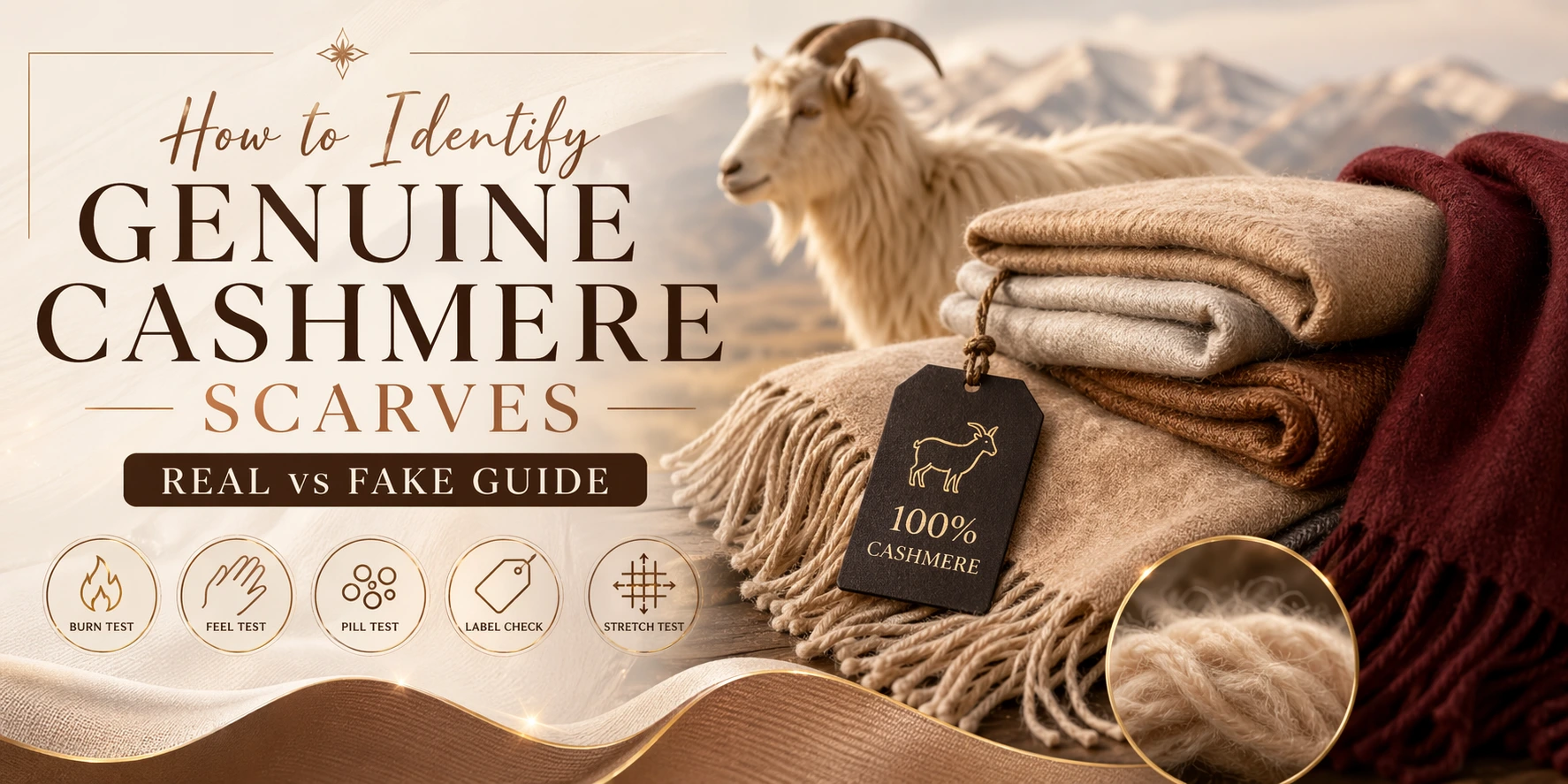
How to Identify Genuine Cashmere: 5 Tests You Can Do
These five tests work at home, in a store, or when evaluating samples from a supplier. Some take 10 seconds. One takes a lighter. All of them give you real answers.
1. The Burn Test
This is the most reliable test available. It works because cashmere is a protein fibre, just like human hair. And protein fibres behave very differently from synthetic ones when they meet a flame.
Here is how to do it, step by step:
- Pull a few loose threads from an inner seam or a hidden edge of the scarf.
- Hold the threads with tweezers, or carefully pinch them at a distance.
- Bring a small flame to the threads.
- Watch how they burn. Smell the smoke. Check what’s left behind.
What real cashmere does:
- Burns slowly and hesitantly
- Smells strongly of burnt hair (that is exactly what it is, a protein burning)
- Produces a soft, dark, crushable ash
- The flame dies out quickly once removed
What acrylic does:
- Melts and curls away from the flame
- Smells harsh and chemical, like burning plastic
- Leaves a hard, shiny bead that you cannot crush between your fingers
- May continue burning even after the flame is removed
The smell is the most immediate giveaway. Burnt protein and burnt plastic smell nothing alike. Once you’ve experienced both, you will never mix them up again.
Do this in an open space, over something fireproof. The test itself is small and controlled, but basic caution still applies.
2. The Feel Test
No tools. No flame. Just your hands.
Pick up the scarf and hold it for a moment. Then rub it gently between your palms.
Real cashmere warms up almost immediately. It responds to body heat. The softness is not slippery or synthetic, it has a subtle, almost velvety grip. It feels light. Airy. There’s a reason people describe it as wearing a cloud.
Acrylic or blended fabric behaves differently. It stays cool. It can feel slightly scratchy against the skin even when it looks soft. Sometimes it has a uniform, too-perfect smoothness that feels manufactured rather than natural.
Cheap cashmere blends are often the trickiest. They feel almost right, but not quite. There’s a coarseness to the fibre that gives it away if you pay attention. Like the difference between real butter and margarine. Similar, but your hands know.
3. The Pill Test
Here is a test that surprises most people.
Rub the fabric between your fingers firmly for about 30 seconds. Focus on one small area.
Real cashmere will pill slightly. Small fibre balls will form on the surface. This sounds like a bad thing. It is not. It actually means the fibres are natural and short, which is a characteristic of genuine cashmere. The pilling from real cashmere also settles and reduces over time with washing and wear.
Acrylic pills aggressively and permanently. The pills are larger, harder, and they don’t go away. They just keep forming. Washing makes it worse.
This is one of the most common misconceptions in cashmere buying. People return genuine cashmere thinking it’s defective because it pilled. Meanwhile, they’re keeping the acrylic scarf that looks pill-free but feels nothing like the real thing.
If a “cashmere” scarf doesn’t pill at all on first inspection, that’s actually a reason to be more suspicious, not less.
4. The Label and Price Check
The label should be your first stop. And what it says matters a great deal.
A genuine cashmere product should say: “100% cashmere.” Nothing else. Not “cashmere blend,” not “cashmere-like,” not “premium pashmina,” not “super soft cashmere feel.” Those phrases are ways of communicating that there is no actual cashmere in the product, or very little.
There are specific fake cashmere names that appear repeatedly in the market. Watch for these:
- Cashmilon – a branded acrylic fibre often marketed as a cashmere alternative
- Cashmillon – same family, different spelling
- Pashmina acrylic – a blended or fully synthetic product borrowing the pashmina name
- Art silk pashmina – often viscose or rayon, not cashmere at all
These are not variations of cashmere. They are synthetic products using cashmere-adjacent names to justify higher prices.
Now, about price. Real cashmere is not cheap. It cannot be. The production process alone, from combing the goat to spinning the yarn to weaving the scarf, is labour intensive and low yield. A genuine 100% cashmere scarf from a reputable manufacturer typically starts at several thousand rupees on the lower end. In international markets, quality cashmere scarves range from $80 to $400 or more.
If a scarf is labelled “100% cashmere” and priced like a polyester shawl, something is off. Trust the price as much as the label.
5. The Stretch Test
This one is fast. Takes less than 10 seconds.
Hold the scarf at two points and stretch it gently. Then let go.
Real cashmere springs back. It has a natural elasticity built into the fibre structure. It recovers its shape cleanly without distortion. This is because the cashmere fibre itself has a fine, crimped structure that gives it memory.
Synthetic blends either don’t stretch well, or they stretch and stay stretched. A scarf that loses its shape and doesn’t recover is almost certainly not pure cashmere.
You can also try this along the width of the scarf and then the length. Real cashmere behaves consistently in both directions.
Cashmere vs Acrylic vs Pashmina: What’s the Actual Difference?
These three terms create a lot of confusion. Here’s a clean comparison.
| Feature | Real Cashmere | Acrylic | Pashmina |
|---|---|---|---|
| Fibre source | Cashmere goat undercoat | Petroleum-based synthetic | Fine cashmere from Kashmir (pashm) |
| Feel | Extremely soft, lightweight, warm | Can feel soft but slightly scratchy | Ultra-fine, softer than standard cashmere |
| Price range | Mid to high | Low | High to very high |
| Burn behaviour | Burns like hair, crushable ash | Melts, hard plastic bead | Burns like hair (it is cashmere) |
| Durability | Long-lasting with proper care | Wears quickly, pills permanently | Delicate, needs careful handling |
| Care | Hand wash or dry clean | Machine washable | Hand wash only |
| Origin | Mongolia, China, India, Iran | Factory-produced globally | Kashmir Valley, India |
Which is better, pashmina or cashmere? Technically, pashmina is a type of cashmere, and typically a finer one. If you’re buying genuine pashmina from Kashmir, it is among the best cashmere available in the world. However, the word “pashmina” is heavily misused. Many products labelled pashmina contain no cashmere at all. Cashmere with clear certification is often the safer purchase.
Does Cashmere Gauge Matter? 7 Gauge vs 12 Gauge Explained
Most cashmere guides skip this entirely. That’s a gap, because gauge affects what you’re buying significantly.
Gauge refers to the number of stitches per inch in a knitted fabric. That’s it. A lower number means fewer, larger stitches. A higher number means more, finer stitches.
Here is what that means in practice:
7 gauge cashmere is thicker and chunkier. It has a more visible knit texture. It’s heavier, warmer, and better suited for colder climates or people who prefer a more structured, substantial scarf. Think of it like a thick winter jumper in scarf form.
12 gauge cashmere is finer and lighter. The knit is tighter and less visible. The fabric drapes beautifully and feels almost weightless. It’s the better choice for people who want something elegant and versatile across seasons.
Is 7 gauge or 12 gauge cashmere better? Neither is universally better. It depends entirely on what you need. For a winter wrap or throw, 7 gauge makes sense. For a refined travel scarf or a gift for someone who runs warm, 12 gauge is the right call.
What gauge does not tell you is whether the cashmere is genuine. A fake can be knitted at any gauge. So use this information for product selection, not authentication.
What to Look for When Sourcing Genuine Cashmere Scarves
This section is for brands, boutiques, and buyers sourcing cashmere at volume. Because the stakes are different when you’re ordering 500 scarves instead of one.
Ask for fibre composition certificates. Any serious manufacturer can provide documentation showing the fibre content of their product. If a supplier cannot or will not provide this, that tells you something.
Request physical samples before committing to an order. Run the feel test. Run the burn test on a few loose threads from the sample. A genuine manufacturer will expect this and will not be offended by it.
Ask about the source of the raw fibre. Where does the cashmere come from? Is it graded? What micron count are they working with? Fine cashmere is typically under 16 microns in diameter. The finer the fibre, the softer the final product. A manufacturer who knows their fibre source can answer these questions without hesitation.
Look for certifications. The Woolmark certification applies to wool and wool-adjacent fibres including cashmere blends. For Kashmir-origin pashmina, the GI (Geographical Indication) tag is a strong quality marker. The Craft Development Institute in Srinagar also certifies genuine pashmina products.
Understand what production control means. A manufacturer who controls the full process, from yarn sourcing to weaving to finishing, has far more visibility into fibre quality than a trader who is simply reselling. When quality issues arise, a vertically integrated manufacturer can trace the problem. A trader often cannot.
Be specific in your purchase orders. State the fibre composition, the gauge, the dimensions, and the finishing requirements in writing. Vague orders invite substitution.
FAQs
How to spot a fake cashmere scarf?
Run the burn test. Pull a few loose threads from a hidden seam and hold a flame to them. Real cashmere smells like burnt hair and leaves a crushable ash. Acrylic melts and leaves a hard plastic bead. Also check the label for terms like “cashmilon” or “cashmere blend,” which indicate synthetic or mixed fibres.
How do I know if my cashmere is real?
Use the feel test first. Real cashmere warms up quickly against your skin and feels lightweight and soft without feeling slippery. Then try the burn test for confirmation. If it smells like burnt protein and the ash crumbles, it is real cashmere.
How much is a 100% cashmere scarf worth?
Genuine 100% cashmere scarves typically start at around 4,000 to 8,000 rupees on the lower end in the Indian market, and go significantly higher for finer grades or pashmina-quality pieces. In Western markets, expect $80 to $400 or more for reputable products. Anything below these ranges labelled as “100% cashmere” deserves scrutiny.
Is 7 gauge or 12 gauge cashmere better?
It depends on the use. 7 gauge is thicker and warmer, suitable for winter scarves and heavier wraps. 12 gauge is finer and lighter, better for elegant, versatile scarves. Neither is superior in terms of cashmere quality. Both can be made from genuine fibre.
How to tell if 100% cashmere?
Check the label, run the burn test, and pay attention to the price. A product claiming to be 100% cashmere should smell like burnt hair when threads are burned, warm up against your skin quickly, and be priced accordingly. Suspiciously low prices and vague label language are both red flags.
How to tell cheap cashmere?
Cheap cashmere is often a blend, with a lower percentage of actual cashmere mixed with wool, acrylic, or viscose. It tends to feel coarser than pure cashmere, pill more aggressively, and not recover well from stretching. The burn test will also show a partial plastic residue if synthetic fibres are present.
What is cashmere called in India?
In India, cashmere fibre is traditionally called pashm, derived from the Persian word for wool. Products made from this fibre are called pashmina. The Kashmir Valley has been the historical centre of pashmina production, and authentic Kashmiri pashmina holds a Geographical Indication (GI) tag from the Indian government.
Which is better, pashmina or cashmere?
Pashmina is a type of cashmere, typically the finer variety sourced from the Kashmir region. In terms of quality, authentic pashmina is among the best cashmere available. However, the word pashmina is heavily misused in the market. Certified cashmere with a documented fibre source is often a safer, more verifiable purchase than an uncertified “pashmina” label.
Is a 100% cashmere scarf good?
Yes, a genuine 100% cashmere scarf is excellent. It is naturally warm, lightweight, breathable, and incredibly soft. It regulates temperature well, making it comfortable in both mild and cold weather. With proper care, it can last decades. The key word is genuine: the quality of the experience depends entirely on the fibre being real.
Conclusion
Real cashmere has a combination of qualities that blends and synthetics cannot fully replicate. The warmth against skin, the way it burns, the softness that doesn’t feel artificial, these things are consistent and testable. Once you know what to look for, identifying genuine cashmere becomes straightforward.
The burn test alone will answer most of your questions. Everything else is confirmation.
If you’re a brand or boutique sourcing cashmere scarves or shawls, working with a manufacturer who controls fibre quality from the raw material stage matters enormously. Bright Star produces genuine cashmere and blended scarves and shawls for brands and retail buyers who need consistent quality at scale. Explore our cashmere scarf and shawl collections, or get in touch to discuss your sourcing requirements.