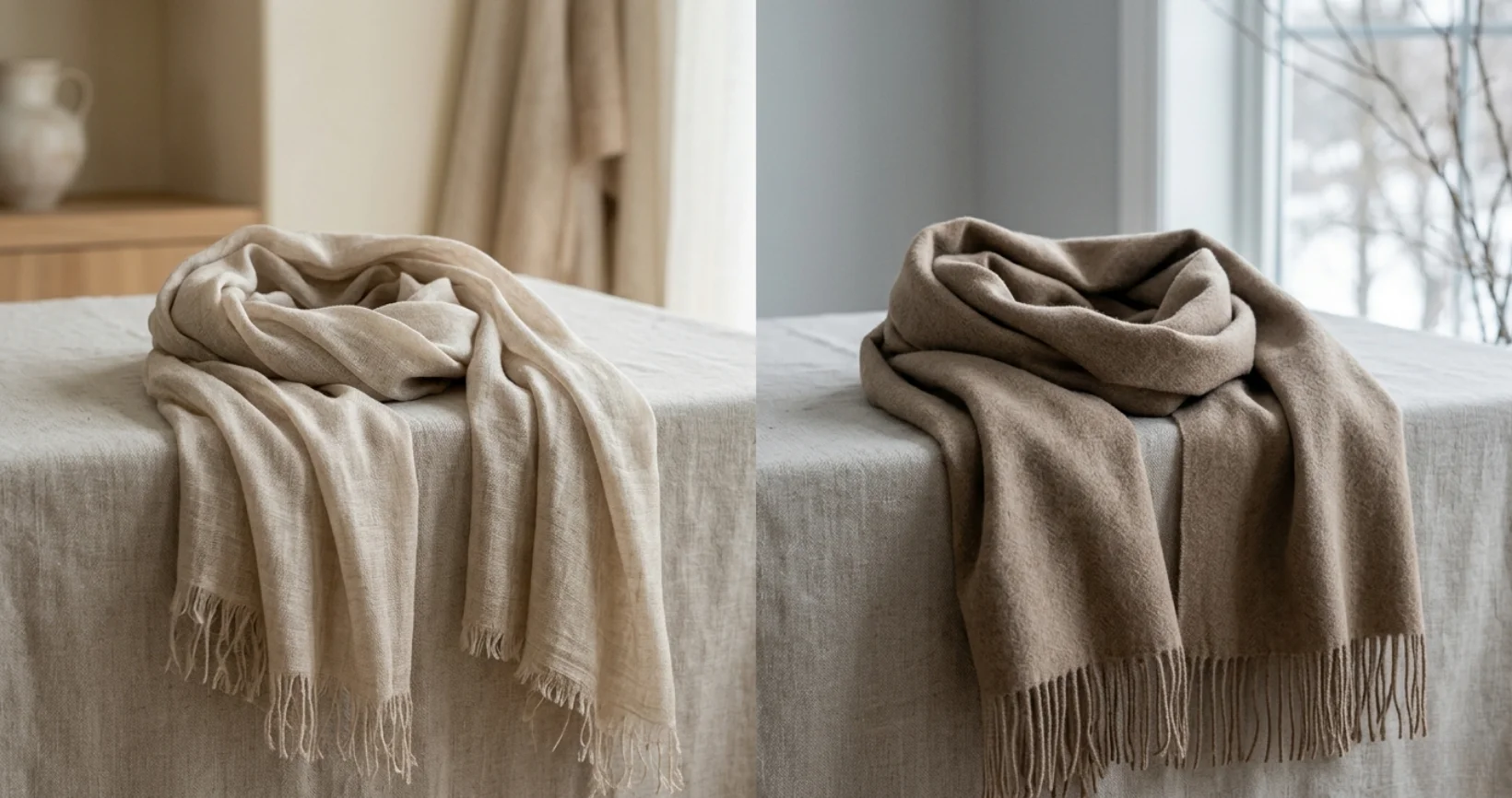
You walk into a luxury fabric store. The salesperson holds up two shawls. One is labeled cashmere. The other says pashmina. Both look nearly identical. Both feel incredibly soft. And both carry a hefty price tag.
So what exactly is the difference?
This is a question that confuses a lot of people. And honestly, it makes sense. Pashmina and cashmere are used interchangeably in fashion marketing all the time. Some brands use the words as if they mean the same thing. But they don’t. Not quite.
Both are luxury wool fabrics. Both are known for their exceptional softness and warmth. But the difference between cashmere and pashmina goes deeper than just the label on the tag.
Understanding that difference matters. It helps you spend your money wisely. It helps you know what you’re actually buying. And it saves you from paying a premium price for something that doesn’t deliver premium quality.
In this guide, we’ll break down everything. The origins, the fibers, the feel, the price, and the production process. By the end, the pashmina vs cashmere debate will make complete sense to you.
What Is Cashmere?
Let’s start with cashmere, because it’s the more familiar of the two.
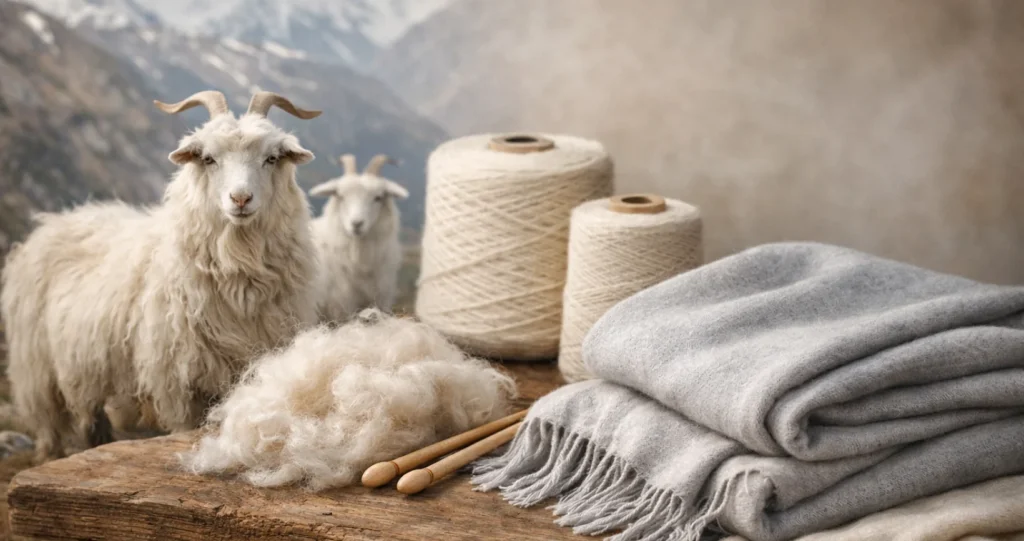
Cashmere wool comes from cashmere goats. These goats are primarily found in Mongolia, China, and parts of northern India. During cold winters, these animals grow a thick undercoat to protect themselves from extreme temperatures. That undercoat is what gets harvested in spring, when the goats naturally shed their winter coat.
The fibers collected from that undercoat are then cleaned, processed, and spun into yarn. That yarn eventually becomes the cashmere scarves, sweaters, and shawls you see in stores.
What makes cashmere special is the combination of softness and lightness. A standard wool sweater can feel scratchy and heavy. A cashmere sweater feels soft against the skin and weighs almost nothing. And yet it keeps you just as warm, sometimes warmer.
Cashmere is also incredibly versatile. You’ll find it used in everything from men’s cashmere scarves to full-length coats to baby blankets. It’s a fabric that has earned its place in luxury fashion over centuries.
But here’s the thing. Not all cashmere is created equal. The quality varies significantly depending on the source, the fiber thickness, and the production method. And that brings us to pashmina.
What Is Pashmina?
Pashmina is not a completely different fabric. Think of it as cashmere’s rarer, more refined cousin.
The word “pashmina” comes from the Persian word pashm, which means soft gold. That name tells you something right away. This isn’t just a fabric. It’s considered something precious.
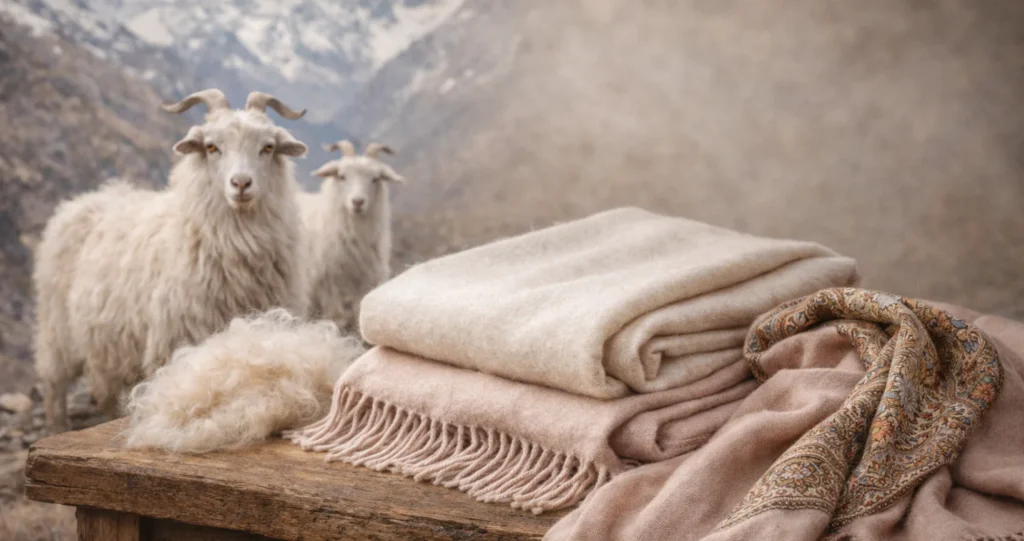
True pashmina comes from a specific breed of goat called the Changthangi, also known as the Pashmina goat. These animals live in the Himalayan highlands of the Ladakh region in Kashmir, at altitudes above 14,000 feet. Up there, temperatures can drop to minus 40 degrees Celsius in winter. The extreme cold forces these goats to grow an ultra-fine undercoat that is arguably the softest natural fiber in the world.
I remember handling a genuine Kashmiri pashmina shawl for the first time at a craft exhibition in Delhi. I expected it to feel like a normal scarf. What I actually felt was closer to holding a cloud. It was almost hard to believe something that thin could be that warm.
What is pashmina material, really? It’s the finest grade of cashmere fiber, handwoven using traditional techniques that have been passed down through generations of Kashmiri artisans. The origin of pashmina is deeply tied to the culture and heritage of the Kashmir Valley. A single shawl can take weeks or even months to weave by hand.
That’s why genuine pashmina is considered more luxurious than regular cashmere. It’s not just a fabric. It carries a tradition with it.
Is Pashmina the Same as Cashmere?
Here’s the clearest way to understand it.
All pashmina is cashmere. But not all cashmere is pashmina.
Think of it like champagne and sparkling wine. All champagne is sparkling wine, but not every sparkling wine is champagne. The difference lies in origin, process, and standards.
Is pashmina cashmere? Yes, technically. It comes from the same family of fiber. But pashmina refers specifically to the finest, rarest, and highest-quality end of the cashmere spectrum. Regular cashmere is sourced from multiple goat breeds across a wide geography. Pashmina is strictly from the Changthangi goat in the Himalayas.
The label “pashmina” is often misused in the market. You’ll find synthetic scarves or low-quality blends labeled as pashmina. Genuine pashmina is protected under a Geographical Indication tag, which certifies its Kashmiri origin and handmade production.
If a “pashmina” is being sold for a very low price, it’s almost certainly not the real thing.
Key Differences Between Pashmina and Cashmere
Now let’s get into the specifics. This is where the two fabrics genuinely diverge.
Fiber Thickness
This is probably the most important technical difference.
Fiber thickness in textiles is measured in microns. The lower the micron count, the finer and softer the fiber.
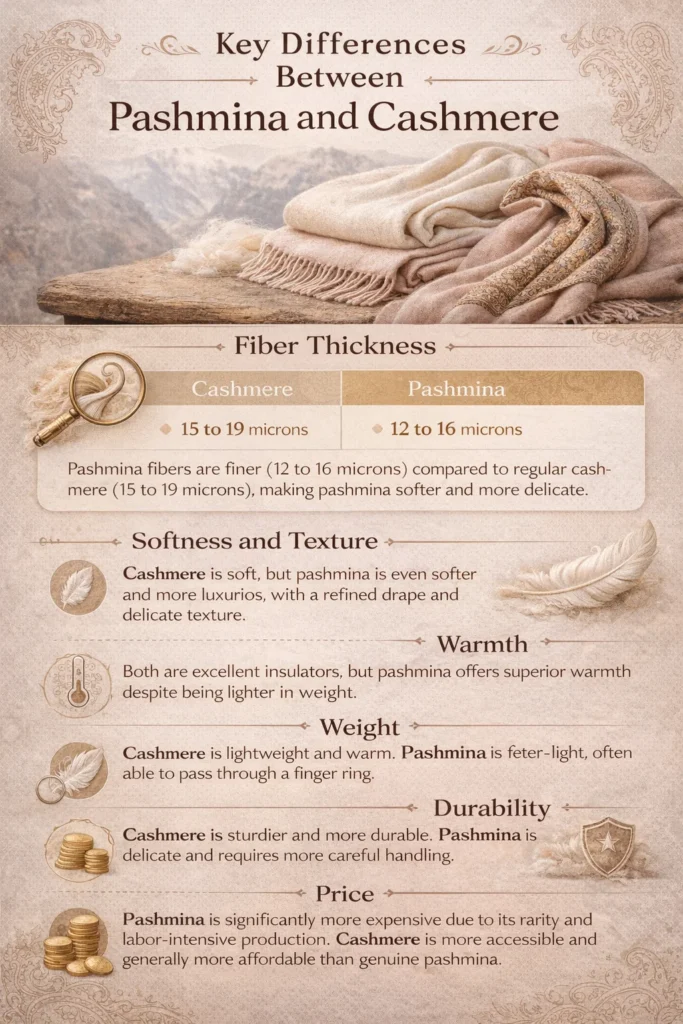
Pashmina fibers measure around 12 to 16 microns. Regular cashmere fibers typically fall between 15 to 19 microns. That difference might sound tiny. But at the level of fiber, it makes a massive impact on how the fabric feels against your skin.
Finer fiber means softer feel. Full stop. This is why pashmina feels noticeably more delicate and luxurious than most cashmere products.
Softness and Texture
Cashmere is soft. Most people who try it for the first time are genuinely surprised by how soft it is compared to regular wool.
But pashmina takes that softness further. It’s like comparing a good mattress to a five-star hotel mattress. Both are comfortable. But one is clearly on another level.
The texture of pashmina is more delicate and refined. It drapes differently too. A pashmina wrap falls with a natural, flowing elegance that heavier cashmere can’t quite match. As a soft scarf material, pashmina sits at the very top of the category.
Warmth
Both fabrics are excellent insulators. That’s part of what makes them so popular in cold weather accessories.
Cashmere traps heat efficiently. It’s warm without being bulky, which is why it’s such a popular choice for winter wear.
Pashmina offers excellent insulation despite being even lighter. The warmth-to-weight ratio of genuine pashmina is remarkable. You’re essentially getting maximum warmth from minimum fabric weight. This is particularly valuable if you want something that keeps you warm without feeling like you’re carrying a heavy layer.
Weight
Cashmere is lightweight compared to regular wool. That’s one of its selling points.
Pashmina goes a step further. It’s feather-light. A genuine pashmina shawl can be so thin that it passes through a finger ring. This is actually a traditional test used to verify authentic Kashmiri pashmina, sometimes called the “ring test.”
This extreme lightness is what makes pashmina such a sought-after featherweight cashmere scarf or shawl. You barely feel it on your shoulders. And yet it keeps you warm.
Durability
Here’s where cashmere has an advantage.
Pashmina is delicate. Those ultra-fine fibers that make it so incredibly soft also make it more fragile. It can snag easily. It needs careful handling. You can’t just throw it in a washing machine and hope for the best.
Cashmere is sturdier. Slightly thicker fibers mean slightly more resistance to wear and tear. A good cashmere scarf, properly cared for, can last many years of regular use.
If you’re buying something for everyday wear, cashmere’s durability gives it a practical edge.
Price
This is often the deciding factor for most buyers.
Pashmina is significantly more expensive. The rarity of the fiber, the geographic limitations of sourcing, and the labor-intensive handwoven production all drive the pashmina price up considerably. A genuine, certified Kashmiri pashmina shawl can cost anywhere from several thousand to tens of thousands of rupees, or equivalent in other currencies.
Cashmere is more accessible. You can find quality cashmere scarves at a range of price points. The cashmere scarf price varies widely based on grade, brand, and whether it’s machine or handmade. But generally, good cashmere is attainable without the premium that comes with true pashmina.
The Manufacturing Process
How these fabrics are made is another major point of difference. And it matters more than people think.
How Cashmere Is Produced
Cashmere production today is largely industrialized. The fibers are combed or sheared from goats, then cleaned, de-haired to remove coarser fibers, and machine-processed into yarn. Large mills in China and Mongolia produce the majority of the world’s cashmere.
This industrial process makes cashmere widely available and relatively affordable compared to pashmina. The quality still varies, but the process is efficient and scalable.
How Pashmina Is Produced
Pashmina production is a completely different story.
The fiber collection itself is delicate. The fine undercoat of Changthangi goats is carefully combed by hand, not sheared. The collected raw fiber is then cleaned and hand-spun on traditional wooden spinning wheels called charkhas. This spinning process alone is incredibly time-consuming.
The yarn is then handwoven on traditional looms by skilled weavers in Kashmir. A single Kashmiri shawl can take a skilled artisan anywhere from 30 to 180 days to complete, depending on the complexity of the design. Intricate embroidered designs called kani or sozni add even more hours of work.
This is why genuine pashmina is not just a fabric. It’s a piece of handcraft. And that craftsmanship is a major reason for the price difference.
Appearance and Finish
Cashmere products typically have a smooth, uniform finish. Machine processing creates consistency. The surface feels even and polished. This gives cashmere a clean, modern look that works well in contemporary fashion.
Pashmina has a more natural, matte finish. Because it’s handwoven, there are slight irregularities in the weave that are actually a sign of authenticity, not a flaw. The texture has a warmth and character to it that machine-made fabrics can’t replicate.
If you hold a genuine pashmina up to the light, you’ll notice the natural variation in the weave. That’s the human hand at work. And for many buyers, that’s exactly what makes it special.
How to Identify Real Pashmina vs Cashmere
The market is full of fakes. Synthetic scarves and low-quality blends are sold as “pashmina” all the time. Here’s how to spot the real thing.
Check the softness: Genuine pashmina feels almost impossibly soft. If a scarf feels slightly rough or plasticky, it’s likely synthetic or a poor-quality blend.
Look for handwoven irregularities: A genuine Kashmiri pashmina will have very slight variations in the weave. Perfect uniformity is actually a red flag for machine-made imitations.
The burn test: Natural fibers burn slowly and smell like burning hair. Synthetic fibers melt and smell like burning plastic. Carefully burn a single thread from the scarf. The result tells you a lot.
Look for the GI tag: Authentic Kashmiri pashmina carries a Geographical Indication certification label. This is the most reliable proof of origin and authenticity. If there’s no GI tag, treat the product with caution.
Buy from reputable sources: If the price seems too good to be true, it almost always is. Real pashmina cannot be cheap. The production costs alone make it impossible.
Uses of Pashmina and Cashmere
Both fabrics have their ideal use cases. And knowing the difference helps you choose the right one for the right occasion.
Pashmina Uses
Pashmina is at its best when you want something special.
Luxury shawls are the most iconic use. A pashmina wrap draped over formal wear is a classic look that signals quality without being loud about it. It works for weddings, evening events, and any occasion where you want to dress with intention.
It’s also popular as a premium fashion accessory for travel. A pashmina is light enough to fold into a small bag but warm enough to serve as a proper shawl on a cool evening.
For wedding wear, particularly in South Asian traditions, embroidered Kashmiri pashmina shawls are given as gifts of considerable value. They’re the kind of thing that gets passed down through generations.
Cashmere Uses
Cashmere is your everyday luxury.
A men’s cashmere scarf is a wardrobe staple that works with suits, overcoats, and smart casual outfits alike. It adds a touch of quality to any winter look without being precious about it.
Cashmere sweaters, cardigans, and winter accessories are widely available and practical for daily use. You don’t need to worry as much about handling them carefully as you would with pashmina.
It’s also a great gifting option. A well-chosen cashmere scarf hits the sweet spot between luxurious and practical.
Pashmina vs Cashmere: Which Is Better?
This is the question everyone wants answered. And the honest answer is: it depends entirely on what you need.
Choose pashmina if you want the absolute finest softness available in a natural fabric. If you appreciate traditional craftsmanship. If you’re buying for a special occasion, a meaningful gift, or as an investment piece. If you want something with genuine cultural heritage attached to it.
Choose cashmere if you want something you can wear regularly without worrying too much. If durability matters more than ultra-fine softness. If you have a moderate budget and want good quality that lasts. If you want a wide variety of styles and products to choose from.
Neither is objectively better. They serve different needs at different price points.
Pashmina vs Cashmere Price Comparison
| Factor | Pashmina | Cashmere |
|---|---|---|
| Price | High | Moderate |
| Availability | Limited | Widely available |
| Craftsmanship | Handmade | Machine or handmade |
| Fiber Thickness | 12-16 microns | 15-19 microns |
| Durability | More delicate | More durable |
| Best For | Special occasions, gifting | Everyday luxury wear |
Care and Maintenance
How you look after these fabrics matters. Get it wrong and even the finest pashmina will look worn and tired within a season.
How to Care for Pashmina
Pashmina is delicate. Treat it accordingly.
Hand wash only. Use cold or lukewarm water. Never hot water. Hot water causes fibers to shrink and felt together.
Use a gentle, pH-neutral detergent. Baby shampoo actually works well. Avoid harsh chemicals or regular laundry detergent. They break down the fine fibers over time.
Never wring or twist it. Gently press out excess water and lay it flat on a clean towel to dry. Hanging it while wet can distort the shape.
Store it carefully. Fold it and store in a breathable fabric bag. Cedar balls or lavender sachets help deter moths. Never hang pashmina for long-term storage as the weight can stretch the delicate fibers.
How to Care for Cashmere
Cashmere is more forgiving, but it still needs some care.
Gentle washing is best. Hand washing in cool water is ideal. Many cashmere items can also handle a delicate machine wash cycle in a mesh laundry bag. Always check the label first.
Mild detergent only. Cashmere-specific detergents are available and worth using. They help maintain softness and prevent pilling.
Lay flat to dry. Just like pashmina, avoid hanging cashmere when wet. Reshape it while damp and let it dry naturally.
Pilling is normal. Cashmere can develop small pills with wear. A cashmere comb or fabric shaver removes these easily and restores the surface.
Common Myths About Pashmina and Cashmere
There’s a lot of misinformation floating around about these fabrics. Let’s clear some of it up.
Myth 1: “All pashmina is cheap.” This one is completely false. The word “pashmina” has been so badly misused in mass-market retail that many people associate it with cheap synthetic scarves. Real pashmina is among the most expensive natural fabrics in the world. If it’s being sold at a low price, it is not genuine pashmina.
Myth 2: “Cashmere and pashmina are identical.” They’re related. They are not the same. As we’ve covered, pashmina is a specific, finer, and rarer type of cashmere. The fiber source, the micron count, and the production process are all different.
Myth 3: “A higher price always means real pashmina.” Unfortunately, no. There are overpriced imitations in the market too. Price alone is not a reliable indicator. Always look for the GI certification tag when buying Kashmiri pashmina, and buy from verified, reputable sellers.
Myth 4: “Cashmere is not that special.” Some people dismiss cashmere as overrated. That’s unfair. Good quality cashmere is genuinely luxurious, warm, and long-lasting. It might not have the rarity or heritage of pashmina, but it’s still a premium fabric by any reasonable standard.
Frequently Asked Questions
Is cashmere more expensive than Pashmina?
No. Pashmina is more expensive than regular cashmere. Pashmina comes from rarer Himalayan goats and is handwoven by artisans. That rarity and craftsmanship drives the price up. Good cashmere is still pricey, but genuine pashmina costs significantly more.
What is 100% Pashmina made of?
100% Pashmina is made from the fine undercoat fibers of the Changthangi goat, native to the Himalayan region of Ladakh, Kashmir. These ultra-fine fibers measure 12 to 16 microns, making them exceptionally soft and lightweight compared to regular wool.
Is Pashmina made of cashmere?
Yes. Pashmina is technically a type of cashmere. It comes from the finest grade of cashmere fiber. However, it is sourced only from Changthangi goats in the Himalayas, making it rarer and softer than standard cashmere from other regions.
What is better, cashmere or Pashmina?
Pashmina is softer and more luxurious. Cashmere is more durable and practical. For special occasions and premium quality, choose pashmina. For everyday wear and better durability, cashmere wins. Neither is universally better. Your budget and purpose decide which one suits you.
How to identify fake Pashmina?
Rub it gently. Fake pashmina feels rough or static-y. Burn a single thread. Synthetic fibers melt and smell like plastic. Real pashmina burns slowly like hair. Also check for the GI certification tag. No tag usually means it is not authentic.
How to spot fake cashmere?
Check the price first. Unusually cheap cashmere is almost never real. Rub the fabric. Fake cashmere pills quickly and feels slightly scratchy. Read the label carefully. Blends with acrylic or polyester are not pure cashmere. The burn test also works here.
What are the disadvantages of cashmere?
Cashmere pills with regular use. It requires gentle washing and careful storage. It can be expensive for good quality. It is also vulnerable to moths if not stored properly. And lower-grade cashmere loses its softness quickly after just a few washes.
How much does 100% Pashmina cost?
A genuine 100% Pashmina shawl typically costs between 5,000 to 50,000 Indian rupees or more, depending on craftsmanship and embroidery. In international markets, prices range from $100 to $500 and beyond. Anything sold far below this range is likely not authentic.
Which country has the best cashmere?
Mongolia is widely considered the source of the world’s finest cashmere. Mongolian goats produce long, soft fibers due to the extreme cold climate. Scottish-processed Mongolian cashmere is also highly regarded. China produces the most volume, but Mongolia leads on raw fiber quality.
Which city is famous for Pashmina?
Srinagar, the capital of Jammu and Kashmir in India, is the city most famous for Pashmina. It has been the heart of Pashmina weaving for centuries. Kashmiri artisans here produce the most celebrated handwoven Pashmina shawls in the world.
Conclusion
So here’s where we land on the pashmina vs cashmere debate.
They are both exceptional fabrics. Both come from the same family of fiber. Both offer softness and warmth that most other materials simply can’t match. But they are not the same thing.
Pashmina offers premium softness and exclusivity. It’s handmade, steeped in tradition, and genuinely one of the finest natural fabrics on the planet. If you’re buying for a special occasion, a meaningful gift, or you simply want the best, pashmina is worth every rupee.
Cashmere provides durability and everyday luxury. It’s more accessible, more versatile, and still genuinely high quality. For regular wear, gifting on a budget, or building a practical wardrobe, cashmere is an excellent choice.
Choosing between them ultimately comes down to three things: budget, occasion, and personal preference. Know what you’re buying, understand the difference, and you’ll never go wrong with either.
The next time someone tries to sell you a “pashmina” for a bargain price, you’ll know exactly what questions to ask.