Ask ten suppliers how long a custom scarf order takes, and you will get ten different answers, most wrapped in the phrase “eight to ten weeks.” That is not a timeline. That is a placeholder while someone works out whether they can actually make what you want.
The real answer is closer to 90 days, and everyone of them has a job. This is the honest, phase-by-phase timeline a scarf manufacturer in India follows from artwork brief to container handover, whether you are a private label brand, boutique importer, or first-time buyer.
Why 90 Days Is the Honest Number
The 90-day window covers a genuine custom development cycle: brief, artwork, sampling, approval, bulk production, quality control, and export. It reflects what a properly planned first order looks like when both sides act on time. Faster is possible with ready stock or repeat designs. Slower happens with mid-production artwork changes, multi-SKU spreads, or scarce fibres like yak or genuine cashmere.
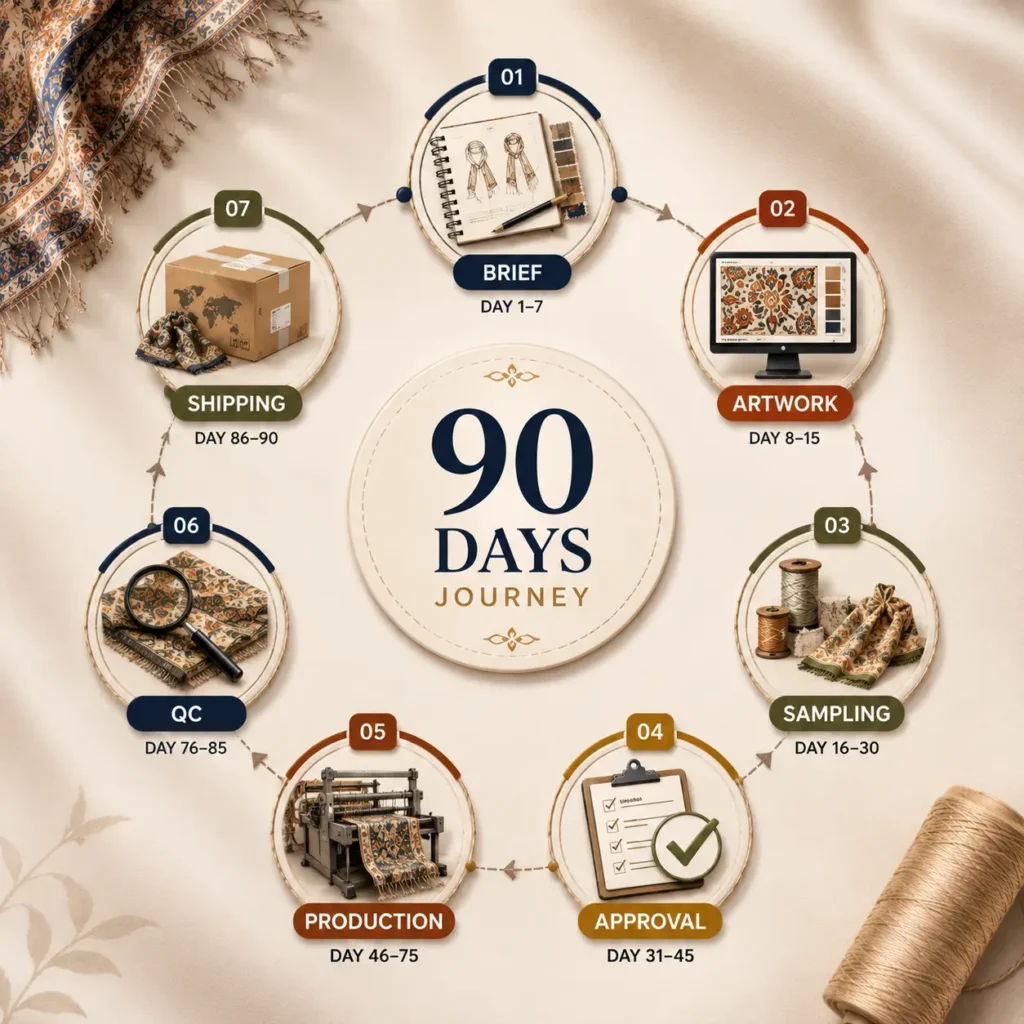
The 90-Day Timeline at a Glance
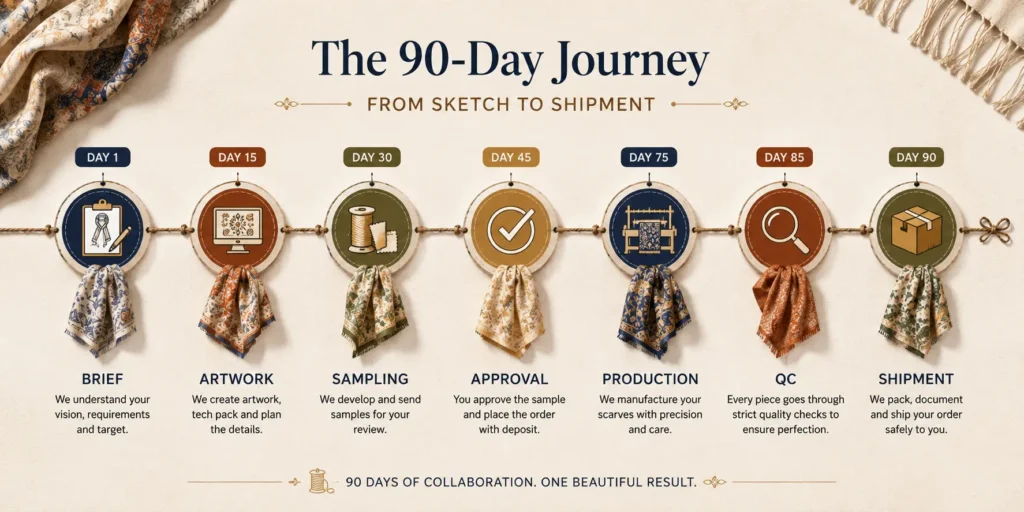
Before the phase-by-phase detail, here is the full schedule in one table.
| Phase | Days | Activity | Buyer’s Role | Manufacturer’s Role |
| Discovery and Brief | 1 to 7 | Design brief, MOQ discussion, costing | Share a brief, mood board, and target price | Feasibility check, initial quote |
| Artwork and Tech Pack | 8 to 15 | Artwork finalisation, colour separation, weave planning | Send print-ready files or references | CAD, tech pack, yarn plan |
| Sample Development | 16 to 30 | Strike-offs, first proto sample | Review sample, mark corrections | Weave or print sample, dispatch |
| Sample Approval and PO | 31 to 45 | Revisions, final approval, and deposit | Approve PPS, sign off, wire deposit | Finalise BOM, block yarn |
| Bulk Production | 46 to 75 | Weaving, printing, finishing | Weekly production updates | Bulk manufacturing |
| QC and Finishing | 76 to 85 | Inspection, hemming, and labelling | Review the AQL report | Final QC, packaging prep |
| Packing and Dispatch | 86 to 90 | Export packing, documents, freight | Confirm mode, wire balance | Cartons, invoice, BL, loading |
Phase 1: Discovery and Brief (Days 1 to 7)
The first week saves the most time later. Both sides ask the questions that decide whether the order is viable and what success actually looks like.
What happens in this phase:
- Buyer shares design references, colour palette, target fabric, and MOQ
- Manufacturer reviews design feasibility against the loom or print capacity
- Preliminary quote is issued with a landed cost breakdown
- Both sides agree on fibre, weave direction, size, and finish
- MOQ, per piece cost, and payment terms are confirmed
Rushing this stage is the most common cause of trouble in month three. A vague brief produces an off-target sample; a vague quote pushes landed cost up 12 to 18 percent once freight and revisions land. A serious scarves manufacturer in India slows this stage on purpose.
Phase 2: Artwork and Tech Pack (Days 8 to 15)
Once feasibility is agreed, the design becomes a producible file: colour separations for prints, or a yarn plan and weave draft for wovens. The more finished your file, the shorter this phase; inspiration that needs full CAD interpretation adds about a week.
Key deliverables:
- Colour-separation artwork for print methods
- Loom draft or CAD for wovens and jacquards
- Yarn count and specification
- Size, hem, and fringe plan
- A signed tech pack that becomes the reference for the rest of the timeline
This is also when you finalise labelling and branding. A manufacturer with in-house Custom Design and Private Label capability shortens this stage because sampling and branding run in parallel.
Phase 3: Sample Development (Days 16 to 30)
The strike-off or prototype sample is the first physical proof of what you have designed. For printed scarves, it shows how colours behave on the base fabric. For wovens, it confirms weave structure, drape, and hand feel.
This phase includes:
- First sample weave or print
- In-house quality check on colour matching, hand feel, size, and finish
- Sample courier to the buyer for physical review
- Buyer’s feedback with marked corrections
Two full weeks may feel long, but it is not. A single colour print or plain twill is ready in seven days; a multi colour jacquard or a print with 10 to 20 pantones takes the full window. Cut corners here, and the bulk will look off.
Phase 4: Sample Approval and Purchase Order (Days 31 to 45)
Almost every order goes through one round of revision. What separates a smooth timeline from a slipping one is how quickly the buyer marks corrections and how tightly the manufacturer executes them.
What happens in this phase:
- Revised sample with corrections applied
- Pre-production sample (PPS) approval
- Bulk purchase order raised and countersigned
- Deposit wired, usually 30 to 40 percent
- Yarn and dyes blocked from suppliers
Every scarf in the bulk order is manufactured according to the approved PPS. Design changes after sign-off push the timeline out by two to three weeks, which is why serious scarf manufacturers in India insist on a physical PPS before bulk starts.
Phase 5: Bulk Production (Days 46 to 75)
Thirty days for bulk is realistic for a first order of 1,000 to 5,000 pieces across two or three colourways. Larger orders or multi-SKU spreads need proportionally longer. Repeats on approved artwork run faster.
Bulk production involves:
- Yarn procurement and dyeing to the approved shade
- Weaving or printing at a production scale
- Finishing (softening, washing, or heat setting, depending on fibre)
- Cutting, hemming, and fringing
Hemming and fringing are quite cost drivers. A hand-rolled silk hem takes about 20 minutes per piece; a machine hem takes under a minute. Buyers ordering premium scarves and shawls with hand-rolled edges should budget the full 30 days.
Phase 6: Quality Control and Finishing (Days 76 to 85)
QC is where good manufacturers earn their reputation. Every serious export order goes through a formal AQL (Acceptable Quality Level) inspection before packing. AQL 2.5 is the industry norm for scarves, shawls, throws, and cushion covers.
Steps in this phase:
- 100 percent visual inspection for weave defects, print alignment, and colour consistency
- Random pull inspection at AQL 2.5 sample sizes
- Care label, brand label, and hang tag attachment
- Steaming and folding
- Rejects segregated and reworked or replaced
Buyers who want the highest confidence appoint a third-party inspection agency for a final random inspection. It adds two to four days but saves container rework later.
Phase 7: Packing and Dispatch (Days 86 to 90)
The final five days are documentation-heavy. This is when export experience actually matters.
What gets done:
- Master and inner cartons packed by SKU and colourway
- Commercial invoice, packing list, and country of origin certificate prepared
- Bill of lading or airway bill raised
- Container stuffing and freight handover
- Final balance payment or LC negotiation
Air freight from Delhi to New York runs three to five days. Sea freight from Nhava Sheva or Mundra runs 28 to 35 days to the US East Coast and 20 to 25 days to Europe. The 90-day window ends at container handover; add sea transit if shelf dates are fixed.
What Compresses the 90-Day Timeline
Not every order needs 90 days. The timeline shortens when:
- The design is a repeat of an already approved artwork
- The order is placed against ready-to-ship stock with slight customisation
- The fibre is standard (viscose, polyester, cotton) with local yarn availability
- The MOQ is limited to one or two colourways of a single design
- The buyer signs off on samples within 48 hours instead of two weeks
At the extreme, a repeat order of a proven design can ship in 30 to 40 days, production and QC only, with no artwork or sampling loop.
What Extends the Timeline
The 90 days can extend when:
- Multiple colourways or SKUs require separate sampling and approval
- The fibre is scarce (real cashmere, yak, hand-spun pashmina)
- Certifications such as GOTS, OEKO-TEX, or GRS are required, and audit windows apply
- Custom fringing, embroidery, or beadwork is part of the finish
- Payment terms delay yarn procurement or dyeing
The biggest cause of delay is not manufacturing. It is slow buyer feedback. A sample sitting on a merchandiser’s desk for 10 days is 10 days added to the timeline.
Common Delays and How to Avoid Them
A few practical rules keep a scarf order on schedule:
- Send press-ready artwork, not sketches, whenever possible
- Consolidate feedback into one clear document per revision
- Approve the pre-production sample within 72 hours of receipt
- Wire the deposit on the day of PO confirmation
- Pre-book freight two weeks before container handover during peak season
- If you need certifications, flag them in week one, not week five
Buyers who follow these six habits routinely ship in 75 to 85 days.
How This Timeline Applies Across Categories
The 90-day model works beyond scarves. Stoles follow the same schedule. Shawls add one to two weeks for larger cashmere weaves. The throws collection tracks similarly, with weaving taking longer due to size. The decorative cushion covers range runs faster overall, typically 70 to 90 days depending on the technique.
Working with Bright Star
Bright Star has been manufacturing scarves, shawls, stoles, throws, and cushion covers from India since 1950. Three generations of family experience, in-house sampling, weaving, and finishing infrastructure, and the working knowledge of what it takes to hit a 90-day promise are what most buyers need from a scarf manufacturer in India.
Whether the order is 500 pieces of a single silk scarf or 25,000 units across a multi-SKU winter shawl programme, the timeline works the same way. Reach out through the Bright Star team with a brief, and the first quote lands within seven days.
Frequently Asked Questions
What is the average lead time for a custom scarf order from India?
The average end-to-end lead time is 90 days from brief to container handover. This includes sampling, approval, bulk production, quality control, packing, and export documentation for first orders.
Can a scarf manufacturer in India deliver faster than 90 days?
Yes, for repeat orders on approved designs, or when working from ready stock with minor customisation. Repeat production can ship in 30 to 40 days if the artwork, fibre, and colourways are already finalised together.
What is the minimum order quantity for a custom scarf?
Standard MOQs range from 300 to 1,000 pieces per design and colourway, depending on fibre, weave complexity, and print method. Bright Star supports flexible MOQs for genuine buyers and first-time private label brands.
Is the sampling stage chargeable?
Sampling is often chargeable, especially for complex artwork or custom weaves. Sample costs are usually adjusted against the bulk order once the buyer confirms production. Actual costs vary by fibre and technique.
What documents are required for scarf export from India?
Standard export documents include a commercial invoice, a packing list, a bill of lading or airway bill, a country of origin certificate, and, where applicable, GSP form A or textile-specific reports like OEKO-TEX and GOTS.
Do you offer both air and sea freight options?
Yes, both are available. Air freight from Delhi to major hubs runs three to five days. Sea freight from Nhava Sheva or Mundra runs 20 to 35 days, depending on destination and vessel schedule at the time of loading.
Can I visit the factory before placing an order?
Yes, factory visits are welcomed and encouraged for serious buyers. Bright Star hosts brand teams, private label owners, and sourcing agents at the manufacturing unit with prior notice and a scheduled review itinerary.
What are the standard payment terms for a first order?
Typical first-order terms are 30 to 40 percent deposit against the pre-production sample approval, with the balance paid against a bill of lading copy or via an irrevocable letter of credit from a reputable bank.
How many revision rounds are included during sampling?
One full revision round is standard between the first sample and the pre-production sample. Additional revisions are possible and typically chargeable, since each round consumes yarn, machine time, and skilled labour hours.
Can you handle multi-SKU orders within the 90-day window?
Multi-SKU orders within 90 days are possible when planned early. Simpler designs share sampling and production windows. Complex multi-fibre or multi-technique programmes need a modest schedule extension to protect quality.