
Ask any home retail buyer sourcing cushion covers wholesale from India what they wish suppliers had told them earlier, and the answers cluster around the same four things. What MOQ actually means at each price tier. Which sizes are “standard” versus custom. What packaging arrives inside the container. And how long the sample cycle really takes before bulk can start.
This is the buyer brief nobody publishes because it is operational rather than promotional. But it is exactly what a private-label buyer or import wholesaler needs before signing off a first order. Here is the honest working document from a cushion covers manufacturer in India, based on the numbers that show up on real POs and packing lists, not the ones on marketing pages.
Why the Operational Brief Matters More Than the Price Sheet
A cushion cover programme lives or dies on operational alignment, not per-unit price. A perfectly costed range that misses its retail floor date by six weeks because the sample cycle stretched is a range that loses money. A container that arrives with wrong-sized covers because “standard” meant different things to buyer and seller writes off a whole SKU.
The four operational dimensions covered below (MOQ, size, packaging, sample timeline) are where 80 percent of first-order friction happens. Getting them defined in writing at the brief stage is what separates a first order that ships smoothly from one that stalls in month three.
MOQs: The Actual Tiers Manufacturers Work With
MOQ (minimum order quantity) varies far more than most quote sheets suggest. It depends on fabric type, print method, whether the design is a repeat or a first-time development, and which retail tier the programme is aimed at. Here is the practical map from an Indian cushion cover manufacturer’s perspective.
| Programme Type | MOQ per Design | MOQ per Colourway | Suitable For |
|---|---|---|---|
| Ready stock (existing catalogue) | 20 to 100 pieces | Available across colourways | Boutique testing, sample orders |
| Custom entry programme (printed cotton) | 100 to 300 pieces | 100 to 300 pieces | Small importers, e-commerce brands |
| Standard commercial (custom print or dye) | 300 to 500 pieces | 300 pieces | Retail chains, private label |
| Jacquard woven programme | 500 to 800 pieces | 500 pieces | Premium retail, hospitality |
| Embroidered or embellished | 500 to 1,000 pieces | 500 pieces | Boutique luxury, artisanal |
| Volume/mass programme | 2,000+ pieces | 1,000+ pieces | Big-box retail, chain stores |
The single most useful negotiation habit for a new buyer is to consolidate two or three SKUs at the standard commercial tier rather than push for a single-SKU low MOQ. A 300-piece per SKU across three SKUs (900 pieces total) often prices better than a 300-piece single SKU because packaging, freight, and setup costs amortise across a larger container fill.
Sizes: What “Standard” Actually Means from an Indian Manufacturer
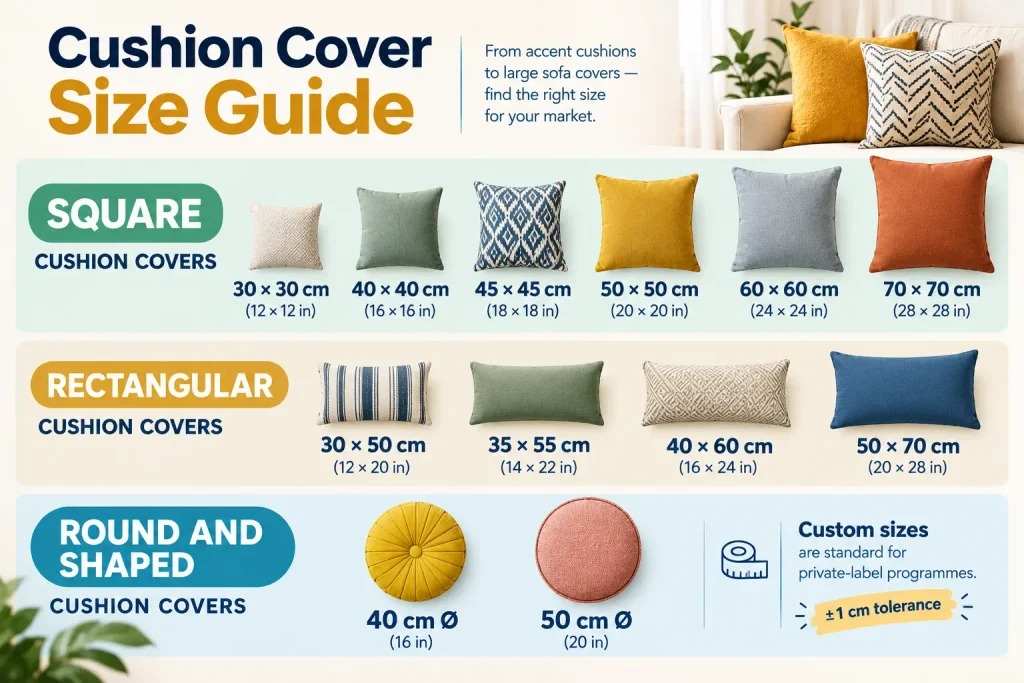
Cushion cover sizes vary between markets. What sells in a US department store is not what sells in a European boutique or an Indian domestic retailer. Here is what “standard” means in Indian export production.
Square cushion covers:
- 30 x 30 cm (12 x 12 inches): Small accent, chair cushion
- 40 x 40 cm (16 x 16 inches): The single most common global size; industry baseline
- 45 x 45 cm (18 x 18 inches): Standard sofa cushion in US and UK retail
- 50 x 50 cm (20 x 20 inches): Large sofa cushion, popular in premium retail
- 60 x 60 cm (24 x 24 inches): Oversized sofa or floor cushion
- 70 x 70 cm (28 x 28 inches): European floor cushion
Rectangular cushion covers:
- 30 x 50 cm (12 x 20 inches): Lumbar cushion, common in US retail
- 35 x 55 cm (14 x 22 inches): Long lumbar, hospitality standard
- 40 x 60 cm (16 x 24 inches): Bolster or body pillow
- 50 x 70 cm (20 x 28 inches): Large rectangular floor cushion
Round and shaped:
- 40 cm diameter (16 inch round): Round accent cushion
- 50 cm diameter (20 inch round): Round floor cushion
Custom sizes are standard for private-label programmes. Expect a size tolerance of plus or minus 1 cm in bulk production. Specify the tolerance in writing on the tech pack; leaving it implied leads to arguments at inspection.
One quiet detail buyers miss: cushion covers are typically manufactured about 1 to 2 cm smaller than the stated size to fit inserts snugly. A “45 cm cover” in production is usually cut and stitched at 43 to 44 cm finished. This is industry practice, not a defect.
The Sample Timeline: From Brief to Approved Pre-Production Sample
The sample cycle is the operational stage where most first-order timelines slip. Here is what to expect at each stage from a cushion covers manufacturer in India.
Stage 1: Brief review and quotation (Days 1 to 5)
- Manufacturer reviews artwork, fabric spec, size, print method, closure
- Feasibility check against loom or print capacity
- Preliminary quote issued with per-piece cost breakdown
- MOQ and payment terms confirmed
Stage 2: First sample development (Days 6 to 20)
- Fabric sourced or dyed to shade
- Print (digital, screen, block) or weave sampled
- Cover cut, hemmed, closed with specified closure
- Sample courier to buyer for physical review
- Standard printed cotton programme: 7 to 15 days
- Jacquard or embroidered programme: 15 to 25 days
Stage 3: Revision cycle (Days 21 to 35)
- One or two rounds of revisions are typical
- Colour, print alignment, closure position, size adjustments
- Each revision cycle adds 5 to 10 days
- Serious buyers approve revisions within 72 hours to hold the timeline
Stage 4: Pre-production sample (PPS) approval (Days 36 to 45)
- Final PPS is the reference every bulk cushion is manufactured against
- Physical PPS sign-off is standard practice for serious programmes
- Bulk PO raised, deposit wired, yarn and fabric blocked
Total sample cycle: 30 to 45 days for standard cushion cover programmes. Complex embroidered or jacquard-woven pieces extend to 45 to 60 days. Once PPS is approved, bulk production runs 25 to 50 days depending on order size.
Packaging: What Ships Inside the Container
Packaging is where operational discipline becomes visible. A properly packed container arrives with cushion covers ready for retail. A poorly packed one arrives with creased, unsteamed goods and rework costs at destination.
Individual packaging (per unit):
- Poly bag: LDPE 30 to 40 micron transparent bag, standard for most export cushion covers. Sealed with self-adhesive strip.
- Tissue wrap: Acid-free tissue paper wrap for premium programmes. Adds ₹5 to 12 per unit.
- Branded box: Individual gift box for boutique retail. Adds ₹40 to 150 per unit depending on box quality.
- Header card: Cardboard label attached to cover, standard for retail-ready packaging.
- Hang tag or brand label: Cotton or polyester tag with brand and care instructions.
Master carton (shipping unit):
- Carton material: 5-ply corrugated for standard programmes; 7-ply for heavy or premium shipments
- Typical carton size: 60 x 45 x 40 cm or 65 x 45 x 45 cm
- Pieces per carton: 20 to 50 covers depending on size and individual packaging density
- Carton markings: Buyer’s shipping marks, SKU code, quantity, gross/net weight, cubic measurement, country of origin, made in India label
- Sealing: BOPP tape, 48 mm width, or PP strapping for heavier cartons
Master carton weights:
- Typical loaded weight: 12 to 18 kg per carton
- Cartons above 20 kg require reinforced 7-ply or additional strapping
Cartons are sealed, labelled, and stacked in the 40-foot high-cube container in a pattern that maximises fill while protecting the corners of the load. A properly stuffed container fits 8,000 to 15,000 cushion covers depending on size mix and packaging density.
Documentation: What Every Export Shipment Needs
Documentation is where first-time buyers most often get caught. A container that leaves without complete paperwork sits at destination customs and racks up demurrage.
Standard export documents:
- Commercial invoice (in triplicate, matching PO exactly)
- Packing list (per carton, per SKU, per colourway)
- Bill of lading (sea freight) or air waybill (air freight)
- Certificate of origin (Form A for GSP-eligible destinations)
- Textile-specific declarations (relevant for US CBP and EU customs)
- Insurance certificate (for CIF shipments)
Optional but often required:
- OEKO-TEX Standard 100 certificate
- GOTS certificate for organic cotton programmes
- GRS certificate for recycled fibre content
- BSCI or Sedex social compliance audit reports
- Fumigation certificate for shipments requiring wooden pallets
Confirm with the buyer’s freight forwarder which specific documents their customs broker needs. Requirements differ meaningfully between US, UK, EU, Middle East, and Asian destinations.
Payment Terms and Inspection
Standard payment terms for a first cushion cover order from India:
- Deposit: 30 to 40 percent against pre-production sample approval
- Balance: Against bill of lading copy, or via irrevocable letter of credit (LC) at sight or 30 to 60 days
- Wire transfer: Standard for smaller and repeat orders
- LC: Standard for larger orders and first-time buyer relationships requiring bank-backed security
Inspection options:
- Manufacturer’s in-house QC: Standard AQL 2.5 inspection, included in per-unit cost
- Third-party inspection agency: Buyer appoints an inspector (SGS, Bureau Veritas, Intertek) for final random inspection at 100 percent of production. Cost typically $250 to $500 per inspection day, borne by buyer
- Buyer’s own representative: Some buyers send their sourcing agent to conduct final inspection before container stuffing
Third-party inspection adds 2 to 4 days to the timeline but is standard practice for orders above 3,000 pieces or when working with a new supplier.
The Complete Order Timeline
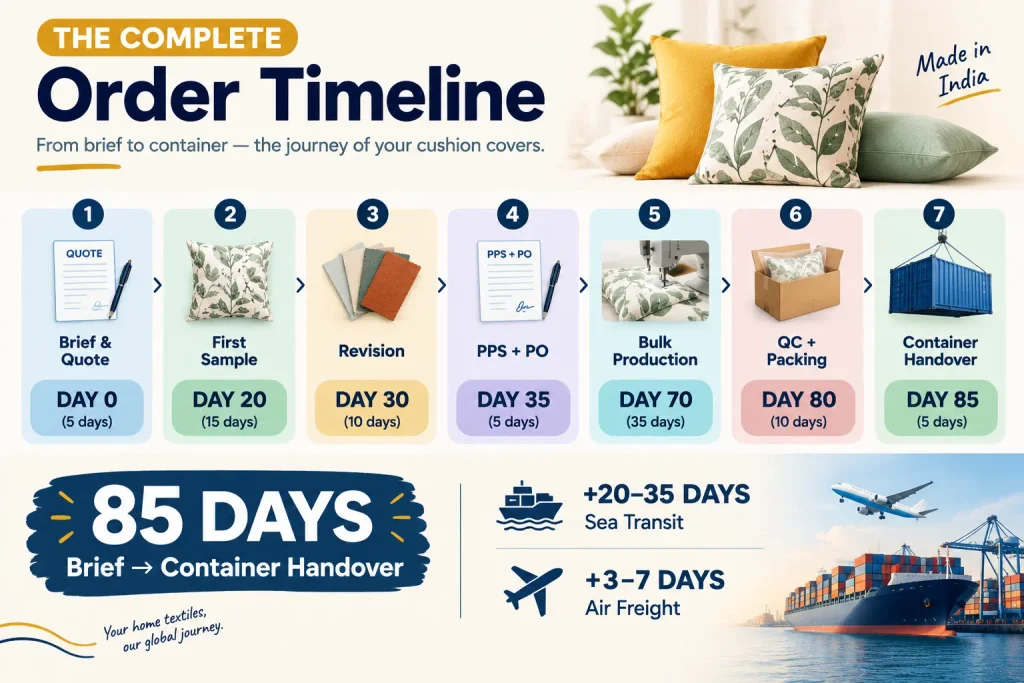
Putting it all together, here is what a first cushion cover order from India actually looks like on a calendar.
| Phase | Duration | Cumulative Days |
|---|---|---|
| Brief and quotation | 5 days | 5 |
| First sample development | 15 days | 20 |
| Revision cycle (one round) | 10 days | 30 |
| PPS approval and PO | 5 days | 35 |
| Bulk production | 35 days | 70 |
| Quality control and packing | 10 days | 80 |
| Documentation and container stuffing | 5 days | 85 |
| Total from brief to container handover | 85 days |
Sea transit adds 20 to 35 days depending on destination. Air freight adds 3 to 7 days. Buyers who plan against a 90-day window from brief to container, plus sea transit, hit their retail floor dates comfortably.
Working with Bright Star
Bright Star has manufactured cushion covers, throws, scarves, and shawls from India since 1950. Three generations of family experience across fabric sourcing, sampling, weaving, printing, and finishing means the mill accepts complete operational briefs and delivers PPS-quality bulk on the first attempt.
Whether the brief is 300 pieces of a printed decorative cushion cover programme for a boutique retailer or 20,000 pieces of coordinated cushions and throws for a department store private label, the Bright Star team quotes MOQ, sizes, packaging, and sample timelines transparently at the brief stage. For custom fabric, print, or embroidery development, in-house Custom Design and Private Label capability shortens the entire cycle further, with coordinated cross-category briefs across cushions, throws, and scarves and shawls handled from a single point of contact.
Frequently Asked Questions
What is the minimum order quantity for wholesale cushion covers from India?
Standard MOQs are 300 to 500 pieces per design and colourway for commercial programmes. Ready stock ships from 20 to 100 pieces, while jacquard or embroidered cushions typically require a minimum of 500 to 1,000 pieces.
What is the standard size for a cushion cover in India?
The most common global standard is 40 x 40 cm (16 x 16 inches). Indian export manufacturers also produce 45 x 45 cm, 50 x 50 cm, and rectangular lumbar sizes at 30 x 50 cm as standard.
How long does the sample cycle take for cushion covers?
Jacquard or embroidered samples run 15 to 25 days. Including revisions and pre-production sample approval, the full sample cycle averages 30 to 45 days.
What is the total lead time from brief to shipment for cushion covers?
The full timeline from brief to container handover is 80 to 90 days for a first cushion cover order. Repeat orders on approved designs can ship in 40 to 55 days by skipping the sampling cycle.
How are cushion covers packed for export from India?
Individual polybag (LDPE 30-40 micron) is standard, plus optional tissue wrap or branded box. Master cartons are 5-ply or 7-ply corrugated, typically 60 x 45 x 40 cm, holding 20 to 50 pieces per carton depending on size.
What documents are required to export cushion covers from India?
Standard documents include a commercial invoice, packing list, bill of lading or air waybill, certificate of origin, and textile compliance declarations. OEKO-TEX, GOTS, GRS, and social compliance certificates are provided as required.
What are the standard payment terms for cushion cover orders?
Typical first-order terms are a 30 to 40 percent deposit against pre-production sample approval, with the balance paid against bill of lading copy or via an irrevocable letter of credit at sight or with a 30 to 60 day tenor.
Can I get custom-sized cushion covers manufactured from India?
Yes, custom sizes are standard for private-label programmes. Provide the exact dimensions in cm or inches with tolerance in the tech pack. Custom sizes typically add 3 to 5 days to the sampling cycle.
How many cushion covers fit in a 40-foot container?
A 40-foot high-cube container typically holds 8,000 to 15,000 cushion covers depending on size mix and packaging density. Larger cushions and premium packaging reduce container fill; smaller covers with poly-only packaging maximise it.
Do cushion covers ship with inserts included from India?
Reduce freight volume. Buyers can order inserts included, but freight cost typically exceeds the value of local insert sourcing at destination for most programmes.