You walk into a store. You pick up a beautiful piece of fabric. The label says “stole.” But it looks exactly like the shawl hanging next to it. And honestly? It’s about the same size as the wrap on the shelf below.
Sound familiar?
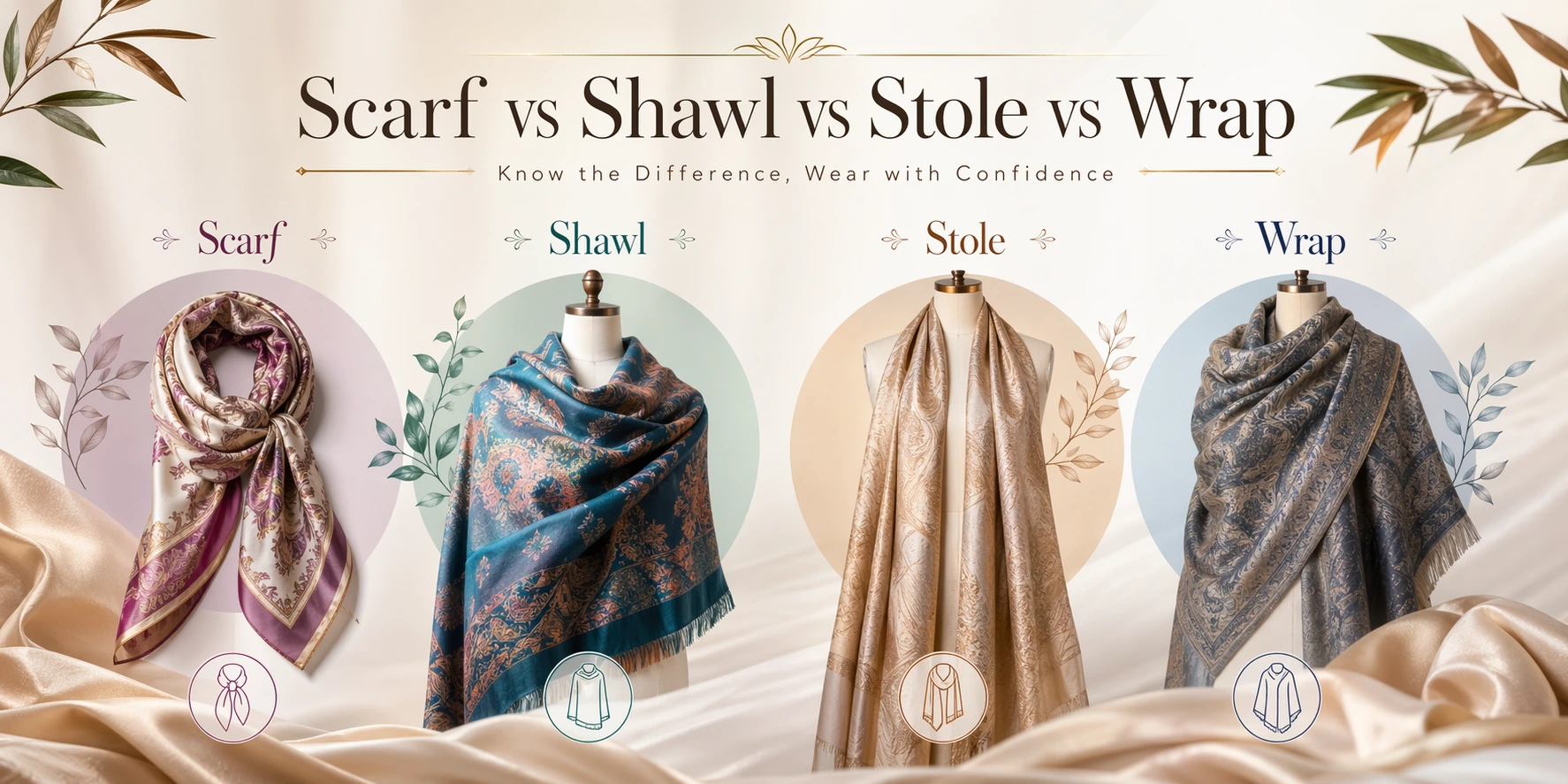
These four words get used interchangeably all the time. By retailers, by manufacturers, by fashion writers, and even by people who sell these products for a living. But they are not the same thing. Each one has a distinct size, shape, draping style, and purpose.
By the end of this guide, you’ll know exactly what separates a scarf vs shawl vs stole vs wrap, which one works for which occasion, and how to use the right term when you’re buying or sourcing these products.
Let’s clear this up once and for all.
Quick Answer: The Core Difference at a Glance
Before we go into detail, here’s a fast comparison of all four. Think of this as your cheat sheet.
| Scarf | Shawl | Stole | Wrap | |
|---|---|---|---|---|
| Typical size | 150-200 cm long, 20-30 cm wide | 100-150 cm x 100-150 cm | 180-220 cm long, 50-70 cm wide | 150-200 cm x 100-150 cm |
| Shape | Narrow, long | Large square or rectangle | Long, narrow rectangle | Large rectangle |
| Fabric weight | Light to medium | Medium to heavy | Light to medium | Medium to heavy |
| Primary use | Neck, head, or wrist styling | Shoulder coverage, warmth | Draped over shoulders or one arm | Full shoulder or body coverage |
| Best for | Casual, everyday, travel | Formal, bridal, winter | Evening wear, events | Travel, winter, versatile layering |
Now let’s go deeper into each one.
What Is a Scarf?
A scarf is the smallest and most versatile of the four. It’s typically a narrow, long piece of fabric worn around the neck, tied at the head, or even looped around the wrist. The key word is narrow. A scarf is not meant to provide shoulder coverage. It’s an accent piece as much as a functional one.
Scarves come in many styles. A few common types worth knowing:
Bandana: A small square scarf, usually 50-60 cm, tied around the neck or head. Often cotton or silk. Very casual.
Neckerchief: Similar to a bandana but slightly longer. Popular in workwear and vintage fashion.
Skinny scarf: A very narrow, elongated scarf. More decorative than warm.
Infinity scarf: A looped scarf with no ends. You pull it over your head and it sits as a continuous circle around the neck.
Square silk scarf: A fashion staple. Usually 90 cm x 90 cm. Can be worn around the neck, tied at the handle of a bag, or used as a headscarf.
The scarf’s defining characteristic is its proportions. It’s designed to wrap, loop, or tie rather than drape. If you’re throwing it over your shoulders for warmth, you’re probably holding the wrong piece of fabric. That’s what shawls are for.
What Is a Shawl?
A shawl is significantly larger than a scarf. Think of it as a blanket for your shoulders, but a stylish one.
A typical shawl is a large rectangular or triangular piece of fabric measuring roughly 100 to 150 cm on each side. It’s designed to be draped over both shoulders, wrapped around the upper body, or pulled over the head. The weight is usually medium to heavy, which is why shawls are so often associated with warmth.
Shawls are a staple in formal and occasion wear. At weddings, they serve as elegant cover-ups over sleeveless dresses or bridal lehengas. In Indian fashion especially, a fine pashmina shawl is considered a luxury accessory in its own right. It’s the kind of thing that gets passed down in families.
Speaking of weddings, the scarf shawl pairing for bridal events is very common. A silk or pashmina shawl draped over the shoulders photographs beautifully and adds a layer of texture to formal outfits without overwhelming them.
One question that comes up often: what is a shawl with sleeves called? The answer is a capelet or sometimes a shawlette. A capelet has armholes or sleeves built in, giving it a structured cape-like quality. A shawl itself has no sleeves. If someone is selling you a “shawl with sleeves,” what they actually mean is a capelet.
The other distinction worth noting: a shawl is meant to cover. A scarf is meant to accent. That is the simplest way to remember the difference.
What Is a Stole?
A stole sits right between a scarf and a shawl in terms of size. And that middle position is exactly what causes all the confusion.
A stole is a long, narrow rectangle of fabric, typically 180 to 220 cm long and 50 to 70 cm wide. It’s wider than a scarf but narrower than a shawl. It’s usually worn draped flat over both shoulders, hanging down evenly on either side. Sometimes it’s draped over one arm, especially in formal settings.
The fur stole is one of the most well-known style variants. Historically, fur stoles were a mark of luxury and worn over evening gowns or formal coats. Today, faux fur and fabric stoles are the norm, but the silhouette is the same: long, flat, draped.
Now, a question that comes up constantly in the Indian market: are a stole and a dupatta the same thing?
Not exactly. A dupatta is a cultural garment specific to South Asian dress. It’s worn as part of a traditional outfit, typically with a salwar kameez or lehenga. It can be styled in several ways: over the head, across the chest, or draped over one shoulder.
A stole, on the other hand, is a fashion accessory with no cultural attachment to any particular outfit or tradition. The two can look similar in size and shape. But a dupatta carries cultural meaning and is usually styled within a traditional context. A stole is standalone.
Can you wear a stole as a scarf? Yes, technically. You can loop or knot a stole around your neck much like a scarf. But it will be considerably wider and more voluminous than a standard scarf. Some people love that look. Others find it too bulky. It depends on the fabric weight and the outfit.
Does stole mean scarf? No. They are related, but not the same. A stole is always longer and wider than a typical scarf, and it’s draped rather than tied or looped.
What Is a Wrap?
A wrap is the biggest and most flexible of the four. It’s essentially an oversized rectangle of fabric that can be styled in multiple ways, and that versatility is its defining feature.
A typical wrap measures 150 to 200 cm long and up to 150 cm wide. That’s almost the size of a light blanket. You can drape it over your shoulders like a shawl. You can fold it and tie it at the front. Some styling guides show you how to wear a wrap as a skirt or a light cover-up at the beach. It’s the kind of accessory that earns its space in a travel bag precisely because it does so much.
The blanket stole sits in the grey zone between a wrap and a stole. It’s wider than a traditional stole but not quite as large as a full wrap. The name is a reasonable description: it has the length of a stole and the warmth and weight of a blanket. Brands use “blanket stole” and “blanket wrap” almost interchangeably, which adds to the terminology confusion.
If you’re cold and you want maximum coverage with minimum fuss, you want a wrap. No folding, no tying, no technique required. You throw it on and that’s it.
Scarf vs Shawl vs Stole vs Wrap: Key Differences Explained
Now that each one is defined, let’s talk about how they actually differ in use, not just on paper.
Size is the biggest factor. The scarf is the smallest. The shawl is large. The stole is long and narrow. The wrap is the largest. If you remember nothing else, remember the size hierarchy.
Draping style separates the stole from the shawl. A shawl wraps and envelops. It provides coverage. A stole drapes flat. It lies across the shoulders or hangs from one arm. The silhouette is very different even if the fabric is similar.
The scarf vs stole confusion usually comes down to width. Scarves are narrow. Stoles are noticeably wider. If you can pull it snugly around your neck in one loop, it’s probably a scarf. If it lies flat across both shoulders with fabric to spare, that’s a stole.
The wrap vs shawl confusion is mostly about size and versatility. Shawls are large but they’re typically worn one way: over the shoulders. Wraps are large and can be styled multiple ways. A shawl used as a wrap is still a shawl. A wrap used as a shawl is still a wrap.
For women choosing between a stole, shawl, scarf, and wrap: think about occasion first. Casual day out? Scarf. Winter event? Shawl. Formal evening? Stole. Travelling light? Wrap.
When to Wear Which: A Simple Style Guide
This is the part most guides skip. Knowing the definition is one thing. Knowing when to reach for each one is where the real value is.
For weddings and formal occasions:
A stole or shawl is your best option. A silk or embroidered stole draped over a gown is a classic formal look. A fine pashmina shawl over a bridal or cocktail outfit adds elegance without effort. Scarves can work too, if styled carefully (think a silk square tied at the neck), but they offer less coverage and less visual impact.
For everyday and office wear:
A scarf wins here. It’s easy, lightweight, and doesn’t interfere with your outfit. A silk neck scarf, a linen bandana, or a simple knit scarf around the neck works in almost any setting. Stoles can work in office settings if kept simple and draped cleanly.
For travel:
The wrap is the obvious choice. It folds small, packs light, and works as a blanket on a flight, a cover-up at a beach, and a layer over your shoulders when you step into an over-air-conditioned restaurant. One piece. Many uses.
For winter warmth:
Shawl or wrap. Both offer enough coverage to actually keep you warm. A wool or cashmere shawl worn over the shoulders and pinned at the front is both warm and put-together. A wrap in a heavier fabric doubles as a light coat alternative.
Are stoles still fashionable? Absolutely. They have had consistent presence on runways and in formal wear for decades. Fur stoles (now largely faux) are still a red carpet staple. Silk and cashmere stoles remain popular for evening events. The stole is not a trend. It’s a category.
For Indian occasions and traditional wear:
This is where the dupatta and stole distinction matters. A dupatta is the right choice with traditional Indian outfits. A stole works when you want the coverage and elegance of a dupatta but in a more contemporary, standalone way. Many Indian brands now position stoles as the modern alternative to the dupatta for fusion styling.
FAQs
What is the difference between a shawl, scarf, and stole?
A scarf is narrow and typically worn around the neck or head. A shawl is large and draped over the shoulders for coverage and warmth. A stole is long and narrow, wider than a scarf but narrower than a shawl, and is usually draped flat over both shoulders. Size and draping style are the main distinctions.
What is the difference between a scarf and a shawl wrap?
A scarf is small and designed for the neck or head. A shawl wrap is much larger and covers the shoulders and upper body. A wrap is the most versatile of the two, as it can be styled multiple ways. A scarf is typically tied or looped while a shawl or wrap is draped.
What is a stole wrap?
A stole wrap usually refers to a wide stole that has the length of a traditional stole but enough width to be draped more generously, like a light wrap. It sits in the overlap between the two categories. Some brands also use this term to mean a stole that can double as a wrap for travel.
Does stole mean scarf?
No. A stole is not a scarf. It is longer and wider than a scarf and is draped rather than tied or looped. The two serve similar purposes in terms of being worn over the upper body, but they differ significantly in size and styling.
Can you wear a stole as a scarf?
Yes, but it will look different from a standard scarf. Because a stole is wider and longer, it will be more voluminous around the neck. This can look intentional and stylish if done with the right fabric and outfit. It works particularly well with lightweight silk or chiffon stoles.
Are stole and dupatta the same?
They are similar in shape but not the same. A dupatta is a cultural garment worn with traditional South Asian outfits, carrying specific styling conventions. A stole is a fashion accessory with no cultural attachment. They can look alike in size and proportion, but their context and use are different.
Are stoles still fashionable?
Yes. Stoles remain a consistent presence in formal and evening wear. Silk, cashmere, and faux fur stoles are regularly seen at weddings, events, and formal occasions. They are not a trend that comes and goes. They are an established accessory category with lasting relevance.
Is a blanket stole a scarf?
No. A blanket stole is larger and heavier than a scarf. It is a wide, long piece of fabric that sits between a traditional stole and a full wrap in size. It is closer to a wrap in terms of warmth and coverage, but retains the elongated, narrow proportions of a stole.
What is a shawl wrap called?
A shawl wrap does not have one universally agreed name. It is sometimes called a wrap shawl, a blanket wrap, or simply a wrap. When a shawl is large enough and styled to cover more of the body, the terms shawl and wrap begin to overlap. The distinction is mostly about size and intent of use.
Conclusion
A scarf goes around your neck. A shawl covers your shoulders. A stole drapes and frames. A wrap does a bit of everything. Each one has a distinct size, weight, and use case, and once you know the difference, choosing the right one becomes instinctive.
The confusion between these four terms is not just a buyer problem. It affects product descriptions, sourcing conversations, and even what ends up on a label. Getting the language right matters.
If you’re a brand or boutique sourcing scarves, shawls, stoles, or wraps, Bright Star manufactures across all four categories in silk, cashmere, wool, and blended fabrics. Explore our collections or get in touch to discuss your sourcing requirements.