You’ve seen a beautiful silk scarf in a shop window. It looks delicate. Almost fragile. And a small voice in your head asks: will this thing survive real life?
That’s a fair question.
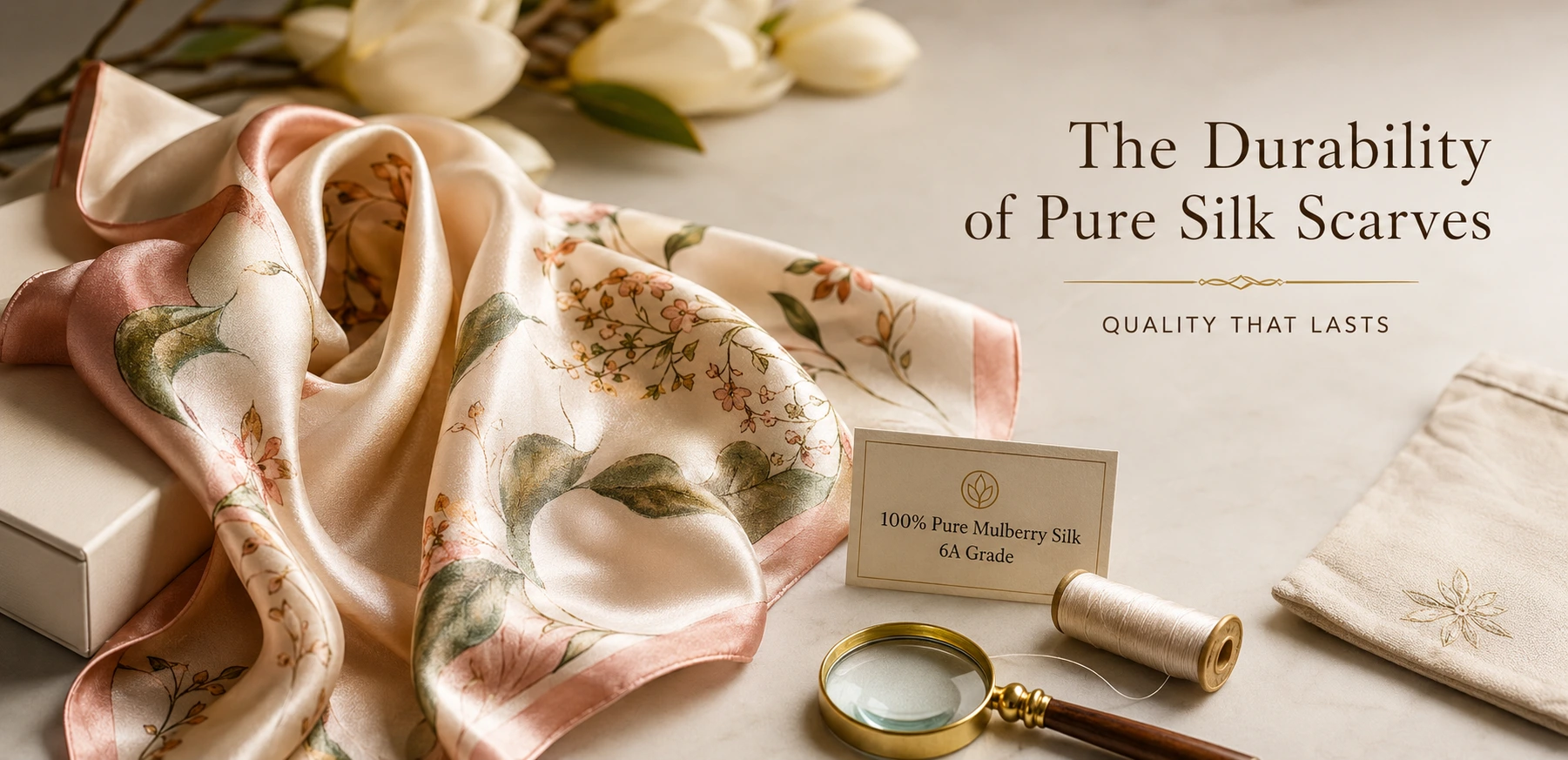
Pure silk scarves are far more durable than most people assume. High-quality Mulberry silk scarves can last for decades when maintained correctly, thanks to silk’s natural strength and elasticity. But here’s the thing. That durability depends on what grade of silk was used, how the scarf was constructed, and how well you care for it once it’s yours.
This guide covers all of it. What determines silk scarf durability, how long a quality piece can realistically last, what quietly destroys it faster than you’d think, and exactly how to maintain it correctly.
Is Pure Silk Actually a Durable Fabric?
Yes. Pure silk is genuinely strong.
Silk has exceptionally high tensile strength for a natural fibre and is stronger than many people expect. Natural silk is stronger than wool, cotton, and linen when measured by filament strength. It also has natural elasticity, which means it can stretch slightly under stress and bounce back, rather than snapping.
But here’s the honest nuance. Silk weakens when wet. In dry conditions, it holds up impressively. Add moisture, and that changes. This is exactly why you can’t just throw a silk scarf in the washing machine and call it a day.
So there’s a useful distinction to hold onto: durability and delicacy are not the same thing. Silk is durable in the sense that a well-made piece resists normal wear and tear effectively. It is delicate in the sense that it’s sensitive to incorrect handling. Understanding that difference is the key to getting decades of use from a single scarf.
How Long Does a Pure Silk Scarf Last?
Here’s the short answer. A well-made, properly maintained pure silk scarf can last decades. Some pass through generations. Others show visible deterioration within one or two years.
The difference is almost never bad luck. It’s almost always a combination of production quality and maintenance habits.
Think of it this way. A 6A grade Mulberry silk scarf, hand-washed in cold water and stored in a cotton pouch, is built to last 20 years or more. It will hold its colour, its sheen, and its structure with minimal degradation. Now compare that to a low-grade silk blend, machine-washed regularly, left in a plastic bag in a sunny drawer. That scarf might look tired within 12 months.
The pure silk scarf lifespan with proper care is genuinely impressive. But good maintenance isn’t optional fine print. It’s the whole equation.
The realistic range looks something like this. Basic care, average grade: 5 to 10 years of good appearance. Excellent maintenance, high grade: 20+ years, sometimes a lifetime.
What Determines the Durability of a Pure Silk Scarf?
This is where the real story is. And it’s the part most content on silk scarves skips entirely.
The durability of a silk scarf is not just about the fibre itself. It’s about how that fibre was graded, woven, dyed, and finished. Three factors matter most.
Silk Grade: 6A vs Lower Grades
Silk is graded on a scale, with 6A being the highest commercial grade. Higher grade means longer, more uniform filaments. And longer, uniform filaments produce stronger, more consistent fabric.
Lower grades, such as 3A or 4A, use shorter and less uniform filaments. These are more prone to snagging. The surface breaks down faster under friction. The fibre weakens more quickly over time, even with identical handling.
In practical terms: a 6A Mulberry silk scarf will outlast a 3A grade scarf under the same conditions. It’s not a subtle difference. It’s the difference between a scarf that stays beautiful for 20 years and one that starts looking worn by year three.
One clarification that comes up often. Is 100% Mulberry silk the same as 100% silk? Not exactly. Mulberry silk refers to a specific variety, produced by silkworms fed exclusively on Mulberry leaves. It is generally the most refined and durable silk variety available. “100% silk” is a broader label. It tells you the fibre is genuine silk, but says nothing about the variety or the grade. Mulberry silk at 6A grade is the benchmark for durability.
Weave Density and Thread Quality
Imagine two pieces of fabric. One has 80 threads per square centimetre. The other has 50. Run your fingers across both, apply the same friction, and the denser one holds up significantly better.
That’s weave density in practice. More threads per square centimetre means greater resistance to snagging, pulling, and surface abrasion.
Momme weight is the standard measure here. Most everyday silk scarves fall in the 14 to 19 momme range. At 22+ momme, the fabric is heavier and noticeably more durable. A higher momme scarf has more body to it. It wears better, drapes more confidently, and holds its structure over more years of use.
If you’re choosing a scarf and durability matters, always ask about momme weight. A scarf sold only by “100% silk” with no momme specification is leaving out information that directly affects how long it will last.
Finishing and Edge Quality
A silk scarf can be woven beautifully and still fail at the edges. Edges are where wear concentrates. Fraying, unravelling, and fabric breakdown almost always start there.
Hand-rolled edges are the gold standard. A skilled artisan rolls and stitches the edge by hand, creating a finish that resists fraying significantly better than a machine-stitched alternative. It also looks more refined.
Machine-stitched edges are faster and cheaper to produce. They serve their purpose, but they’re more vulnerable over time. If you hold a scarf up and the edge stitching looks uniform to the point of being mechanical, that’s exactly what it is.
Before buying, run your finger along the edge. A hand-rolled finish has a subtle, slightly irregular texture. That imperfection is a sign of craftsmanship, and it directly contributes to longevity.
Dyeing and Printing Quality
High-quality dyeing and printing techniques also affect scarf longevity. Poor-quality dyes fade faster under sunlight and repeated cleaning, making the scarf appear older even when the fabric itself remains intact.
Premium silk scarves typically use higher-quality colour treatments that preserve vibrancy for much longer. This becomes especially noticeable after years of wear and repeated washing.
Factors That Shorten the Lifespan of a Pure Silk Scarf
Most silk scarves don’t fail because of heavy use. They fail because of specific, avoidable damage that compounds quietly over time.
Sunlight and UV exposure are the most underestimated threat. UV light breaks down silk’s protein structure, causing the fibre to weaken and the colour to fade.
This happens slowly. You won’t notice it after a single afternoon in the sun. But leave a silk scarf draped over a chair near a window for a few months and the damage will be visible and irreversible.
Perfume and chemical contact do real damage. Most perfumes contain alcohol, and alcohol degrades silk protein over time. The classic mistake is spraying perfume after you’ve put your scarf on. Always apply perfume first, let it dry, then wear your scarf. The same logic applies to hairspray and body lotions.
Sweat and body oils create a more gradual problem. The oils and salts in sweat break down silk fibre if allowed to sit in the fabric. This is why a silk scarf that’s been worn through a warm day needs to be aired out properly and cleaned regularly. Folding it away damp or unwashed accelerates deterioration significantly.
Incorrect washing is the most common cause of early silk scarf damage. Machine washing exposes silk to mechanical agitation it’s not built for. Hot water accelerates fibre weakening. Harsh detergents weaken silk fibres and dull the fabric’s natural softness and sheen. One machine wash on the wrong cycle can do more damage than two years of correct hand washing.
Improper storage is the final culprit. Storing a silk scarf folded tightly under heavy objects causes fibre stress and creasing that becomes permanent over time. Storing it in a plastic bag traps moisture and creates conditions for discolouration and mildew. And storing it near direct heat does the same slow UV-style damage that sunlight does.
How to Care for a Pure Silk Scarf to Maximise Its Lifespan
Good care isn’t complicated. It’s mostly about a few consistent habits.
Washing:
- Fill a clean basin with cool water. Not lukewarm. Cool.
- Add a small amount of pH-neutral silk detergent or very mild shampoo.
- Submerge the scarf and gently swirl. No scrubbing, no twisting.
- Let it soak for no more than three minutes.
- Rinse thoroughly in cool water until the water runs clear.
- Never wring the fabric. Gently press it against the side of the basin to remove water.
Drying: Lay the scarf flat on a clean dry towel. Roll the towel loosely around the scarf and press gently to absorb excess water. Then unroll and lay the scarf flat to air dry, away from direct sunlight. Never use a tumble dryer.
Ironing: Iron on the lowest setting, while the scarf is still slightly damp. Always use a pressing cloth between the iron and the silk. Never iron directly on dry silk. Steam settings are fine if your iron is set correctly.
Storage: Fold loosely or roll the scarf. Wrap it in acid-free tissue paper. Store in a breathable cotton pouch or a drawer away from light and heat. Never hang a silk scarf for long-term storage, as the weight can stretch the fibres over time.
Pure Silk vs Polyester and Viscose: Which Lasts Longer?
This is the comparison buyers genuinely want to see before committing to a silk scarf at a higher price point.
Polyester is more forgiving of neglect. It resists moisture and UV better in the short term, doesn’t weaken when wet, and tolerates machine washing. If you’re looking for something you can throw in a laundry bag without thinking, polyester wins on that narrow measure. But polyester doesn’t age well in terms of appearance. It pills, it develops static, and it never develops the kind of subtle depth that silk has.
After five or ten years of wear, a polyester scarf looks worn. A silk scarf, maintained correctly, looks refined.
Viscose (sometimes sold as artificial silk) mimics the drape and sheen of silk at a lower price point. But it degrades noticeably faster. Viscose is sensitive to moisture, weakens with repeated washing, and lacks the natural protein strength of genuine silk. It’s a short-term visual substitute, not a durability match.
With proper maintenance, a quality silk scarf outlasts both alternatives in terms of how it looks and feels over years of use. Polyester is more forgiving. Viscose is more affordable. Neither comes close to the long-term value of a high-grade silk piece that’s well maintained.
What About Satin vs Silk?
This comparison causes confusion because satin is not actually a fibre. It’s a weave style. Satin can be made from silk, polyester, viscose, or synthetic blends.
A polyester satin scarf may look glossy initially, but it typically won’t age as well as genuine silk. Silk satin combines the smooth finish of satin weaving with the durability and breathability of natural silk fibres, making it a significantly higher-quality long-term option.
FAQs
Are silk scarves durable?
Yes. Pure silk is one of the strongest natural fibres available. A well-made silk scarf from high-grade Mulberry silk, cared for correctly, will hold its appearance and structural integrity for decades. The key is combining quality manufacturing with consistent maintenance.
Is 100% Mulberry silk the same as 100% silk?
Not exactly. “100% silk” confirms the fibre is genuine silk but doesn’t specify variety or grade. Mulberry silk is a specific, premium variety produced by silkworms fed on Mulberry leaves. It is generally finer, more uniform, and more durable than other silk varieties. Always look for both labels when quality matters.
How long does pure silk last?
A high-grade pure silk scarf that is hand-washed, dried flat, and stored correctly can remain in excellent condition for 20 years or more. Lower-grade silk with inconsistent care may show visible wear within a few years. Lifespan is directly tied to production quality and maintenance habits.
Does wearing a scarf help a sore throat?
Some people find that a soft scarf worn around the neck provides warmth and comfort when the throat is irritated. Silk is particularly suitable for this given its natural temperature-regulating properties and hypoallergenic fibre. It’s a comfort measure rather than a medical one.
How do you care for a 100% silk scarf?
Hand wash in cool water with a pH-neutral detergent, rinse thoroughly, press gently in a towel to remove moisture, and lay flat to dry away from sunlight. Iron on a low setting with a pressing cloth while still slightly damp. Store in a breathable cotton pouch away from heat and light.
What are the 4 types of silk?
The four main commercial types are Mulberry silk (most refined and widely used), Eri silk (coarser, more sustainable), Tasar silk (wild silk with a natural golden sheen), and Muga silk (a rare, naturally golden variety from Assam). Mulberry silk accounts for the majority of premium silk scarves globally.
Which is better, Mulberry silk or pure silk?
Mulberry silk is pure silk, but it’s a specific premium category within it. When you see “Mulberry silk” on a label, you’re getting a silk variety known for its uniformity, fineness, and durability. It is generally considered the highest quality commercial silk available, making it the preferred choice for long-lasting scarves.
How do you know if it’s 100% silk?
Professionals sometimes use burn testing to identify silk fibres, but for consumers, checking weave quality, texture, label details, and seller credibility is safer and more practical. Real silk also warms quickly to the touch compared to many synthetic fabrics, which often feel cooler and less responsive.
Conclusion
A pure silk scarf made from high-grade Mulberry silk, woven with proper density, finished by hand, and cared for consistently is one of the most durable fashion accessories you can own.
The durability is real. But it’s not automatic. It’s built at the point of manufacture and maintained through everyday use.
When quality silk is maintained correctly, it ages remarkably well compared to most fashion accessories.
If you’re sourcing or shopping for silk scarves built to last, browse Bright Star’s pure silk scarf collection, where manufacturing quality and material grade are central to every piece.