You land at the airport. You’re tired, jet-lagged, and running on vending machine coffee. Then you see it. A shawl, soft as a cloud, folded neatly in a duty-free window. The tag says “100% Pashmina.” The price feels steep, but hey, you’re on vacation. You buy it.
Here’s the hard truth. That shawl is probably not pashmina at all.
It’s likely acrylic. Maybe viscose. Maybe a cheap wool blend dressed up with a fancy label. And you’re not alone in getting fooled. Counterfeit pashmina is widespread in tourist-facing retail, and textile experts have long warned that a significant proportion of products marketed as “pashmina” are actually blends or synthetic fabrics. That’s not a small problem. It has become one of the biggest challenges facing buyers looking for genuine pashmina.
This isn’t a rant. It’s an investigation. We’re going to break down why this scam is so widespread, how real pashmina is actually made, and how you can test a shawl on the spot before you hand over your money. By the end, you’ll know exactly about real vs fake pashmina and what you’re looking at, and whether it’s worth the price tag.
What is Real Pashmina and Where Does It Actually Come From?
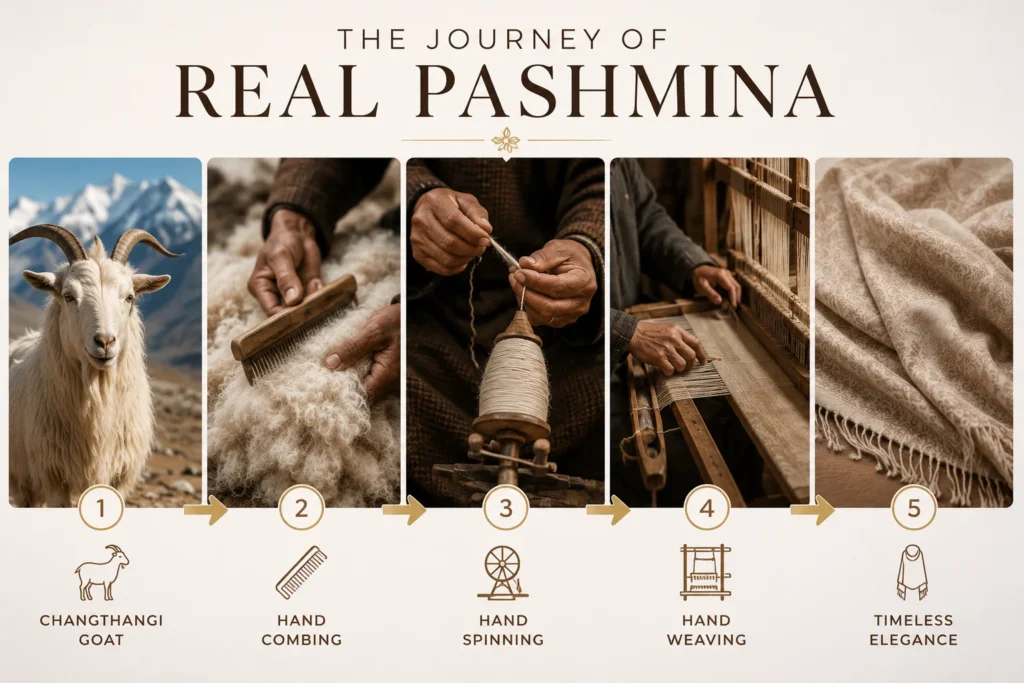
Let’s start with the basics. What even is pashmina?
Real pashmina comes from the ultra-fine undercoat of the Changthangi goat, traditionally reared in the high-altitude Changthang region of Ladakh. These goats live on the Changthang plateau in Ladakh, at altitudes above 14,000 feet. It’s brutally cold up there. And that cold is exactly why the fibre is so special.
To survive the extreme winters, Changthangi goats grow an ultra-fine undercoat beneath their outer hair. This fibre measures just 12 to 16 microns thick. For comparison, that’s finer than most cashmere. Nature basically built the world’s best insulation, and it happens to be incredibly soft too.
Here’s what makes traditional Kashmiri Pashmina so special. The fibre is hand-combed from the goat, hand-spun into yarn, and hand-woven into fabric by skilled Kashmiri artisans. No factory line. No shortcuts. Every step follows techniques passed down for generations. While authentic pashmina can also be produced using modern spinning or weaving methods, Certified Kashmiri Pashmina continues to preserve this traditional handcrafted process.
So what about pashmina from Nepal? Is that real, too? Yes, it can be. Nepal is well known for producing authentic pashmina shawls, with many manufacturers sourcing genuine pashmina fibre from the Himalayan region before spinning and weaving it locally. But Nepali pashmina faces the same problem as Kashmiri pashmina. It gets counterfeited constantly. A “Nepal” label on a tag doesn’t guarantee anything on its own.
Why Is Almost Everything Sold as Pashmina Fake?
This is the real question. Why does one product get faked so much more than others?
Think about it from a business angle. Real pashmina is brutally labour-intensive. A single shawl can take weeks to hand-spin and hand-weave. The raw fibre itself is scarce and expensive before any labour even happens. That’s a slow, costly process.
Now compare that to a machine spitting out acrylic scarves by the thousand. One shawl takes weeks of human effort. The other takes seconds off a production line. Guess which one duty-free shops want to stock and mark up?
There’s another issue, too, and it’s a legal one. While India protects Kashmiri Pashmina through its Pashmina Centre framework and some countries have textile labelling regulations, the word “pashmina” is still used very loosely in many markets. That makes it much easier for misleading labels and inaccurate product descriptions to reach consumers. No one’s stopping them. There’s no fabric police checking tags at the till.
The problem? Most tourists have never heard of it, and most duty-free shops aren’t exactly volunteering the information.
How to Spot Fake Pashmina: 3 Tests You Can Do
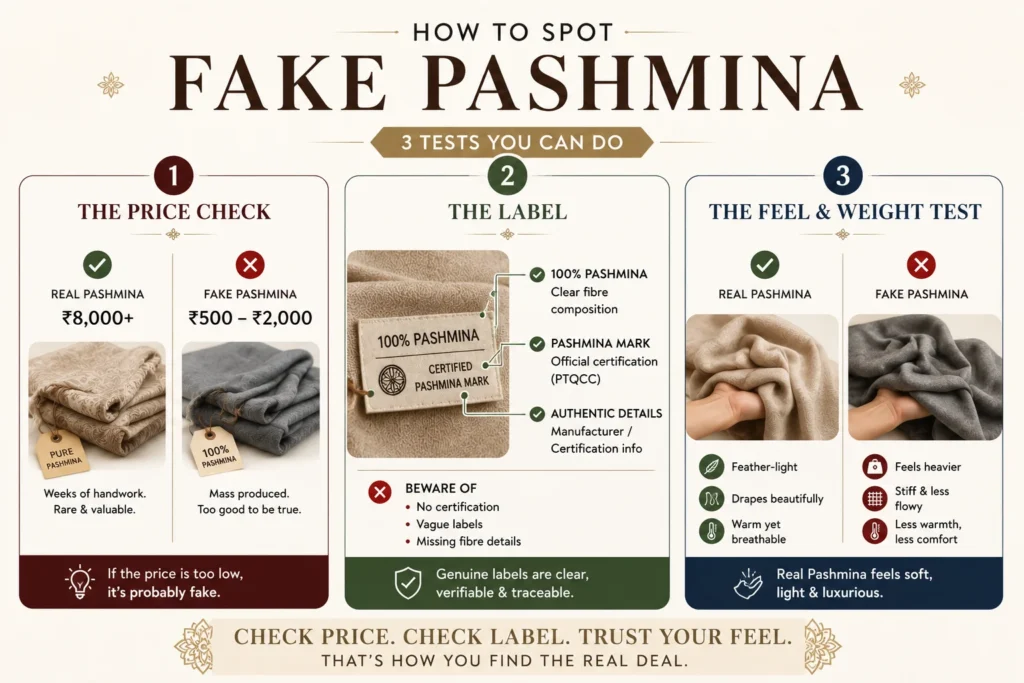
Alright, here’s the part you actually came for. You don’t need a lab or a textile degree to check if a pashmina is real. You just need a few simple tests. Some need nothing but your hands. One needs a lighter. Let’s go through all five.
1. The Price Check
Price might be the single most honest signal you’ll get.
Genuine pashmina usually costs several thousand rupees, with handcrafted Pashmina Centre-certified shawls often starting around ₹8,000 at source in Kashmir and increasing significantly depending on the weave, craftsmanship, embroidery, and overall quality. Retail prices, especially abroad, are often considerably higher.
So if you’re standing at a duty-free counter looking at a shawl labelled “100% Pashmina” for ₹500 to ₹2,000, ask yourself a simple question. Does that price even cover the cost of raw fibre, let alone weeks of skilled hand-labour? It doesn’t. Not even close.
Remember what we covered earlier. Fibre is scarce. Spinning is done by hand. Weaving is done by hand. All of that costs money and time. A rock-bottom price basically confirms the shawl skipped every single one of those steps.
2. The Label
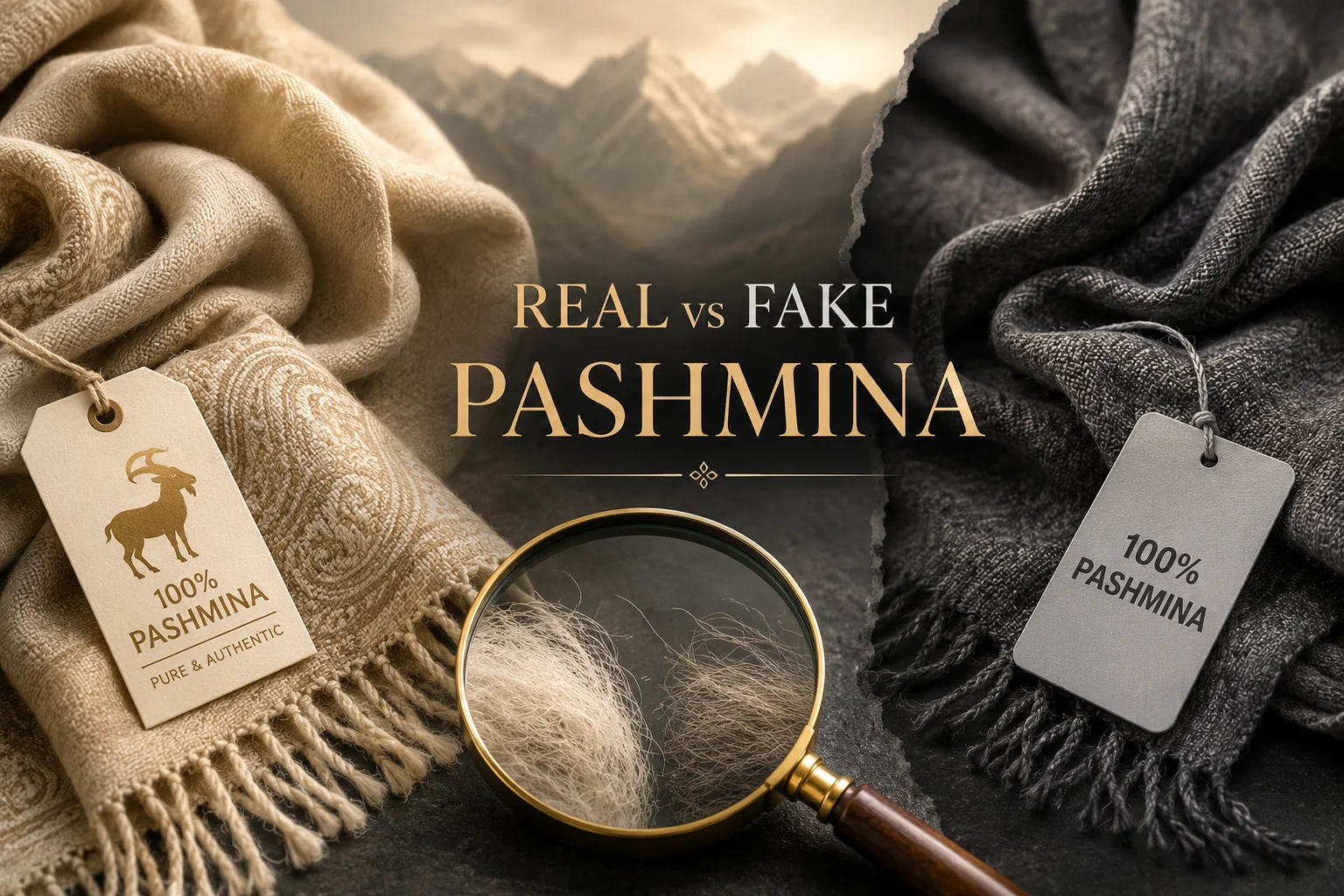
Check the label carefully. A genuine pashmina product should show certification for Kashmiri pashmina. It should clearly list the fibre composition. Pure pashmina products should state 100% pashmina, while blended products should accurately disclose every fibre used. It may also carry the official Pashmina Mark, certified through the Pashmina Testing & Quality Certification Centre (PTQCC) under the Crafts Development Institute.
Here’s the catch, though. A “100% Pashmina” label by itself doesn’t prove anything. That label is a necessary condition, but it’s not a sufficient one. Anyone can print those words on a tag. Without Pashmina Centre certification backing it up, the label means very little.
If you want to go a step further, check whether the manufacturer or seller is an authorised Pashmina Centre user or provides verifiable certification details. It takes a few extra minutes, but it’s one of the best ways to buy with confidence.
3. The Feel and Weight Test
Real pashmina feels almost weightless in your hands, yet it keeps you noticeably warm. That combination, feather-light but genuinely insulating, is hard to fake.
Acrylic blends usually feel a bit coarser. Sometimes heavier. Sometimes slightly plasticky, especially once you’ve handled the real thing for comparison.
Honest disclaimer here. This test takes practice. If you’ve never touched authentic pashmina before, it’s hard to trust your fingers on the first try. That’s exactly why the other four tests matter so much, especially if this is your first time buying.
Put simply, real versus fake usually comes down to feel, weight, and drape. Real pashmina drapes softly and moves like liquid fabric. Fakes tend to hold a stiffer shape.
Can Home Tests Guarantee Authenticity?
The simple answer is no.
The ring test, burn test, price check, and label inspection are all useful ways to spot obvious fakes, but none of them can guarantee authenticity on their own. The only definitive way to confirm pure pashmina is through professional fibre testing, where laboratories examine the fibre under a microscope and measure its diameter.
For most buyers, combining several of the tests in this guide provides a high level of confidence. But if you’re purchasing a particularly expensive shawl, verified certification is always the safest option.
Why Is Real Pashmina So Expensive?
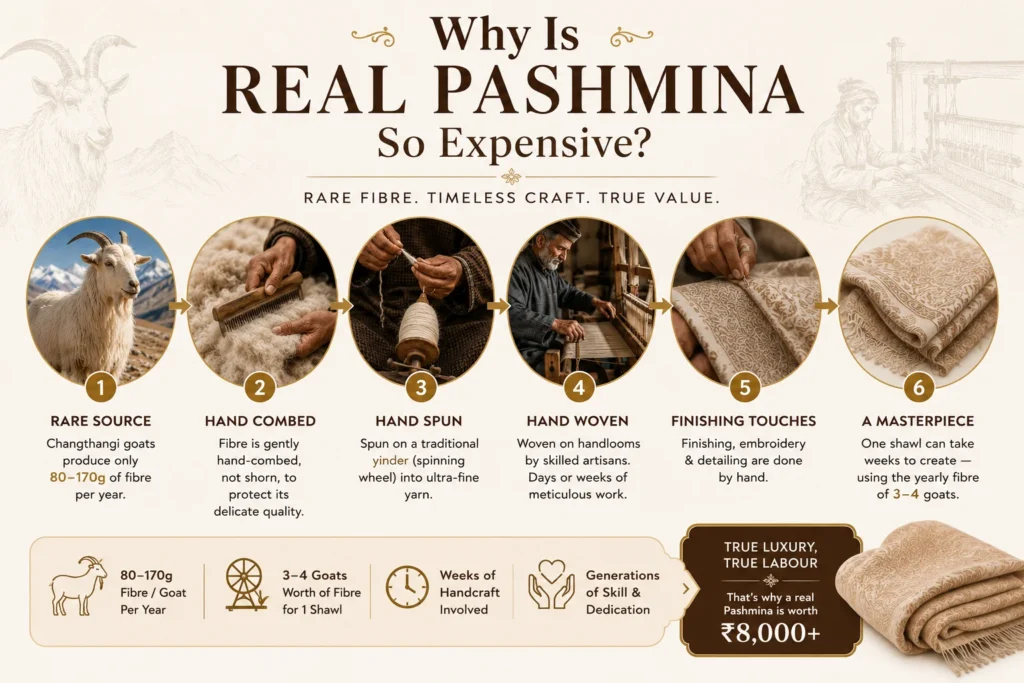
Let’s answer this one head-on, because it’s the question everyone asks right after they see the price.
Start with the goats. A single Changthangi goat produces only 80 to 170 grams of combable fibre per year. That’s it. One year of growth, and you get a small handful of usable material.
The fibre has to be hand-combed too, not shorn like regular wool. Shearing would damage the delicate undercoat. Then it gets hand-spun on a traditional spinning wheel called a yinder. After that, it’s hand-woven on a hand loom, entirely by Kashmiri artisans. Finishing touches are also done by hand.
Add it all up. A single shawl can require the entire annual fibre yield of three to four goats. Combine that with weeks of skilled labour from start to finish, and suddenly that ₹8,000 to ₹12,000 price tag doesn’t feel steep anymore. It feels justified.
Pashmina vs Cashmere: Are They the Same?
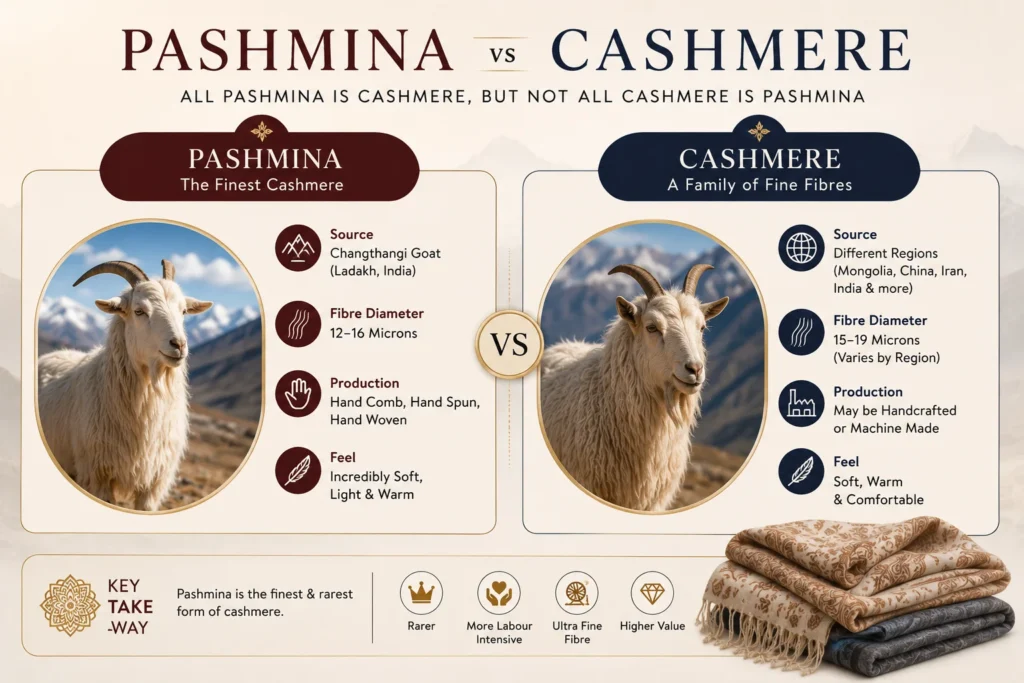
This is one of the biggest sources of confusion for buyers.
Cashmere is the broader name for the fine undercoat fibre obtained from certain breeds of goats. Pashmina is considered one of the finest varieties of cashmere, traditionally sourced from the Changthangi goats of the Himalayan region.
That means all pashmina is cashmere, but not all cashmere qualifies as pashmina. You may also come across luxury blends, such as pashmina mixed with silk. These are not fake products, provided the fibre composition is accurately disclosed on the label.
Where to Buy Real Pashmina and What to Avoid
So where should you actually shop if you want the real thing?
Look for Pashmina Centre-certified Kashmiri craft outlets.
Now, what should you be cautious about? Products sold in airport shops, tourist markets, and online marketplaces should always be checked carefully for proper certification and accurate fibre labelling before you buy. And be cautious with online listings that promise “100% pashmina” at suspiciously low prices without any backing it up.
If you want to verify a specific piece, check for certification and look for the Pashmina Mark. Both are backed by official registries you can cross-check. It takes a bit of extra effort, sure. But it’s a lot less effort than realizing months later that your “pashmina” shawl is actually a polyester scarf.
Conclusion
The airport pashmina scam thrives for one simple reason. Real pashmina is rare, slow to make, and genuinely expensive, while most buyers have no reference point for what the real thing looks, feels, or costs like. That gap is exactly what gets exploited..
If you’re looking to source genuinely authentic textile products, it helps to buy from manufacturers who understand this history and respect the craft behind it. You can also check out our guide on How to Identify Genuine Cashmere Scarves for a deeper look at related authentication tests, or browse our shawls collection if you’re ready to shop with confidence.
FAQs
How to spot a fake pashmina?
Check price, label, and texture together. If it’s priced under ₹2,000, lacks and feels coarse or plasticky, it’s very likely fake. Combine the ring test and burn test for extra confidence.
How do I identify if the pashmina shawl I am buying is genuine?
Look for Pashmina Mark on the label. Then confirm with a burn test on loose threads. Real pashmina burns slowly and smells like burnt hair, leaving soft ash behind.
How much is a 100% pashmina scarf?
Genuine pashmina scarves and shawls typically start around ₹8,000 to ₹12,000 at source in Kashmir, with retail prices often running higher.
What does 100% pashmina mean?
It means the fabric is made entirely from pashmina fibre, sourced from the Changthangi goat’s undercoat, with no synthetic or blended materials mixed in.
How to verify pashmina?
Check through India’s official registry, look for the Pashmina Mark, and test the fabric using the burn test and ring test together.
How much does a real pashmina cost?
Real, hand-spun pashmina generally costs ₹8,000 and up at source, reflecting the scarcity of raw fibre and weeks of hand labour involved in production.
Where to buy an original pashmina shawl in Kashmir?
Srinagar are reliable source, along with registered pashmina manufacturers and exporters.
What is the difference between a shawl and a pashmina?
A shawl is simply a type of garment, a piece of fabric worn around the shoulders. Pashmina refers to the specific fibre from which the fabric is made. So a shawl can be made from pashmina, but not every shawl is pashmina.
How to tell real pashmina from fake?
Use a combination of tests. Try the ring test, the burn test, and check the price and label together. No single test is foolproof, but combining a few gives you real confidence.