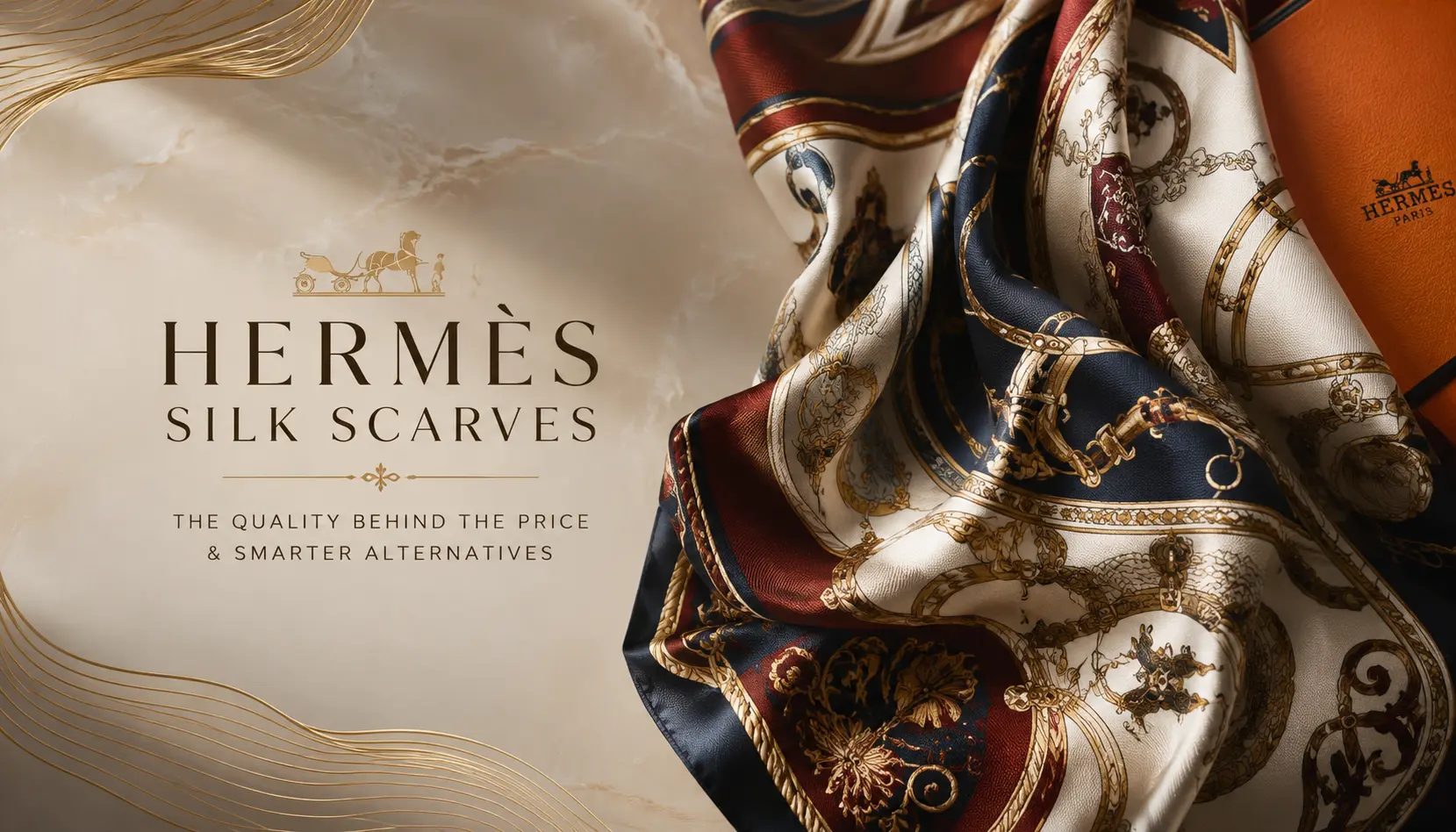
A single Hermès silk scarf carries a price tag of around ₹47,500 to ₹66,500, with limited editions climbing well past ₹95,000. For a 90 by 90 cm square of fabric, that number can feel eye-watering. Yet Hermès scarves consistently sell out, get resold at a premium on secondary markets, and are worn by everyone from royalty to design editors.
So the question is worth asking honestly. What are you actually paying for, and can you get the same silk quality, the same print detail, and the same hand-finishing for a fraction of the price?
This guide breaks down the real economics behind a Hermès silk scarf, examines the manufacturing standards that make it iconic, and shows you how buyers, brands, and retailers can source silk scarves of comparable quality directly from Bright Star, a manufacturer that has been producing premium scarves and shawls in India since 1950.
The Real Cost Breakdown of a ₹50,000 Hermès Silk Scarf
The retail price of a Hermès carré (their classic 90 by 90 cm silk square) is built from several very different cost buckets. Only a small portion is the fabric itself.
Here is a rough breakdown of what goes into the sticker price:
| Cost Component | Approximate Share of Retail |
| Raw silk twill (14 to 16 momme) | 3 to 5 percent |
| Screen printing (up to 46 screens per design) | 10 to 15 percent |
| Hand-rolled hem stitching | 3 to 5 percent |
| Design, artist royalties, and archives | 5 to 8 percent |
| Marketing, boutique real estate, and packaging | 25 to 35 percent |
| Brand premium, exclusivity, and margins | 35 to 45 percent |
The fabric and hand-finishing together rarely account for more than 25 percent of the retail price. The rest is design heritage, distribution, marketing, and brand equity. That is not a criticism of Hermès. It is simply how luxury pricing works.
What You Are Actually Paying For with Hermès
Understanding what drives the number helps you decide whether the price makes sense for you. The main pillars are:
- A century of design archives: Hermès has produced more than 2,000 unique carré designs since 1937
- Artist collaborations: Each design is hand-illustrated, often over months, by a named artist
- Screen-printed detail: Complex Hermès scarves use 30 to 46 individual screens, one per colour
- Hand-rolled hems: Each hem is rolled and stitched by hand, taking around 45 minutes per scarf
- Boutique experience and packaging: The orange box, ribbon, and store service are part of the product
- Resale value and status signalling: Hermès scarves hold and often gain value on the resale market
If you buy Hermès, you are buying design heritage, craftsmanship, and a status symbol. The silk itself is exceptional, but it is not uniquely so.
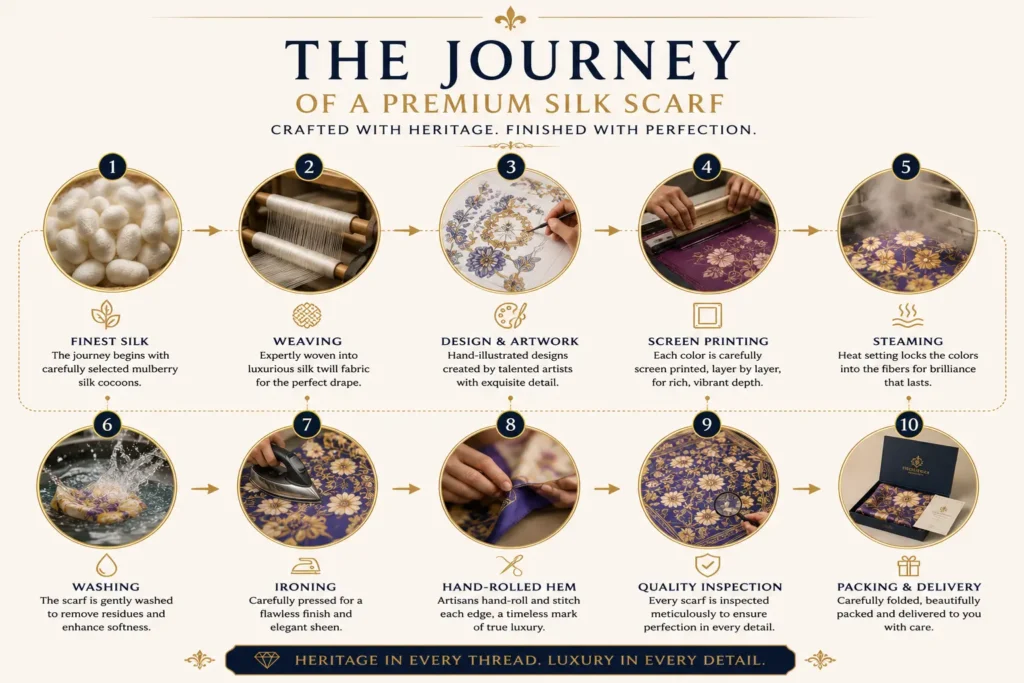
The Quality Standards Behind Luxury Silk Scarves
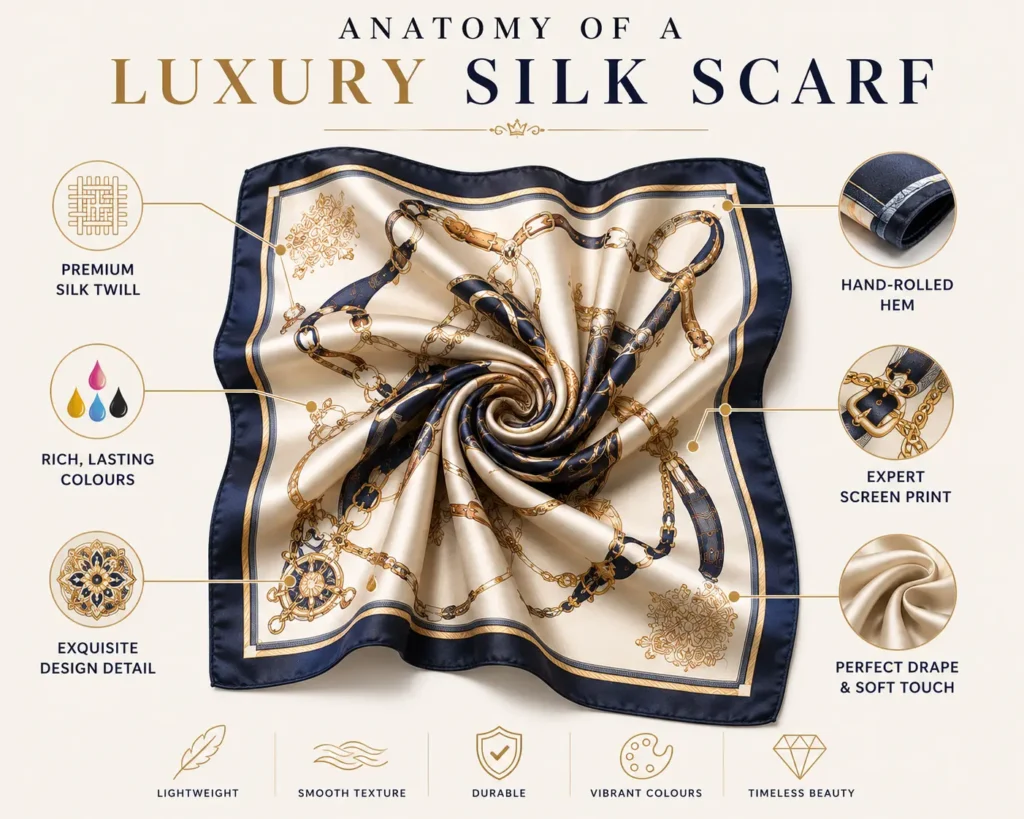
To understand which manufacturers actually match Hermès quality, you need to know what makes a silk scarf genuinely premium. Four measurable standards define the category.
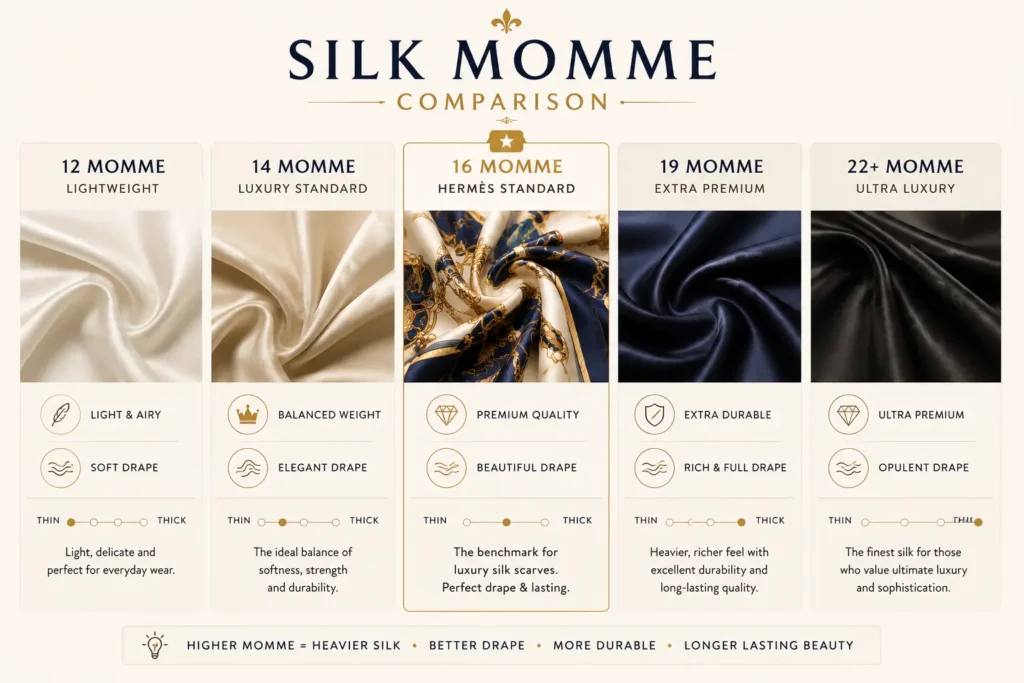
Silk Grade and Momme Weight
Hermès uses silk twill in the 14 to 16 momme range. Momme is a Japanese unit that measures the density and weight of silk. Higher momme silk feels heavier, drapes better, and lasts longer. Anything under 12 momme tends to feel thin and papery.
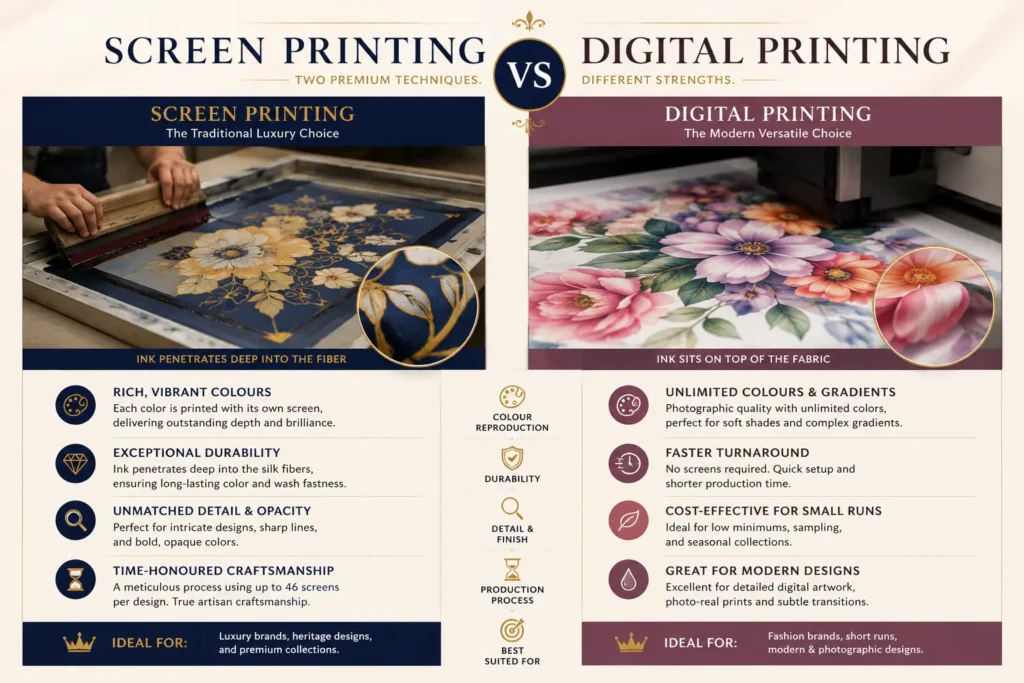
Printing Technique
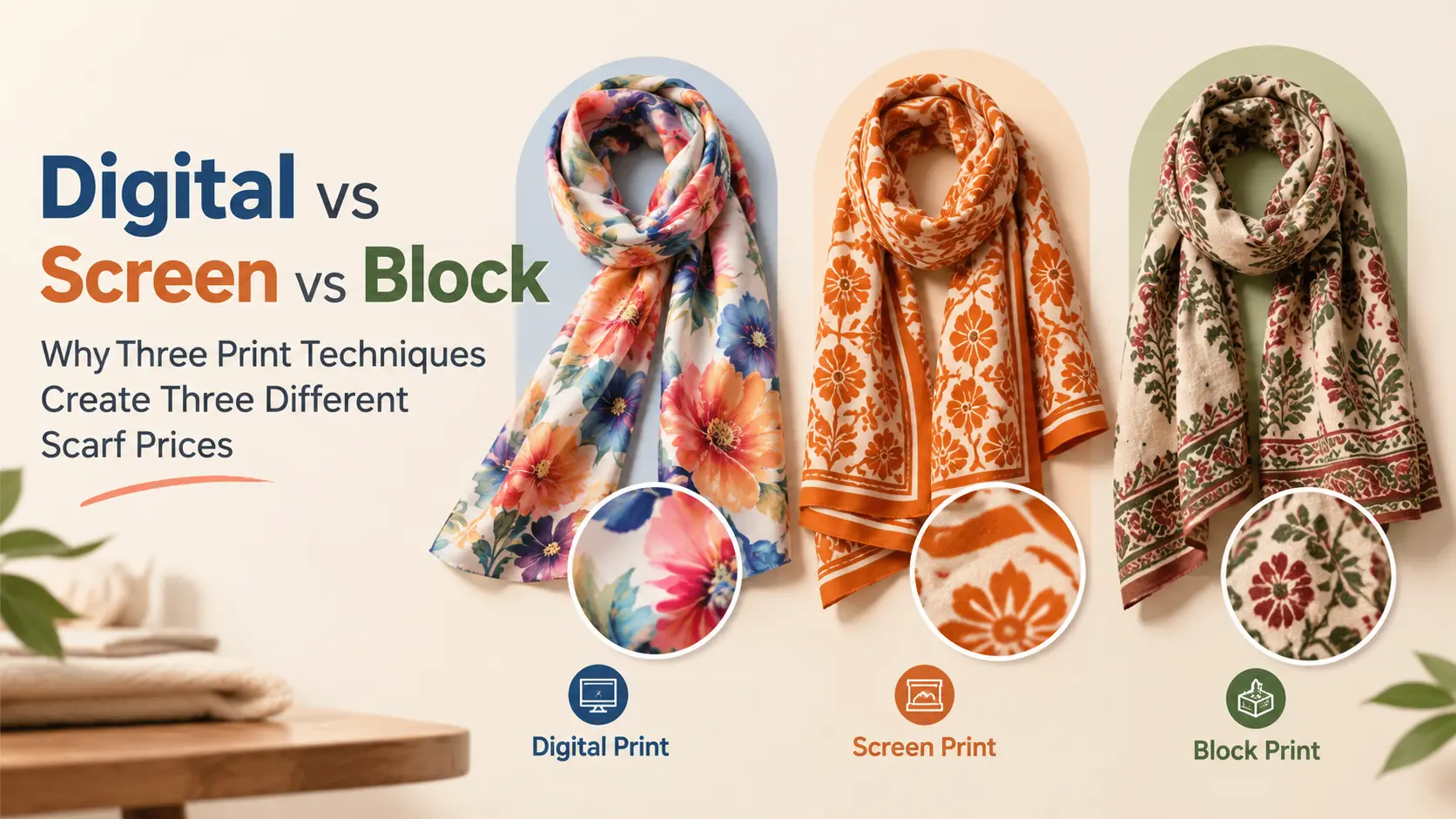
Luxury silk scarves use flat-bed screen printing, one screen per colour, which allows for extraordinary detail and colour depth. Digital printing is faster and cheaper, but tends to sit on the surface of the fabric rather than penetrating it.
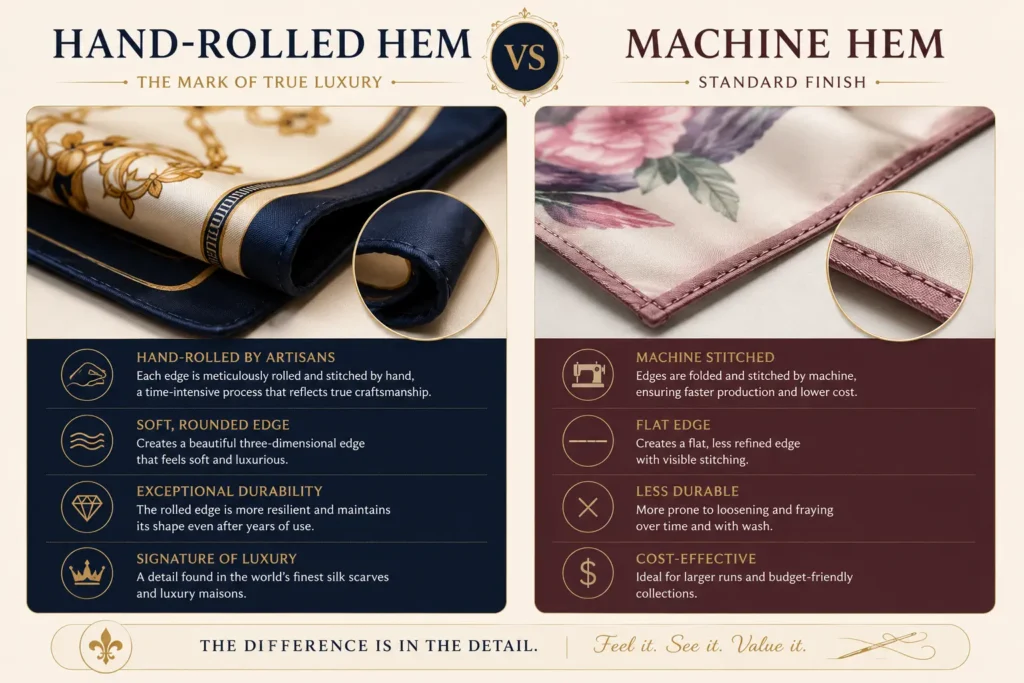
Hand-Rolled Hems
The edges of a premium silk scarf are hand-rolled and stitched, never machine-finished. This gives the scarf a soft, three-dimensional edge that machine hems cannot replicate.
Colorfastness and Finishing
A quality scarf holds its colour through washing, sunlight exposure, and years of wear. This depends on dye chemistry, fixation temperature, and the finishing treatments applied after printing.
Where Hermès Scarves Are Actually Made
Hermès silk scarves are produced in Lyon, France, using silk yarn sourced primarily from Brazil and China. The city of Lyon has been a silk-weaving hub since the 16th century, and Hermès operates its own weaving and printing facilities there.
What is less commonly known is that a very large share of the world’s premium silk scarves, including many pieces sold under well-known European labels, are actually manufactured in India. Indian mills use the same silk grades, the same screen-printing methods, and the same hand-finishing techniques. India has been a global centre for silk weaving and printing for centuries, with generational craftsmanship in Kashmir, Varanasi, and Bangalore.
This is where the price gap starts to make sense. The same technical quality can be produced closer to the fibre source, without the premium boutique overhead.
How Bright Star Delivers Comparable Quality at Wholesale Prices
Bright Star has been manufacturing silk scarves, stoles, and shawls in India since 1950, when the founding family launched KCS Kashmir Shawl Emporium. Over three generations, the business has grown into a full-service manufacturer and exporter, supplying premium retailers, private label brands, and boutique importers across Europe, North America, Australia, and the Middle East.
Here is how Bright Star matches the quality standards behind luxury silk scarves:
- Silk quality: Access to 12, 14, 16, and 19 momme silk twill in mulberry and habotai weaves
- Printing: Both traditional screen printing and high-resolution digital printing, chosen based on the design
- Hand-rolled hems: In-house artisans trained in hand-rolled hem stitching, the same technique used in Lyon
- Custom design: Full design support, from illustration and CAD to production-ready files
- Colour matching: Pantone-accurate colour matching for global brand consistency
- Certifications: Compliance with international textile safety and sustainability standards
You can explore the full range on our stoles manufacturing page and see companion collections in shawls, throws, and cushion covers.
Hermès vs Direct-from-Manufacturer: A Quality Comparison
Here is how the two approaches compare on the specifications that actually determine quality.
| Quality Factor | Hermès | Bright Star (Direct from Manufacturer) |
| Silk momme weight | 14 to 16 momme | 12 to 19 momme (buyer’s choice) |
| Print method | Screen printing (up to 46 screens) | Screen or high-resolution digital |
| Hem finish | Hand-rolled | Hand-rolled available |
| Design origin | In-house artists | Buyer’s custom design or in-house library |
| Minimum order | Not applicable (retail only) | Flexible for wholesale and private label |
| Approximate cost per scarf | ₹47,500 to ₹66,500 retail | A fraction of retail, at wholesale |
| Lead time | Retail availability | 6 to 12 weeks for custom production |
| Buyer type | End consumer | Brands, retailers, boutiques, private label |
The comparison is not that Bright Star is trying to be Hermès. It is that the manufacturing standards behind a premium silk scarf are well understood, and they are directly accessible to buyers who know where to source them.
Who Should Consider Alternatives to Hermès
Not everyone needs a Hermès scarf, and not everyone should pay for one. The buyers who benefit most from working with a manufacturer like Bright Star include:
- Private label brands are building their own silk scarf collection
- Boutique retailers who want high-margin, high-quality products without the luxury brand markup
- Fashion designers launching a signature line under their own name
- Corporate gifting programs ordering branded silk scarves for clients and executives
- Hotels and resorts producing custom scarves for uniforms or in-house retail
- E-commerce brands competing in the premium accessories category
If you are an individual buyer who values the Hermès brand story, the retail experience, and the resale value, no manufacturer alternative will replace that. But if you value the silk, the print, and the finish, direct sourcing changes the maths completely.
How to Source Premium Silk Scarves from Bright Star
The process is straightforward. Bright Star works with buyers at every stage, from initial design brief to finished shipment.
- Share your brief: Design references, colour palette, silk grade, and target quantities
- Review samples: Bright Star produces physical samples for approval before production
- Confirm production: Approve prints, hem finish, packaging, and labelling
- Ship globally: Standard export documentation, air or sea freight, delivered to your warehouse
Minimum order quantities are flexible for genuine buyers, and Bright Star has fulfilled orders as small as 500 pieces and as large as 50,000. Learn more about the full product range on the Bright Star.
Frequently Asked Questions
Why do Hermès silk scarves cost ₹50,000 or more?
Hermès scarves cost ₹50,000 or more because of design heritage, hand illustration, up to 46 screen prints per scarf, hand-rolled hems, boutique overhead, and a significant brand premium built into every piece.
Are Hermès silk scarves really worth the price?
For collectors who value design heritage, artist collaborations, and resale value, Hermès scarves are worth it. For buyers focused purely on silk quality and craftsmanship, similar standards are available for far less.
What silk weight does Hermès use for its scarves?
Hermès uses silk twill in the 14 to 16 momme range. This weight balances drape, durability, and print clarity, and is considered a benchmark for luxury silk scarves worldwide today.
Can other brands really match Hermès quality?
Yes, the manufacturing techniques behind Hermès quality are well understood. Manufacturers like Bright Star use the same silk grades, screen printing, and hand-rolled hems to produce comparable quality scarves.
Where are most luxury silk scarves manufactured?
Hermès scarves are made in Lyon, France. Many other luxury and premium silk scarves are manufactured in India, which has a centuries-old tradition of silk weaving, printing, and hand-finishing.
What is a hand-rolled hem, and why does it matter?
A hand-rolled hem is a scarf edge folded and stitched by hand, taking around 45 minutes per scarf. It creates a soft, three-dimensional finish that machine hems cannot replicate on silk.
Can I order private-label silk scarves from Bright Star?
Yes, Bright Star specialises in private label and custom production. Buyers can choose silk grade, print method, hem finish, packaging, and labelling, with flexible minimum order quantities for global brands.
What is the minimum order quantity for silk scarves at Bright Star?
Bright Star supports flexible minimum orders for genuine buyers, with runs starting from around 500 pieces. Contact the team through the Bright Star website for a project-specific quote and production timeline.
How long does custom silk scarf production take?
Typical lead times for custom silk scarves at Bright Star are six to twelve weeks. This includes sampling, print approval, production, quality checks, hand finishing, and export documentation for global shipping.
Are Bright Star scarves suitable for premium retail?
Yes, Bright Star manufactures for premium retailers, boutiques, and private label brands globally. Silk quality, print detail, hand-finishing, and quality control meet the standards expected in European and North American retail markets.