The default quote every wool scarf buyer gets from India is merino. Not because merino suits every market, but because it is the fibre suppliers who know how to price fastest. Ask for something else, and you will often get quiet, or a “let me check” that never comes back.
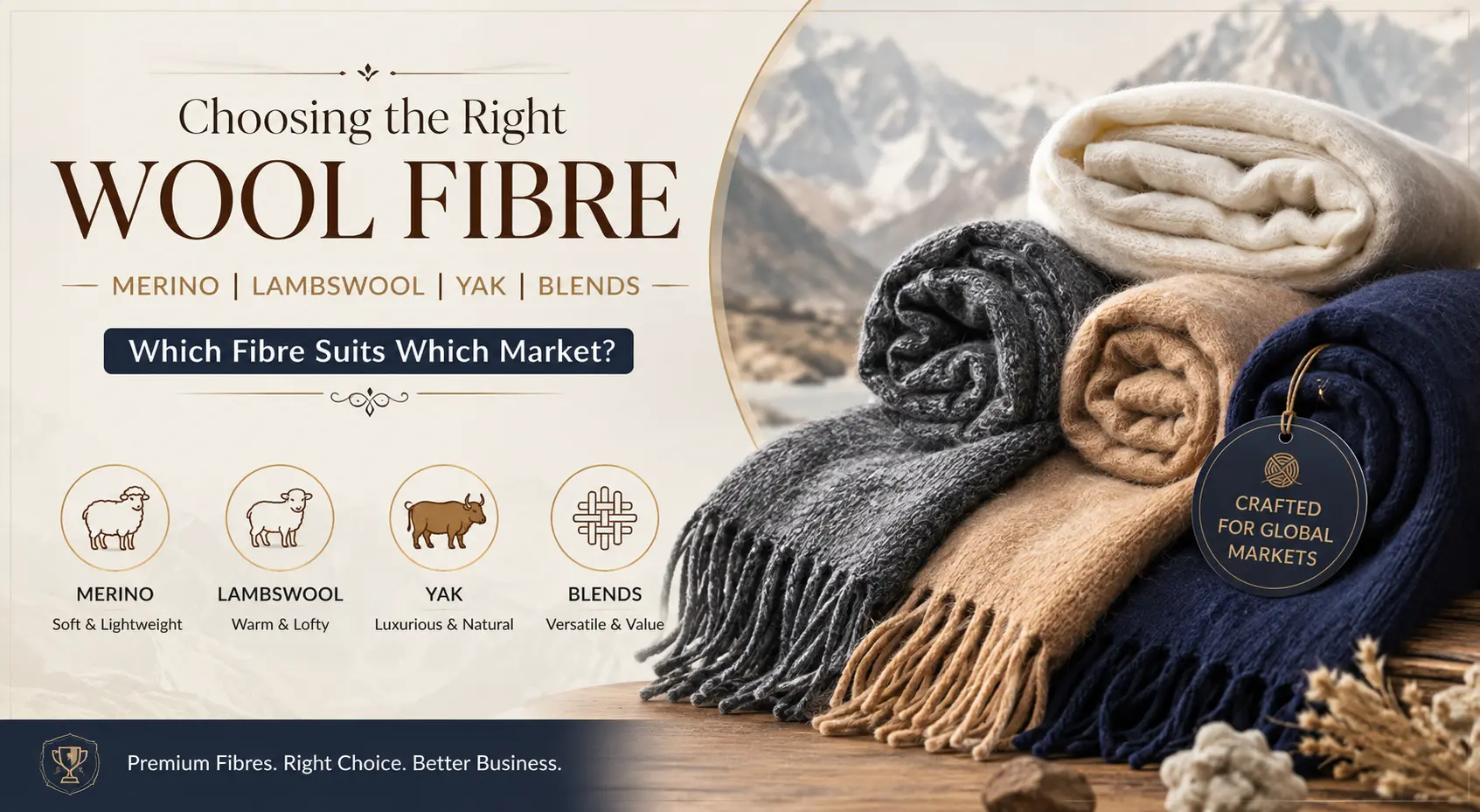
That is the wrong side of the conversation to start on. A range built entirely on merino will hit the wrong shelves in half the markets you want to sell to. This blog is the fuller picture from a wool scarves manufacturer in India. What merino, lambswool, yak, and wool blends actually are, what each costs, and which market each one is built for.
Why Fibre Choice Decides Whether Your Range Sells or Sits
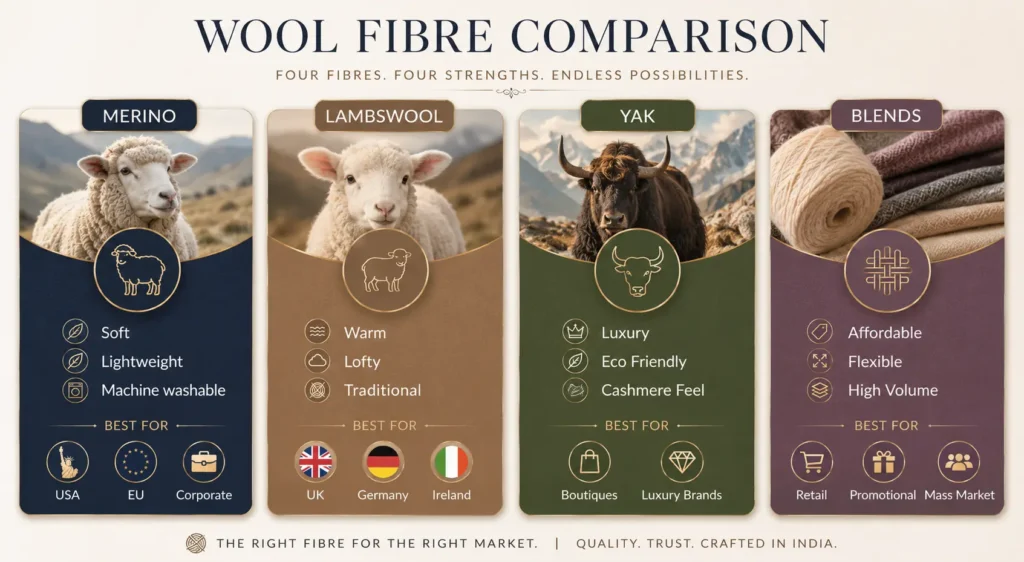
The physical scarf a merchandiser puts on the shelf is only half of the retail equation. The other half is whether it matches what that market’s shoppers actually reach for.
A German department store buyer wants a warm, tightly milled lambswool with heritage weight. A US west coast boutique wants soft, lightweight, machine-washable merino that layers under a jacket. A Middle East retailer wants a decorative winter scarf in yak or fine wool, worn as much for evenings as for warmth. A Japanese private label wants a wool-silk blend that drapes rather than bulks. None of these buyers wants the same product, even though every one is labelled “wool.”
Getting the fibre wrong at a brief stage is the most expensive fix in the whole timeline. Which is why serious wool scarf manufacturers in India start every conversation with market first, fibre second.
The Four Wool Options at a Glance
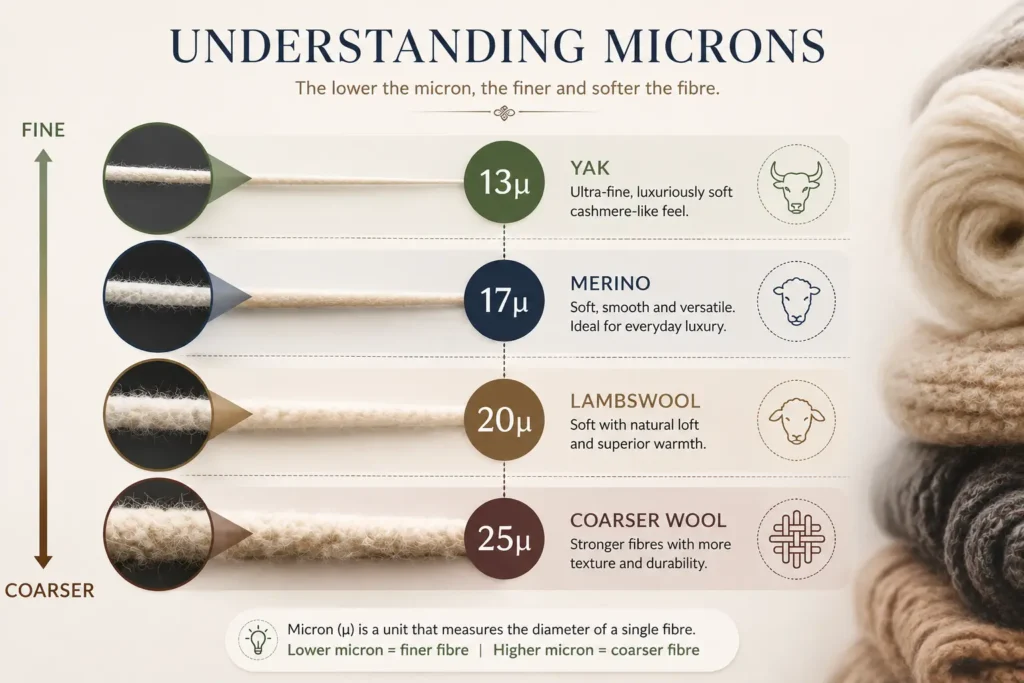
Here is the comparison every buyer should have before finalising a brief.
| Fibre | Micron Range | Feel and Drape | Warmth | Wholesale Price (₹) | Best For |
| Merino | 17 to 24 | Soft, smooth, lightweight | Moderate to high | 800 to 2,500 | US and EU premium daily wear |
| Lambswool | 20 to 25 | Soft with lofty warmth | High | 600 to 1,800 | UK, Ireland, Germany heritage retail |
| Yak | 13 to 19 (baby yak) | Very soft, cashmere-like | Very high | 1,500 to 4,000 | Sustainability-led boutique luxury |
| Blends | Varies | Depends on partner fibre | Moderate | 300 to 1,200 | Mass market, entry retail, gifting |
Prices reflect wholesale FOB for typical scarf sizes in bulk quantities. Higher counts, custom finishes, or certifications push the range up.
Merino Wool: The Default That Suits More Markets Than Any Other
Merino is fine wool from merino sheep, mostly sourced from Australia and reprocessed at Indian spinning mills. What sets it apart is the micron count. Fine merino sits at 17 to 19 microns; standard merino runs 20 to 24. The lower the micron, the softer and pricier the fibre.
Where merino works best:
- US premium daily wear scarves at ₹800 to ₹2,500 wholesale
- EU boutique retail in cream, navy, camel, and heather tones
- Corporate gifting programmes where soft, brandable, and machine washable matter
- Airline and hotel-branded merchandise
- Layering scarves worn under jackets rather than as outerwear
Merino wins these markets because it feels premium, launders reliably, prints cleanly, and holds colour through multiple wash cycles. It is the safest fibre to build a first wool programme around.
Where merino falls short: colder-climate winter retail. It is warm, but not lofty. A German or Scandinavian shopper picking up a wool scarf in November wants weight and body. Merino does not deliver that on its own.
Lambswool: The Fibre That Owns European Winter Retail
Lambswool is wool from a sheep’s first shearing, taken before the animal is seven months old. Because the fibre has not yet coarsened, lambswool feels softer and lofts more than adult wool. It also pills less over its first year of wear, which is why heritage brands still specify it.
Where lambswool wins:
- UK, Ireland, and northern European winter retail
- Heritage and Scottish-style brands looking for weight and warmth
- Department store private label in tartan, herringbone, and gun club check designs
- Menswear and gifting scarves at ₹600 to ₹1,800 wholesale
- Woven jacquards where loft and body matter
Where lambswool falls short: warm-climate markets. It is too heavy for the Middle East, South Asia, or the southern US. And it does not take digital print as cleanly as merino because the fibre surface is less uniform.
Yak Wool: The Sustainability-Led Alternative to Cashmere
Yak wool comes from the undercoat of the Himalayan yak, hand-combed each spring in high-altitude regions across Ladakh, Nepal, and Tibet. Baby yak, at 13 to 19 microns, competes directly with fine cashmere on softness. The animal itself is grazed sustainably, not farmed intensively, which makes yak the ethical-luxury story that boutique brands are actively hunting for.
Where yak wins:
- Sustainability-focused boutique retail in the US, UK, and Germany
- Slow-fashion brands positioning against fast cashmere
- Winter scarves priced at ₹1,500 to ₹4,000 wholesale
- Undyed natural tones (charcoal, brown, ivory), where the fibre’s natural colour is the selling point
Where yak falls short: high-volume programmes. Supply is limited by the animal’s fibre yield (roughly 500 grams a year per adult). MOQs above 5,000 pieces per colourway can be difficult to meet without stretching lead times. It is also priced above merino and lambswool, so mass-market retail rarely absorbs it.
Wool Blends: The Mass Market’s Best-Selling Solution
Blends are what actually sell at scale. A pure fibre is a specialist product; a blend hits a price point, and a hand feels that a broader shopper base will pay for.
Common wool blends and where each fits:
- Wool with cashmere (70/30 or 80/20): Premium feel at half the price of pure cashmere. Sells well in US department stores and gifting.
- Wool with silk (60/40 or 70/30): Lightweight, subtle sheen. Suits Japanese, Korean, and mid-Middle East retail.
- Wool with linen (50/50): Trans-seasonal scarves for spring and autumn. Popular in southern European and US West Coast markets.
- Wool with acrylic (50/50 or 60/40): Entry-price winter scarves at ₹300 to ₹800 wholesale. Absorbs fast-fashion and promotional demand.
- Wool with viscose: Improves drape for a lighter, softer feel. Suits fashion-forward capsule collections.
Blends also let you hit certifications more easily. A GRS-certified recycled wool blend, for example, is easier to source at commercial MOQs than a pure recycled wool.
Which Fibre Suits Which Market? The Buyer Map
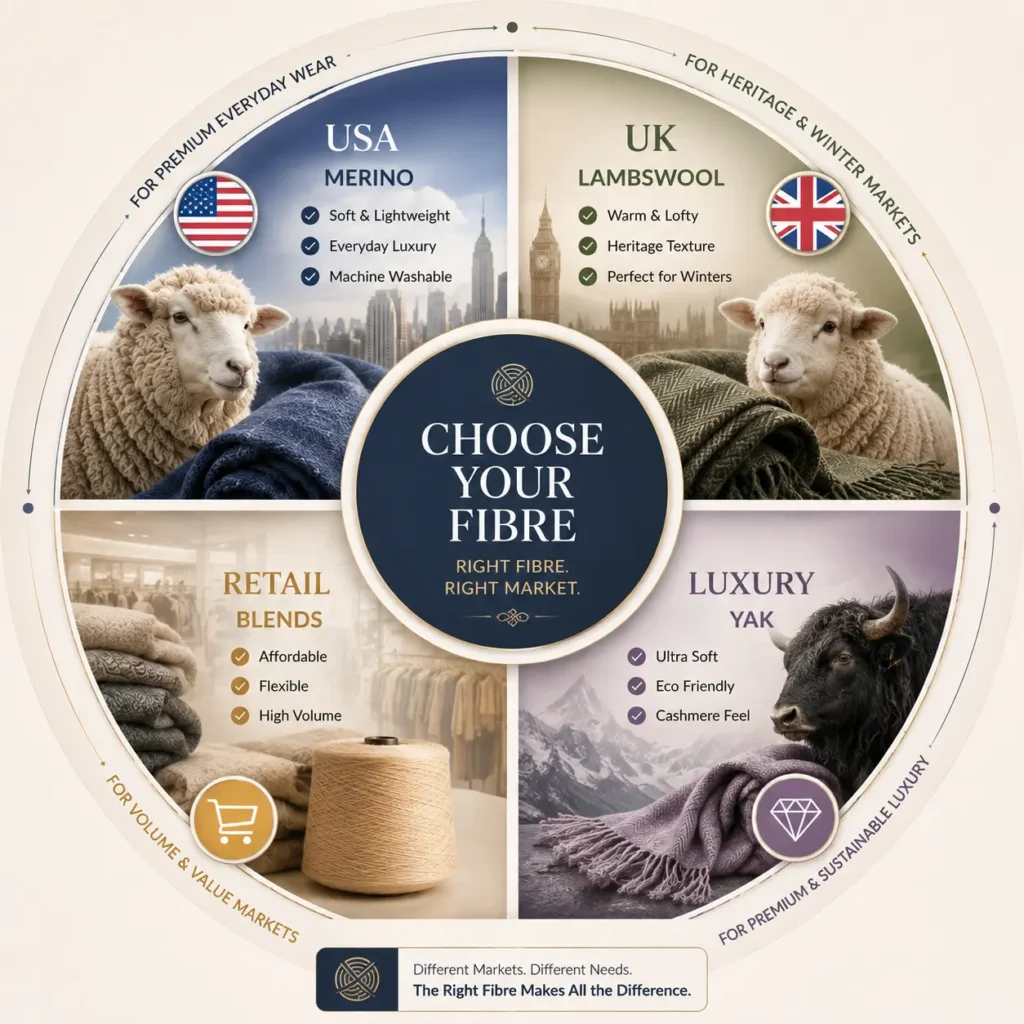
The single question that decides your fibre choice: who is your end shopper?
Here is the working map used across categories, from scarves and shawls through winter accessory ranges.
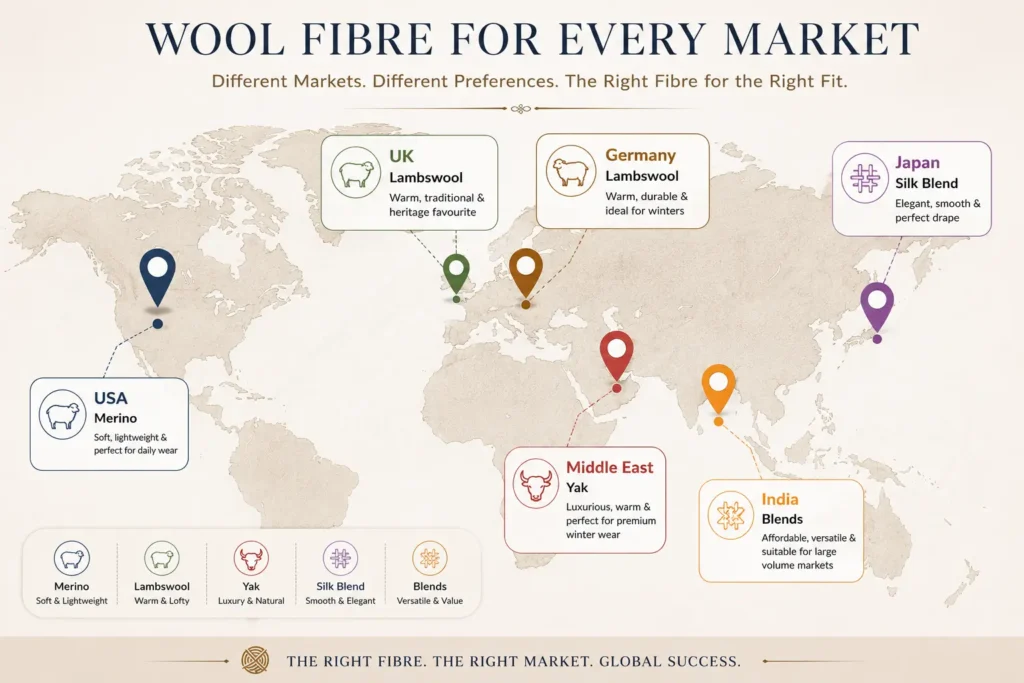
- US premium retail: Merino, wool-cashmere blend, yak for the sustainability tier
- UK and Ireland heritage retail: Lambswool, wool-cashmere, tweed blends
- German and Scandinavian winter retail: Lambswool, yak, wool-alpaca blend
- Southern European retail: Wool-linen, wool-silk, lightweight merino
- Middle East retail: Yak, fine merino, wool-silk decorative scarves
- Japan and Korea: Wool-silk, fine merino, sustainable yak
- India domestic: Wool-acrylic, wool-viscose, lambswool for the luxury tier
- Corporate gifting worldwide: Merino and wool-cashmere blend for feel; blends for volume
- Department store private label: Blends for volume, lambswool for heritage capsules
Building a wool programme means matching this map to your buyer base, not defaulting to whatever the supplier quotes first.
What Manufacturing Considerations Change With Each Fibre
Fibre choice affects more than the scarf. It changes what your production timeline, MOQ, and quote look like.
- MOQ: Merino and blends run comfortably from 300 pieces per design; yak often needs 500 pieces minimum per colourway due to fibre availability.
- Lead time: Merino and blends follow the standard 90-day cycle. Yak adds one to two weeks for fibre sourcing during off-season months.
- Certifications: Merino programmes can be RWS (Responsible Wool Standard) certified; blends can be OEKO-TEX or GRS certified; yak is naturally sustainable but has no dedicated global standard yet.
- Blending ratios: Standard cashmere blends run 70/30 or 80/20 wool-to-cashmere. Silk blends usually cap at 40 percent silk for structural weave integrity.
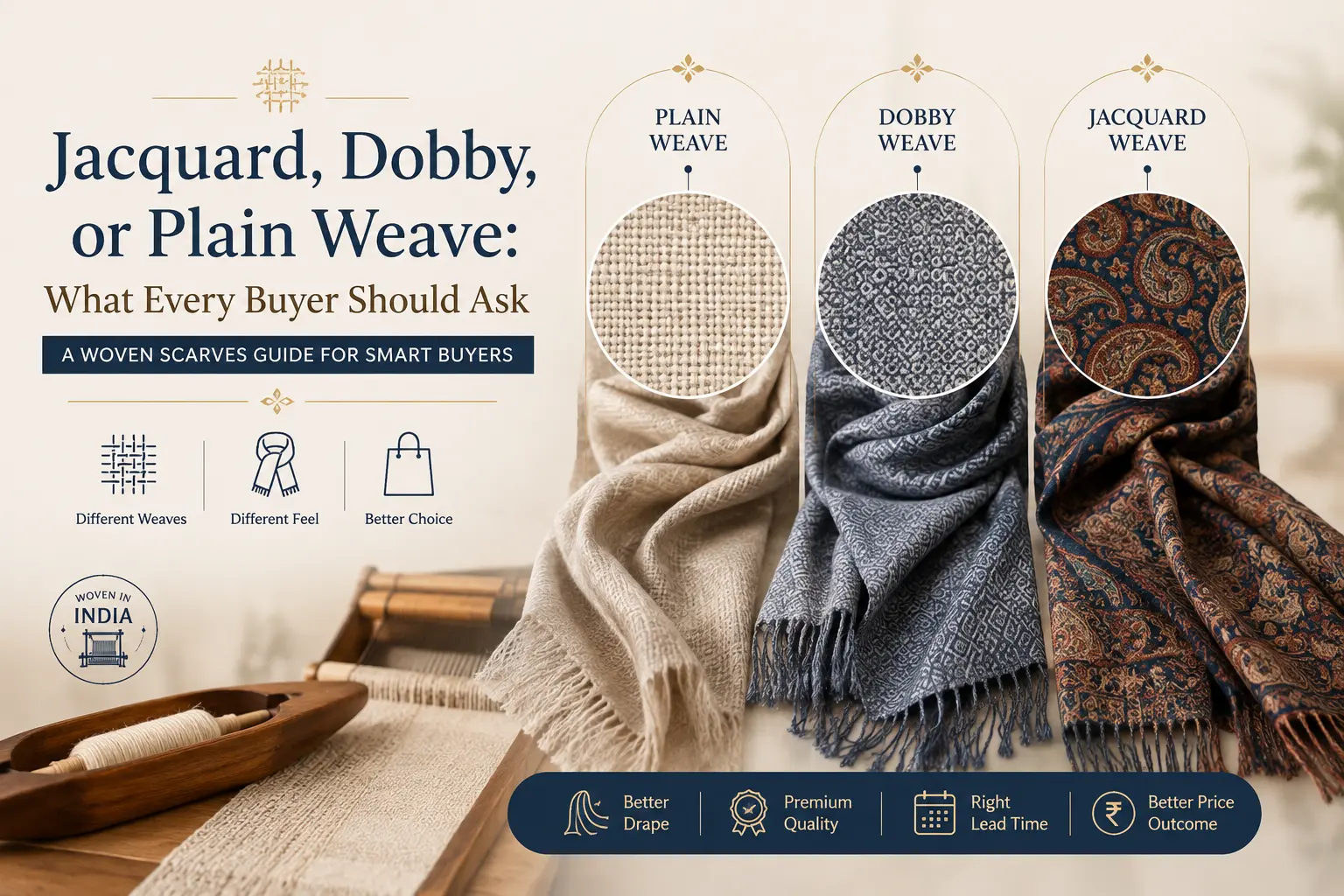
- Print vs weave: Merino and fine wools take digital print well. Lambswool and yak are best suited to woven jacquards and dobby patterns.
For custom weaves, private label details, or specific ratio requirements, working with a manufacturer offering full Custom Design and Private Label capability shortens the sampling loop meaningfully.
Extending the Wool Story Beyond Scarves
The same fibre logic applies across the wider category. Lambswool throws sell strongly in UK and German home retail because the loft translates well to the sofa. Wool-silk blends work in decorative cushion covers for premium hospitality and luxury homes. Yak and fine merino cross over into shawls and stoles for winter apparel programmes.
If wool sits at the centre of your buy, thinking one fibre at a time across categories is the fastest way to consolidate supplier programmes.
Working with Bright Star
Bright Star has been manufacturing wool scarves, shawls, throws, and cushion covers from India since 1950. Three generations of family experience mean the mill knows which fibre suits which market before the buyer has to explain it.
Whether the brief is 1,000 pieces of merino corporate gifts or a 20,000-piece lambswool programme for department store private label, the Bright Star team will match fibre to market on the first call, not the fifth.
Frequently Asked Questions
What is the difference between merino and lambswool?
Merino is fine wool from merino sheep at 17 to 24 microns. Lambswool is any sheep’s first shearing at under seven months, softer and loftier than adult wool with less pilling.
Is yak wool better than cashmere?
Baby yak at 13 to 19 microns is comparable to fine cashmere in softness. It is warmer, more sustainable, and typically priced 30 to 50 percent lower per kilogram than premium cashmere from farmed goats.
What is the minimum order quantity for wool scarves from India?
Standard MOQs are 300 to 500 pieces per design and colourway for merino and blends. Yak often requires a minimum of 500 pieces per colourway due to limited fibre availability during off-season months.
Which wool suits humid or warm-climate markets?
Fine merino and wool-silk blends work best in warm-climate retail. They give a wool label without excess weight. Lambswool and yak feel too heavy for shoppers in warm regions.
Can wool scarves be printed?
Yes. Fine merino and wool-blend fabrics take digital and screen prints cleanly. Lambswool and yak are better suited to woven patterns like jacquards, dobbies, and checks rather than printed designs.
What certifications should a wool scarf manufacturer in India offer?
Standard certifications include RWS for merino, OEKO-TEX for chemical safety, and GRS for recycled blends. Yak has no dedicated global standard but qualifies naturally under sustainable sourcing criteria.
What is the wholesale price range for wool scarves from India?
Wool blends start around ₹300 per piece. Standard merino sits at ₹800 to ₹2,500. Lambswool ranges from ₹600 to ₹1,800. Yak scarves run ₹1,500 to ₹4,000 depending on fibre count.
Which wool blend is most popular globally?
Wool-cashmere blends at 70/30 or 80/20 are the most popular globally. They deliver premium hand feel and warmth at roughly half the wholesale cost of a pure cashmere scarf.
How does yak wool compare to merino for winter retail?
Yak is warmer, softer, and more sustainable than merino, but priced higher and produced in lower volumes. Merino suits daily-wear premium retail; yak suits boutique sustainability-led programmes.
Can I order a mix of fibres in one shipment?
Yes. Multi-fibre orders are standard, provided each fibre meets its individual MOQ. Bright Star regularly ships combined merino, lambswool, yak, and blend programmes to department store private label buyers.