

The comparison shows up in every private label buyer’s spreadsheet at some point. A Scottish cashmere scarf lands at $180 to $800 FOB and up to $1,200 at retail. An Indian cashmere scarf at comparable fibre grade lands at $60 to $300 FOB and $150 to $600 at retail. Same fibre. Roughly half the price. Buyers assume there must be a quality catch.
Usually there is not. Or at least, not the one they are assuming.
The gap is real, and it is explainable, but the explanation has almost nothing to do with fibre quality. It has to do with labour rates, overheads, and where the raw cashmere fibre actually comes from in the first place. This blog is the honest arithmetic behind that gap, written by a cashmere scarf manufacturer in India that has quoted against Scottish mills on the same buyer spec more times than it can count.
The Retail Price Gap Every Buyer Notices
Here is the comparison as it typically appears on a global sourcing manager’s desk.
| Product | Scottish Wholesale FOB | Indian Wholesale FOB | Global Retail Range |
|---|---|---|---|
| Pure cashmere scarf, 30 x 180 cm | $180 to $350 | $60 to $150 | $150 to $600 |
| Pure cashmere stole, 70 x 200 cm | $280 to $600 | $110 to $280 | $300 to $900 |
| Cashmere-silk blend scarf | $220 to $450 | $85 to $200 | $200 to $700 |
| Hand-embroidered cashmere shawl | $500 to $1,200 | $180 to $500 | $450 to $1,500 |
At every tier, the Indian price sits at 40 to 55 percent of the Scottish price. For a buyer running a 10,000-piece programme, that gap is enormous. Understanding what causes it decides whether the shift makes sense for a specific brand.
The Fibre is Not the Difference
The first assumption most buyers make is that Scottish mills use finer cashmere than Indian mills. That assumption is wrong.
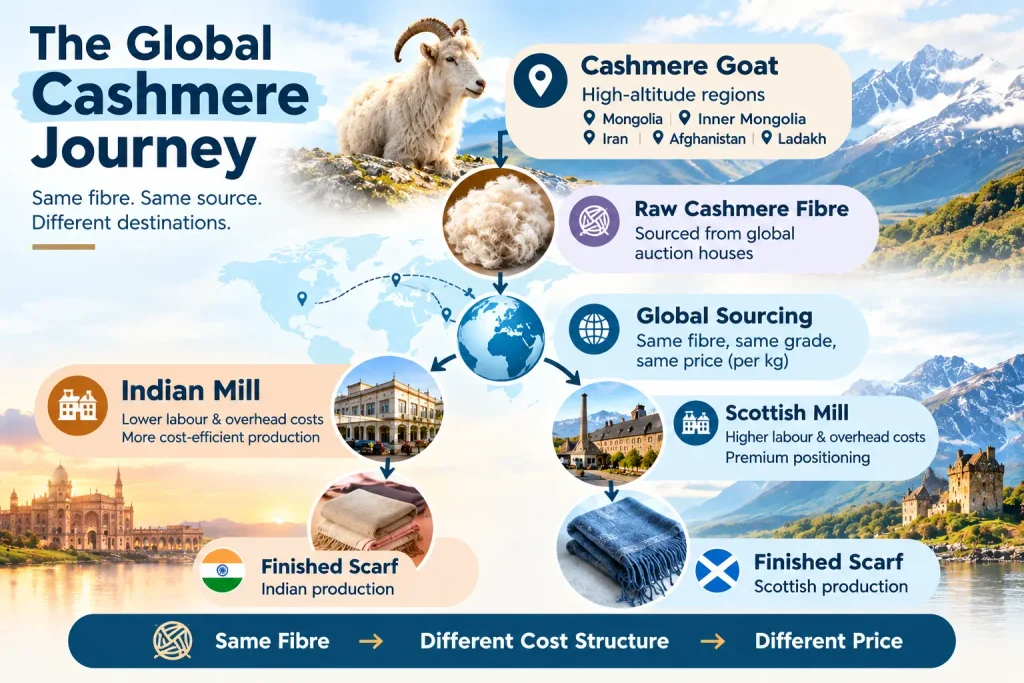
Cashmere as a fibre originates almost entirely from a small band of high-altitude regions: Mongolia (roughly 50 percent of world supply), Inner Mongolia (30 percent), and smaller volumes from Iran, Afghanistan, and India’s own Ladakh region. Scottish mills do not raise cashmere goats. Neither do most Indian mills. Both buy their raw fibre from the same global auction houses in Mongolia, Ulaanbaatar, and China, and both pay broadly similar prices per kilogram for equivalent grades.
Premium cashmere yarn currently costs $110 to $145 per kilogram globally for the finest grades (14 to 16 microns, longer fibre length). Standard commercial cashmere runs $70 to $100 per kilogram. Indian and Scottish mills pay within 10 percent of each other on the same yarn tier.
Which means the fibre in a $60 Indian scarf and the fibre in a $180 Scottish scarf, when specified at the same grade and micron, is essentially the same fibre. The gap has to be somewhere else.
The Real Difference: Labour Economics
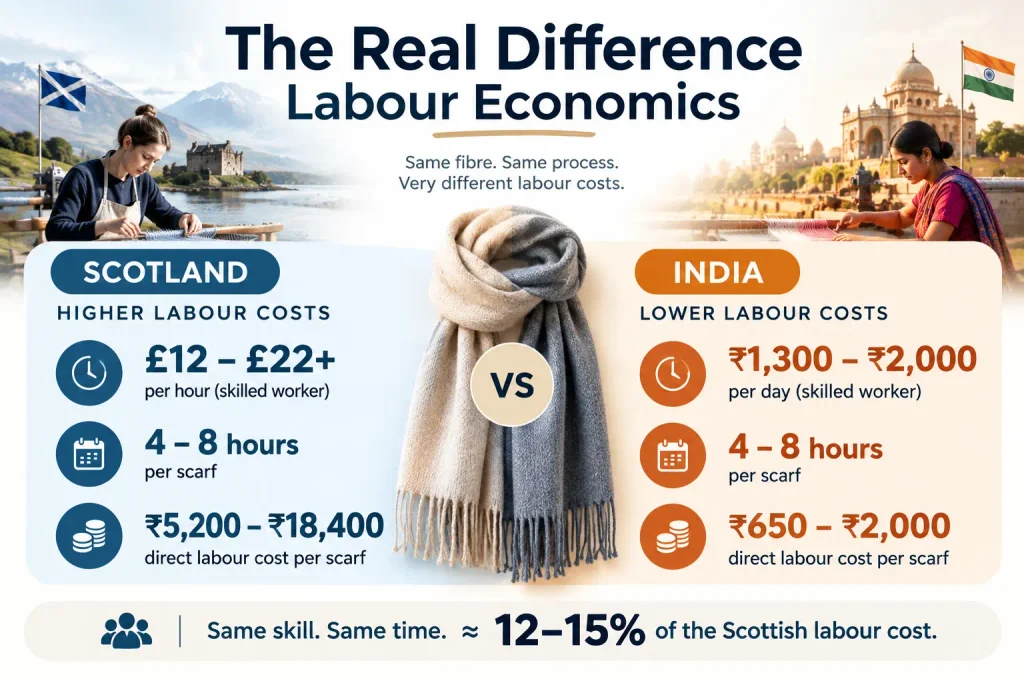
The single largest line item behind the price gap is labour cost. This is not controversial, but it is rarely spelled out in numbers.
A skilled cashmere textile worker in Hawick, Scotland currently earns roughly £12.21 per hour under the UK 2025 National Minimum Wage, with skilled artisans and pattern setters earning £15 to £22 per hour or more. That converts to approximately ₹1,300 to ₹2,300 per hour, or ₹10,400 to ₹18,400 for an 8-hour day.
A skilled cashmere hand-weaver in Amritsar or Ludhiana currently earns ₹1,300 to ₹2,000 per day for the same 8-hour shift on equivalent work. That is roughly 12 to 15 percent of the Scottish rate for the same skill class.
A single hand-woven pure cashmere scarf takes between 4 and 8 hours of skilled labour. That means the direct labour cost of one scarf is:
- Scotland: ₹5,200 to ₹18,400 per piece
- India: ₹650 to ₹2,000 per piece
That single line item accounts for the majority of the price gap. Every other cost comparison is smaller.
Overheads That Do Not Show Up on the Label
Beyond wages, three overhead categories widen the gap further:
- Property and facility cost: Manufacturing property in the Scottish Borders costs 4 to 6 times what equivalent Indian textile-cluster property costs per square metre.
- Energy cost: UK industrial electricity currently runs 30 to 35 pence per kWh; Indian industrial electricity runs 7 to 10 rupees per kWh, roughly 40 percent of the UK rate.
- Compliance and audit cost: UK textile mills operate under BRC, GOTS, UK Modern Slavery Act, and REACH compliance overheads that add 2 to 4 percent to unit cost. Indian mills operate under similar standards (BSCI, Sedex, OEKO-TEX, GOTS) but at lower audit-fee structures.
Together, these three lift the Scottish overhead line by another 15 to 20 percent versus a comparable Indian mill, on top of the labour differential.
The 200-Year Head Start No Longer Justifies the Gap
Scotland’s historical advantage in cashmere was real. The town of Hawick pioneered mechanised cashmere de-hairing and combing in the 19th century, and Scottish mills like Johnstons of Elgin (founded 1797) and William Lockie built techniques that other countries genuinely could not match at the time.
That technical lead has closed. Indian cashmere manufacturers now run the same modern spinning frames, dobby and jacquard looms, and finishing lines that Scottish mills use. Fibre-processing equipment is imported from the same European suppliers. Where Indian mills fall behind Scottish mills is in the scale of finishing infrastructure at the very top tier; where they lead is in hand-craft techniques (kani weaving, hand embroidery, hand-loomed pashmina) that Scottish mills do not offer at all.
For a private-label buyer sourcing a $200-retail cashmere scarf, the technical difference between Scottish and Indian production is now negligible. For a $600-retail luxury heritage piece, the Scottish story still commands its premium at retail because of brand equity, not fibre or technique.
What You Actually Get for the Extra 50 Percent
Here is the honest cost breakdown of what the retail price actually funds in each origin. Both add up to 100 percent, but the composition is completely different.
| Cost Category | Scottish Cashmere Scarf | Indian Cashmere Scarf |
|---|---|---|
| Raw cashmere fibre | 22 to 28 percent | 38 to 45 percent |
| Direct labour | 28 to 35 percent | 10 to 14 percent |
| Facility, energy, overhead | 18 to 22 percent | 12 to 16 percent |
| Brand and marketing | 12 to 18 percent | 8 to 12 percent |
| Distribution and retail margin | 8 to 12 percent | 20 to 26 percent |
Notice the fibre share. Buyers who purchase Indian cashmere are getting 38 to 45 percent of their unit cost in raw fibre value, versus 22 to 28 percent for Scottish cashmere. In dollar terms, the actual weight of premium cashmere fibre in an Indian scarf priced at $85 FOB is often equivalent to or higher than the fibre content of a Scottish scarf priced at $180 FOB.
That is the counter-intuitive finding most buyers miss. Half the price does not mean half the fibre. It means the same fibre with a smaller labour and overhead stack around it.
Where Scottish Cashmere Still Genuinely Wins
Being honest about the price gap means being honest about where Scotland still earns its premium:
- Country of origin equity: “Made in Scotland” carries retail brand cachet that “Made in India” does not, particularly in North American and Japanese luxury retail. This is a marketing reality, not a quality one, but it drives real retail conversion at $600+ price points.
- Consistency of tight-knit construction: Scottish mills specialise in tightly knitted construction that resists pilling and holds shape over years. Some Indian mills match this; most do not without specification and audit.
- Multi-generational skill continuity: Third-generation workers on the same floor produce a level of tacit expertise that scales with time. Indian mills have this too in specific clusters (Amritsar, Ludhiana, Srinagar), though the skill base is broader and less concentrated.
- Heritage brand affiliations: Chanel-owned Barrie, Johnstons of Elgin, William Lockie, and Hawico ship as trusted mills for European luxury houses. Buyers pay for that certainty at the top of the market.
For a brand whose retail proposition is “heritage luxury made in Scotland,” Scottish cashmere is worth the premium. For every other retail proposition, Indian cashmere delivers equivalent product at half the cost.
Where Indian Cashmere Genuinely Wins
The reverse story is equally worth naming:
- Hand-embroidery and kani weaving: Traditional Kashmiri techniques that are not commercially available from Scottish mills at any price
- Handloom character: Genuine handloom cashmere in Ladakhi and Kashmiri traditions
- Custom colour and print flexibility: Indian mills accept smaller MOQs on custom colourways and print programmes
- Faster sample and bulk turnaround: Typical Indian sample time is 21 to 30 days; Scottish sample time is 35 to 60 days
- Broader range across scarves, woven jacquards, throws, and coordinated home textile ranges from one supplier
For a brand looking to source cashmere alongside coordinated wool, silk, and cotton products across categories, the Indian supplier base is significantly deeper.
Landed Cost Reality for Private Label Buyers
Once freight, duty, and landing costs are added, here is what a comparable cashmere scarf looks like at destination.
- Scottish cashmere scarf, FOB $180, US landed cost: $180 base + $12 freight + $27 duty (15 percent, current US tariff on Scottish cashmere) + $8 landing = $227
- Indian cashmere scarf, FOB $85, US landed cost: $85 base + $10 freight + $16 duty (19 percent estimated total including forced-labor tier) + $8 landing = $119
Landed cost gap: $108 per unit, or 47 percent lower on the Indian sourcing route. On a 5,000-piece programme, that is $540,000 in retail margin gain that stays with the private-label buyer instead of funding the Scottish manufacturing overhead stack.
Working with Bright Star
Bright Star has manufactured cashmere scarves, stoles, and shawls from India since 1950. Three generations of family experience across Amritsar and Ludhiana cashmere production infrastructure means the mill delivers Mongolian and Ladakhi cashmere at the fibre grade a buyer specifies, without the Scottish labour and overhead stack that doubles the same product’s retail price elsewhere.
Whether the brief is 500 pieces of pure 14-micron cashmere scarves for luxury retail or 5,000 pieces of cashmere-silk blend for private-label programmes, the Bright Star team quotes against the scarves and shawls range using genuine fibre and honest costing. For programmes needing custom colour, weave, or embellishment work, in-house Custom Design and Private Label capability shortens the cycle further, with digital and screen prints also available on cashmere-blend fabrics.
Frequently Asked Questions
Analyse this blog and tell me how can i enhance this blog in terms of images, graphics and infographics
Indian cashmere costs less primarily because of lower labour and overhead costs, not because of inferior fibre. Both countries buy raw cashmere from the same Mongolian and Central Asian auction houses at comparable prices.
Is Scottish cashmere better than Indian cashmere?
Not by fibre grade. Scottish cashmere is often more consistently finished and carries heritage brand equity. Indian cashmere at the same micron and ply performs equivalently at retail for around half the wholesale cost.
Where does cashmere fibre come from originally?
About 50 percent of world cashmere comes from Mongolia, 30 percent from Inner Mongolia in China, and the remaining 20 percent from Iran, Afghanistan, and India’s Ladakh region. Scotland does not raise cashmere goats.
What is the wholesale price of a cashmere scarf from India?
Wholesale FOB cashmere scarf prices from India range from ₹5,000 to ₹25,000 per piece depending on micron, ply, size, and finish. Pure 14-micron cashmere sits at the top of that range.
What is the minimum order quantity for cashmere scarves from India?
Standard MOQs for cashmere scarves from India start at 100 to 300 pieces per design and colourway. Custom weaves, hand-embroidered pieces, or novel blends may require 300 to 500 piece minimums.
What micron count is real cashmere?
Genuine cashmere is 15 to 19 microns. Premium cashmere runs 14 to 16 microns. Anything above 19 microns is coarse cashmere or often mislabelled sheep wool. Both Indian and Scottish mills source at the same micron bands.
How does US tariff affect Scottish vs Indian cashmere pricing?
Scottish cashmere currently faces roughly a 15 percent US tariff. Indian cashmere faces approximately 19 percent total US duty. The tariff differential is small versus the wholesale price gap, so India remains materially cheaper landed.
What is the difference between cashmere and pashmina?
Pashmina is a subcategory of cashmere. Traditional pashmina refers to hand-woven cashmere from Kashmir at very fine micron counts (12 to 15). Most commercial cashmere is machine-processed and slightly coarser.
Can Indian cashmere scarves be certified for sustainability?
Yes. Indian cashmere scarf manufacturers commonly hold OEKO-TEX Standard 100, GOTS for organic blends, GRS for recycled content, and BSCI or Sedex for social compliance audits that meet European and US retail standards.
What lead time should I expect from an Indian cashmere scarf manufacturer?
Standard lead time is 60 to 90 days from brief to container handover. Repeat orders on established designs can ship in 30 to 45 days. Hand-embroidered or kani-woven pieces need 90 to 120 days.