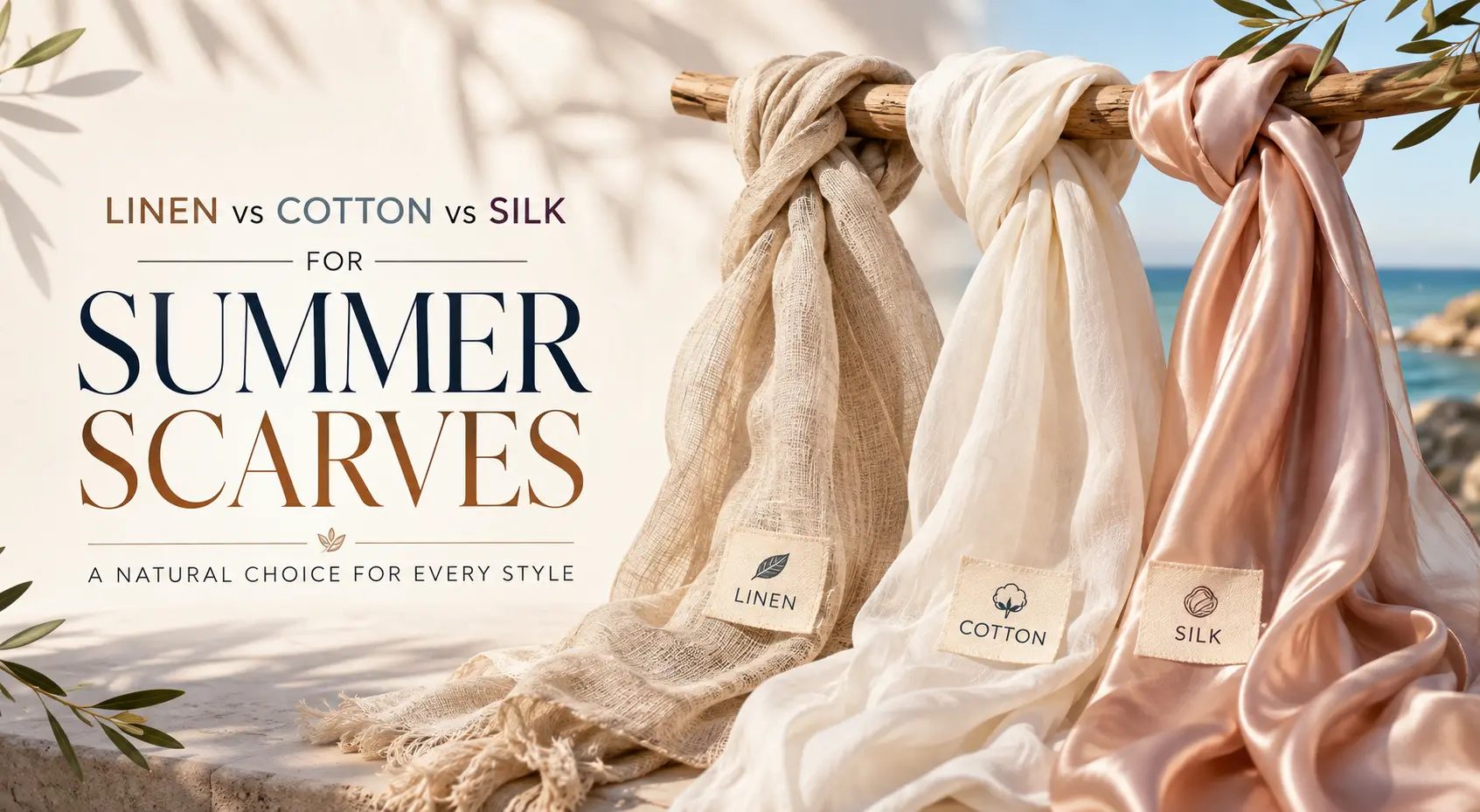
Every spring, home retail and fashion accessory buyers land on the same three-way argument in their sourcing meetings. Linen, cotton, or silk. Each one is a natural fibre. Each one is marketed as breathable. Each one lands in a different price band. And each one behaves completely differently once it hits a shoulder in July.
This is the honest side-by-side buyers Google before finalising their summer buy. Not marketing language. Actual fibre behaviour, real wholesale prices from India, and the retail slots each fabric is genuinely built for. Written from the perspective of a linen scarf manufacturer in India who works with all three fibres across the same production floor.
Why the Summer Scarf Fibre Decision Matters More Than Winter
Winter scarf sourcing is forgiving. If the fabric is warm and looks good on the shelf, the shopper picks it up. Summer scarves get scrutinised differently. A shopper in Miami, Madrid, or Mumbai in July decides in three seconds whether a scarf feels breathable or claustrophobic when they hold it against the neck. Get the fibre wrong, and the range sells poorly regardless of design.
The three natural fibres that dominate summer scarf retail globally are linen, cotton, and silk. Each one solves a different retail problem, and each one has been used for centuries in hot climates for exactly that reason. What follows is the comparison every summer buyer should have on the table before their next brief.
The Three Fibres Head-to-Head
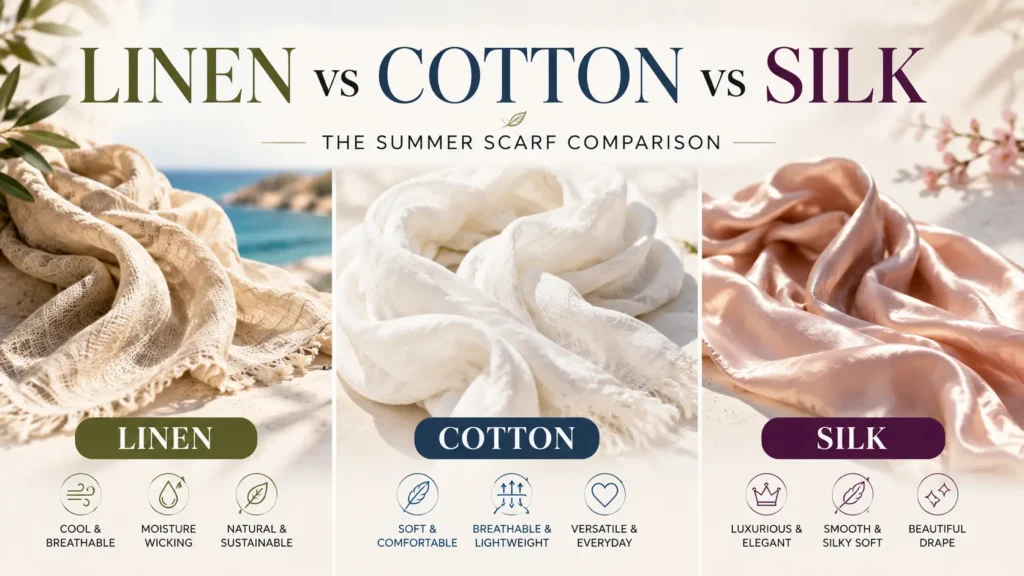
Here is the direct comparison across the attributes that actually decide sell-through at retail.
| Attribute | Linen | Cotton | Silk |
|---|---|---|---|
| Breathability | Excellent | Very good | Very good |
| Moisture wicking | Strongest of the three | Good | Good |
| Drying speed | Fastest | Fast | Medium |
| Wrinkle resistance | Low (part of the charm) | Medium | High |
| Drape | Structured, sculptural | Soft, casual | Fluid, elegant |
| Softness at first touch | Coarse, softens with wear | Immediately soft | Extremely soft |
| Durability | Highest | Medium | Delicate |
| Care | Machine wash | Machine wash | Hand wash or dry clean |
| Retail positioning | Resort, boutique, eco | Mass market, casual, gifting | Luxury, statement, evening |
| Wholesale FOB (₹) | 300 to 1,200 | 150 to 500 | 400 to 2,500 |
None of the three is objectively better than the others. Each one wins a specific retail slot cleanly. Understanding which slot decides which fibre to specify.
Linen: The Fabric That Owns Hot-Climate Retail
Linen is what natural fibre science says a summer scarf should be. Derived from the flax plant, linen has thicker, less uniform fibres than cotton, which creates a naturally looser weave and higher airflow. It absorbs moisture aggressively (up to 20 percent of its weight before feeling damp) and releases it into the air faster than any other natural fibre. That combination is why hot-climate markets from southern Europe through the Middle East and South Asia have relied on linen for centuries.
Where linen wins at retail:
- Resort wear collections in coastal US, southern Europe, Australia
- Boutique and eco-conscious retail where natural fibre credentials matter
- Editorial and slow-fashion positioning against synthetic alternatives
- Middle East and warm-climate retail where breathability is a shopper priority
- Menswear summer scarves at ₹500 to ₹1,200 wholesale
- Trans-seasonal linen-silk and linen-cotton blends for premium retail
Where linen falls short: aggressive wrinkle behaviour and coarser initial hand feel. Both traits soften with washing and wear, and both are increasingly marketed as “linen character” rather than defects. For customers used to smooth cotton or silk, this repositioning matters at retail sign-off.
Blended options soften the wrinkle behaviour. A linen-cotton at 60/40 keeps most of linen’s breathability while adding cotton’s soft touch and lower wrinkle profile. A linen-silk blend at 60/40 keeps the drape elegant while maintaining linen’s cooling behaviour.
Cotton: The Volume Winner That Fits Every Price Band
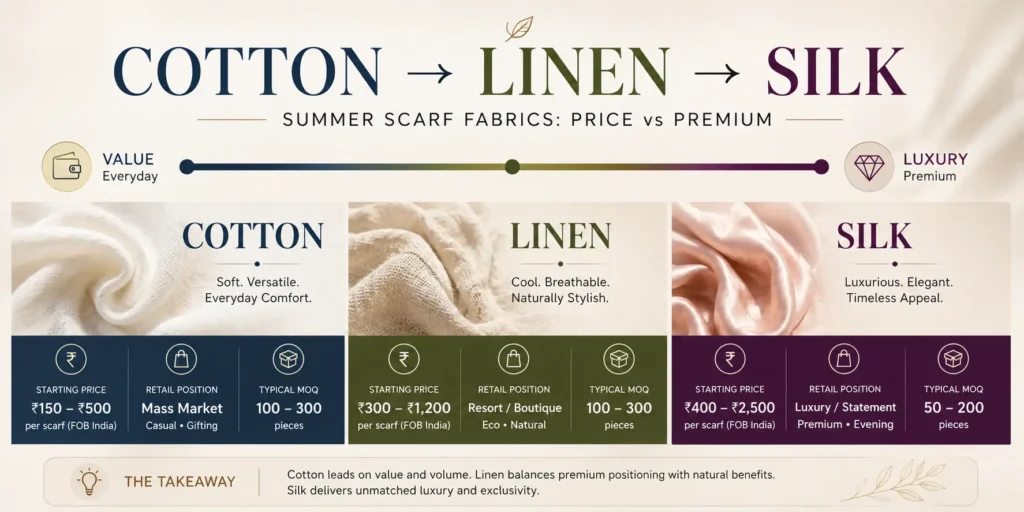
Cotton is the workhorse of summer scarf retail globally. It is soft the moment it is unfolded, it takes print cleanly, it launders easily, and it hits price points that support every retail tier from promotional to premium. India’s domestic cotton belt across Gujarat, Maharashtra, and Andhra Pradesh also gives Indian manufacturers a natural cost and traceability advantage on this fibre versus most other supplying countries.
Where cotton wins:
- Mass-market summer scarf programmes at ₹150 to ₹500 wholesale
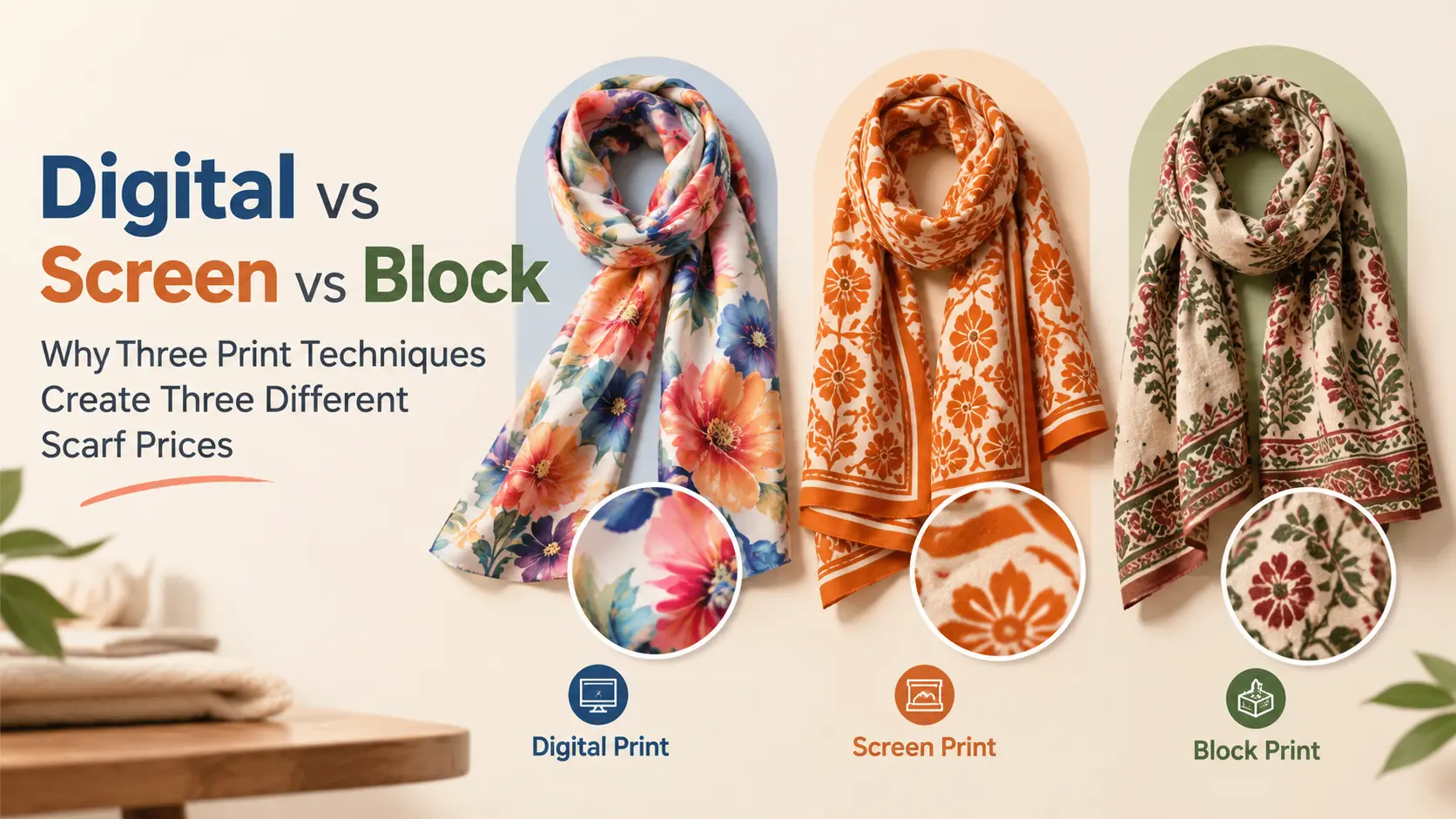
- Printed scarf ranges (block, screen, digital) where cotton takes ink cleanly
- Casual daily-wear scarves that need to be laundered repeatedly
- Kids and family retail where softness and washability matter
- Gifting and promotional programmes
- Bandanas, sarongs, and larger accessory formats
Where cotton falls short: less breathable than linen at extreme heat, less refined than silk at premium retail. A summer scarf in humid 40-degree conditions will feel slightly warmer in cotton than in linen. Not by much, but noticeably to the shopper who is comparing fabrics side by side.
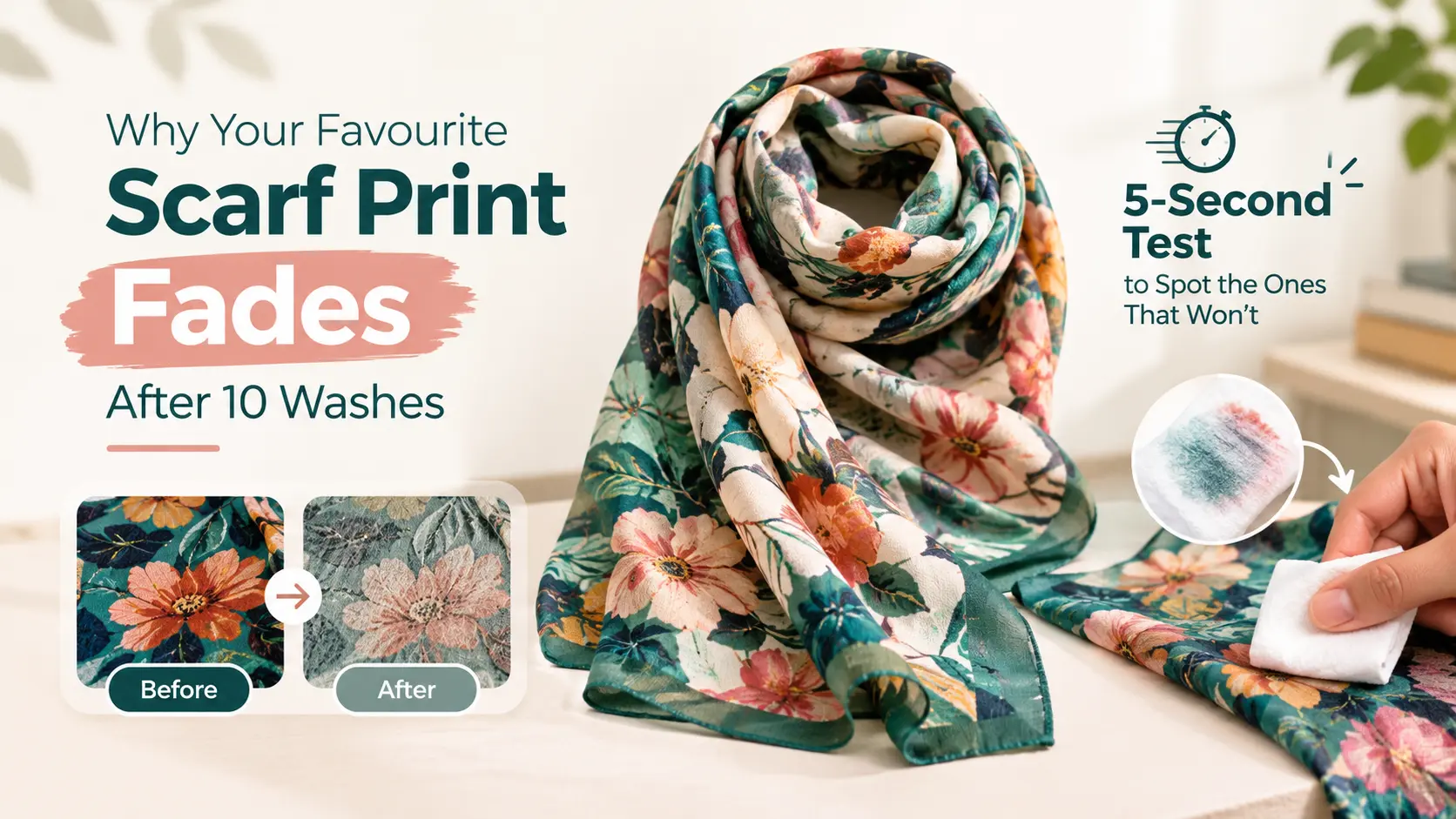
Cotton is also the fibre most commonly used across the prints programme for scarves, because the surface uniformity of plain-weave cotton is what allows sharp print definition at commercial scale.
Silk: The Statement Piece That Anchors the Premium Tier
Silk is the counter-intuitive summer fibre. Because it looks luxurious and feels smooth, many buyers assume silk is a cold-weather product. In reality, silk is a highly efficient thermoregulator with excellent breathability and moisture-wicking behaviour comparable to linen at lower fabric weights. The protein fibre feels cool against the skin in high heat and slightly warmer on cool evenings.
Where silk wins:
- Premium and luxury summer scarves at ₹500 to ₹2,500 wholesale
- Statement print scarves in bold florals, paisleys, or graphic designs
- Evening wear that transitions from beach to dinner
- Gifting programmes with clear luxury positioning
- Hotel and airline branded merchandise where perceived value matters
- Digital and screen-printed silk crepe or silk twill for photographic artwork
Where silk falls short: delicate care requirements and higher price point. A shopper who wants to throw the scarf in the wash will not buy silk. A retailer who wants a $10 accessory cannot stock silk. Silk anchors the top of the summer range, not the middle or the bottom.
Silk also performs beautifully in woven jacquard constructions where the fibre’s natural sheen amplifies pattern depth, though most summer silk scarves are still printed on plain-weave silk crepe or silk chiffon for lightness.
Wholesale Price Comparison and MOQ Reality
Here is the sourcing arithmetic every summer buyer weighs.
| Fibre | Wholesale FOB (₹) | Typical MOQ | Sample Lead Time | Best Retail Tier |
|---|---|---|---|---|
| Cotton | 150 to 500 | 300 to 500 pieces | 21 to 30 days | Entry to mid |
| Linen | 300 to 1,200 | 300 to 500 pieces | 21 to 35 days | Mid to premium |
| Silk | 400 to 2,500 | 300 to 800 pieces | 30 to 45 days | Premium to luxury |
| Linen-cotton blend | 250 to 800 | 300 to 500 pieces | 21 to 30 days | Mid |
| Linen-silk blend | 500 to 1,500 | 300 to 500 pieces | 30 to 40 days | Premium |
MOQ flexibility improves on repeat designs and on standard sizes (typically 70 x 180 cm for scarves and stoles). Custom prints or novel weaves shift MOQs upward.
Blends: When One Fibre Is Not the Answer
Pure fibres win on specificity. Blends win on balance. Common combinations used across summer scarf programmes:
- Linen-cotton (60/40 or 50/50): Softer hand than pure linen, less wrinkling, still highly breathable. Mid retail price point.
- Linen-silk (60/40 or 70/30): Retains linen’s breathability while adding silk’s drape and sheen. Premium retail.
- Cotton-silk (70/30 or 60/40): Adds silk sheen to cotton’s practicality. Popular for printed summer scarves.
- Cotton-modal (60/40): Cooler-feeling cotton with silk-like drape. Rising in warm-climate retail.
- Silk-cotton (50/50): Voile-weight fabric with soft drape. Suits southern European retail.
For summer 2026 briefs, linen-cotton and cotton-modal are the two blends most frequently specified by US and EU buyers who want natural-fibre credentials without pure linen’s wrinkle behaviour.
Which Fibre Suits Which Summer Market
The single question that decides the fibre for a specific programme: which shopper is picking it up?
- US West Coast and Southern US retail: Cotton for casual, linen for premium boho, silk for statement
- UK and Ireland summer retail: Cotton lightweight, linen blends, silk for occasion wear
- Southern Europe (Italy, Spain, Portugal, Greece): Linen dominant, silk for premium, cotton for value tier
- Northern Europe summer: Cotton and silk lead, linen builds slowly as an eco-conscious tier
- Middle East summer retail: Linen and silk for daily wear (light coverage in high heat), cotton for the value tier
- Australian retail: Linen dominant (Sydney, Melbourne resort retail), silk premium, cotton entry
- Japan and Korea: Silk-cotton blends and pure silk lead; linen blends rising
- India domestic: Cotton lead (climate and price), linen boutique, silk for luxury occasion wear
Matching the fibre to the shopper is the single most reliable way to protect summer scarf sell-through.
Manufacturing Considerations from India
India is a natural source for all three fibres and the associated blends, but each fibre has origin quirks worth knowing.
- Cotton production is centred in Gujarat, Maharashtra, Andhra Pradesh, and Tamil Nadu; short lead times, competitive pricing, high MOQ tolerance
- Linen is largely imported into India as flax fibre and yarn (primarily from Europe), then woven locally in Kolkata, Mumbai, and Ludhiana mills; slightly longer lead times, higher yarn cost
- Silk sourcing centres on Bangalore (mulberry silk), Bhagalpur (tussar), Varanasi (silk brocade and fine silks), and Murshidabad (silk yarn)
- Print scarves are produced across Jaipur (block print), Panipat (digital and screen), and Mumbai (silk printing)
- Custom private-label programmes benefit from working with a mill that handles all three fibres in-house, which shortens the sampling loop for Custom Design and Private Label briefs
Working with Bright Star
Bright Star has manufactured scarves, stoles, and shawls across cotton, linen, silk, and blend fibres from India since 1950. Three generations of family experience means the mill can recommend the right fibre for your summer brief without pushing whichever fabric the sales team is overstocked on that quarter.
Whether the brief is 500 pieces of printed cotton beach scarves, 3,000 pieces of linen boutique stoles, or a full silk scarf programme for luxury retail, the Bright Star team costs, samples, and ships against the scarves and shawls range across all three fibres from a single point of contact.
Frequently Asked Questions
Which is the best fabric for summer scarves: linen, cotton, or silk?
Linen is the most breathable for hot-climate retail. Cotton is the best value across mass-market summer ranges. Silk is the strongest choice for premium and luxury summer positioning. Each fibre wins a different retail slot.
What is the wholesale price range for linen scarves from India?
Wholesale FOB linen scarf prices from India range from ₹300 to ₹1,200 per piece depending on yarn count, weave, size, and finish. Pure linen sits higher than linen-cotton or linen-silk blends.
What is the minimum order quantity for summer scarves from India?
Standard summer scarf MOQs from India range from 300 to 500 pieces per design and colourway across cotton, linen, and silk. Custom prints and novel weaves may push MOQ to 500 to 800 pieces.
Is linen or cotton better for summer scarves?
Yes. Silk is a natural thermoregulator with excellent breathability and moisture-wicking properties. Lightweight silk crepe, silk chiffon, and silk twill scarves are widely worn in summer, especially at premium retail positioning.
Can silk scarves be worn in summer?
Yes. Silk is a natural thermoregulator with excellent breathability and moisture-wicking properties. Lightweight silk crepe, silk chiffon, and silk twill scarves are widely worn in summer, especially at premium retail positioning.
What is the difference between linen-cotton and linen-silk blends?
Linen-cotton blends soften linen and reduce wrinkling for mid-retail price points. Linen-silk blends retain linen’s breathability while adding silk’s fluid drape and natural sheen for premium retail positioning.
Which fabric wrinkles the least among linen, cotton, and silk?
Silk wrinkles the least due to its long fibre length and natural protein structure. Cotton wrinkles moderately. Linen wrinkles most, though the crease pattern is increasingly marketed as characterful rather than a flaw.
What is the standard size for a summer scarf from India?
Standard scarf sizes are 70 x 180 cm and 100 x 200 cm. Square silk scarves run from 60 x 60 through 90 x 90 cm. Custom sizes are standard for private label programmes.
Which fabric is best for printed summer scarves?
Cotton and silk take print the cleanest at commercial scale. Cotton suits digital and screen printing for volume programmes; silk suits digital and screen printing for premium print designs with photographic artwork.
What certifications should a linen scarf manufacturer in India offer?
Standard certifications include OEKO-TEX Standard 100 for chemical safety, European Flax for traceable linen fibre, GOTS for organic cotton content, and BSCI or Sedex for social compliance audits.