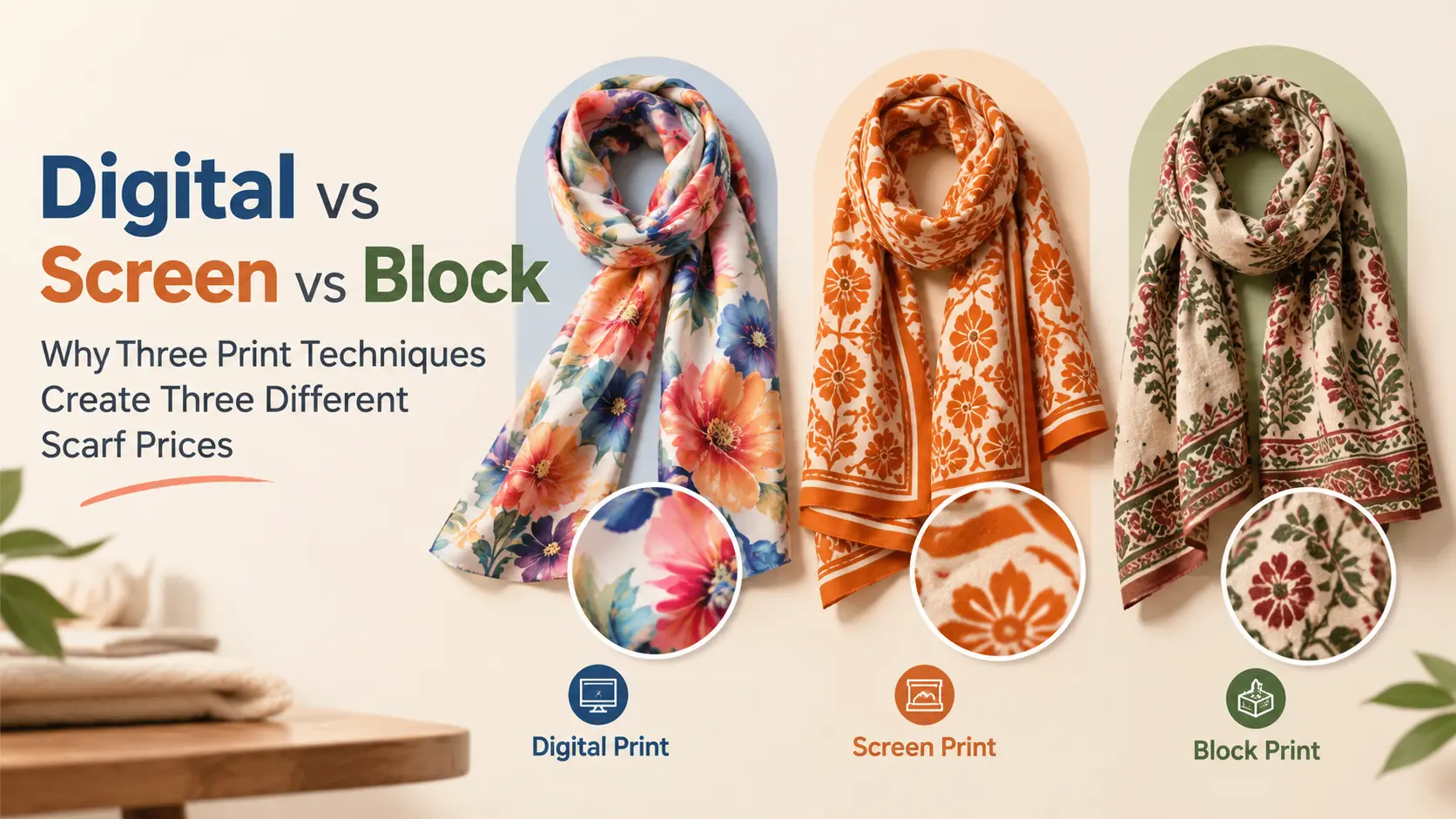
Two scarves can share the same fabric, the same size, and even the same design, yet land on a buyer’s quote sheet at prices that differ by three or four times. The reason is almost always the print technique. Digital, screen, and hand block printing each spend money in a different place, and once you see where that money goes, a scarf quotation stops looking random.
Here is the real cost logic behind each method, from a textile exporter printing scarves since 1950.
The Short Answer
The difference between digital vs screen print scarves comes down to one trade-off: setup cost versus running cost.
- Digital printing has almost no setup cost but a higher cost per metre, so it wins on small runs and complex, multicolour artwork.
- Screen printing has a high upfront cost (one screen per colour) but a very low cost per metre, so it wins on large volumes.
- Hand block printing has moderate tooling cost but the highest labour cost per piece, so it carries a craft premium at every quantity.
Industry research by textile consultancy Gherzi, published through SPGPrints, puts the general break-even point at roughly 1,200 metres per design. Below that length, digital is usually cheaper than rotary screen printing. Above it, screens start paying for themselves.
How Each Print Technique Actually Works
Digital Printing
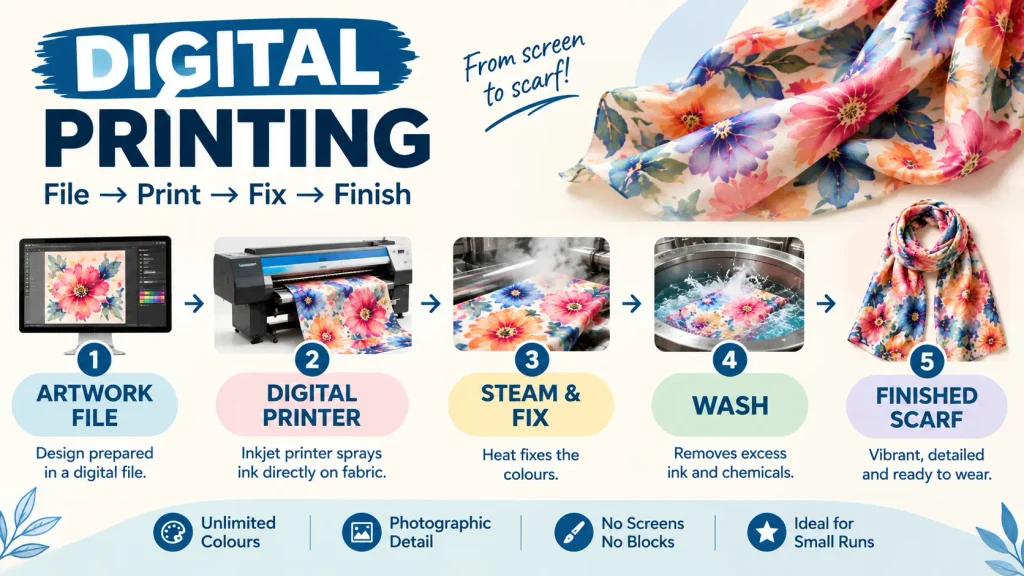
Artwork goes straight from a computer file to an industrial inkjet printer, which sprays reactive, acid or pigment ink directly onto pretreated fabric. The fabric is then steamed and washed to fix the colour.
- No screens, blocks or engraving required
- Unlimited colours, gradients and photographic detail in one pass
- Colourway changes cost nothing beyond a file edit
- Ink and pretreatment chemicals make each metre more expensive than screen
Screen Printing
A separate mesh screen is engraved for every colour in the design. Printing paste is pushed through each screen in sequence, either on a long flatbed table or on a rotary machine for continuous runs.
- One screen per colour, so a six-colour print needs six screens
- Very low ink and labour cost per metre once screens are ready
- Bold, saturated, opaque colour with excellent penetration on wool and viscose
- Each new colourway requires fresh colour mixing and a new strike-off
Hand Block Printing
Artisans carve the design into wooden blocks, usually teak or sheesham, with one block per colour. Artisans dip each block in dye and press it onto the fabric by hand, repeat after repeat, along the length of the scarf.
- Blocks take days to carve and last for many runs
- Output is limited by human speed, often a few dozen scarves per printer per day for multicolour designs
- Slight variations in alignment and depth give each piece a handmade character
- Natural and vegetable dyes are commonly used, which adds further process time
Head-to-Head Cost Comparison
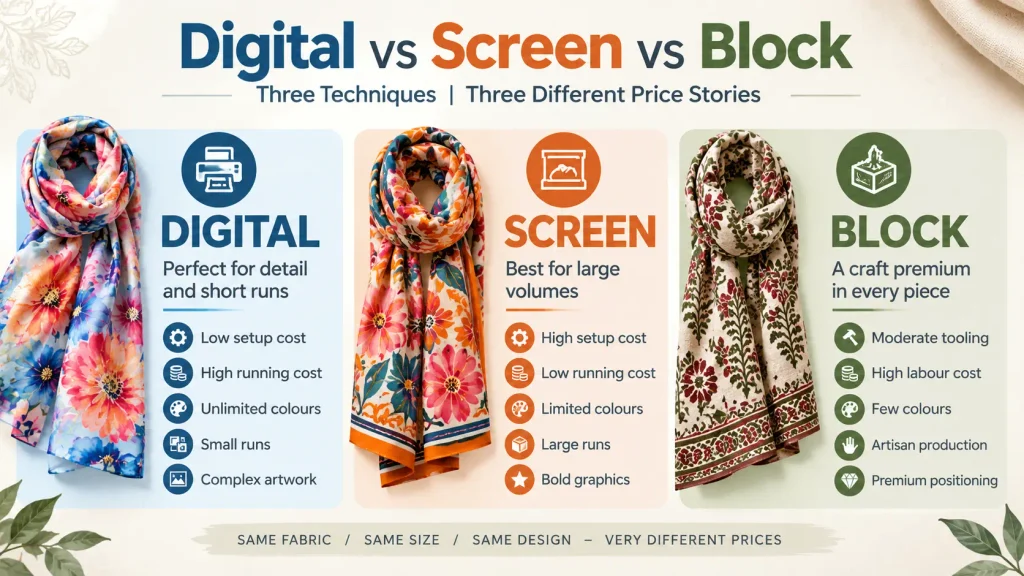
The table below summarises indicative print-only costs for a standard 70 x 180 cm scarf in Indian export production. Fabric, finishing, and packaging are excluded, and actual quotes vary by fabric type, colour count, and order size.
| Factor | Digital Print | Screen Print | Hand Block Print |
|---|---|---|---|
| Setup/tooling | Almost none | High: approx. $50 to $120 per screen, per colour | Moderate: approx. $25 to $80 per carved block |
| Print cost per scarf | Approx. $1.40 to $2.50 | Approx. $0.40 to $0.90 at volume | Approx. $2.50 to $5.00 |
| Colour limit | Unlimited | Practically 8 to 12 | Practically 3 to 6 |
| Typical MOQ per design | Low, often 100 to 300 pieces | High, often 1,000+ metres | Low to moderate, 100 to 500 pieces |
| Sampling speed | Fast, 3 to 7 days | Slower, 10 to 15 days | Slower, 10 to 20 days |
| Price behaviour at scale | Falls slightly | Falls sharply | Barely falls |
| Best suited to | Photographic art, short runs, many colourways | Large repeat orders, bold graphics | Artisan collections, heritage motifs |
The Five Cost Drivers That Separate the Three Prices
Five variables do most of the work when a buyer compares quotes.
1. Setup and Tooling
Screen printing front-loads its cost. Every colour needs an engraved screen, and that charge is the same whether you print 500 metres or 50,000. Digital skips this entirely. Block printing sits in between: carved blocks cost less than screens but still need to be paid for before the first scarf is printed.
2. Number of Colours
Colour count is the single biggest swing factor. In screen and block printing, every added colour means another screen or block plus another pass through production. In digital printing, a 2-colour design and a 20-colour design cost the same to print. This is why watercolour florals and photographic prints are almost always produced digitally.
3. Order Quantity
Spreading a fixed setup cost over more pieces is how screen printing becomes the cheapest technique on the floor. Digital prices stay relatively flat as volume grows, so the gap closes quickly once runs pass the break-even length. Block printing barely benefits from volume because every metre still needs a pair of hands.
4. Labour and Time
Digital and rotary screen printing are machine-driven, so labour per scarf is low. Hand block printing is labour-intensive by definition, which is why it cannot compete with screen printing on price at any volume.
5. Fabric and Finishing
Digital printing needs pretreated fabric to hold ink sharply, which adds a small cost per metre. Wool and wool blends often take screen printing beautifully because the paste penetrates deeper into the fibre. Block printing on natural dyes may need extra washing, drying and fixing, which extends lead time.
A Worked Example: 300 vs 3,000 Scarves
Consider the same six-colour floral design in two quantities. Figures are indicative print costs per scarf, with setup spread across the order.
| Scenario | Digital Print | Screen Print | Hand Block Print |
|---|---|---|---|
| Setup cost | $0 | 6 screens + strike-off ≈ $480 | 6 blocks ≈ $240 |
| 300 scarves: setup per piece | $0.00 | $1.60 | $0.80 |
| 300 scarves: running cost | $1.80 | $0.70 | $3.20 |
| 300 scarves: total per piece | $1.80 | $2.30 | $4.00 |
| 3,000 scarves: setup per piece | $0.00 | $0.16 | $0.08 |
| 3,000 scarves: running cost | $1.60 | $0.60 | $3.00 |
| 3,000 scarves: total per piece | $1.60 | $0.76 | $3.08 |
At 300 pieces, digital is the clear winner. At 3,000 pieces, screen printing costs less than half of digital. Block printing remains the premium option in both cases, which is exactly how it should be positioned at retail.
Colourways widen the gap further. Four colour stories cost digital nothing extra, while screen printing needs separate colour mixing and strike-offs for each one.
What You Get Beyond the Price Tag
Each technique also leaves a visible fingerprint on the finished scarf that affects how it sells.
- Detail and gradients: Digital reproduces photographic detail and soft colour fades that screens cannot match.
- Colour depth: Screen printing delivers rich, saturated colour, especially on wool, modal and viscose.
- Reverse side: Screen paste usually penetrates further, so the back of a heavier scarf looks fuller.
- Handfeel: Both digital and screen keep fabric soft when reactive or acid dyes are used. Pigment prints can feel slightly stiffer.
- Character: Block printing offers small irregularities that customers read as authenticity, a selling point for artisan and slow fashion labels.
- Consistency: Digital and screen give near-identical repeats across thousands of pieces. Block prints vary slightly by design.
Which Technique Fits Which Buyer?
Choose digital printing if you:
- Order under 1,000 pieces per design
- Work with photographic, painterly or multicolour artwork
- Test several colourways before committing to volume
- Need fast sampling for a trade fair or seasonal launch
Choose screen printing if you:
- Reorder bestsellers in large volumes every season
- Use bold graphics, paisleys or geometric repeats with limited colours
- Sell through high-volume retail where a few cents per piece matters
- Want deep colour on wool or heavier winter fabrics
Choose hand block printing if you:
- Sell artisan, heritage or sustainable collections
- Can position the product at a premium retail price
- Accept slightly longer lead times and small variations
- Tell a craft story as part of the brand
How an Experienced Manufacturer Optimises the Choice
A capable Printed Scarves Manufacturer India that buyers trust will rarely lock a collection into a single technique. The smarter approach is to plan the full lifecycle of a design.
- Sample digitally, scale with screens: A new print is sampled and test-sold in digital. Once it proves itself, it moves to screen for reorders, cutting the unit cost sharply.
- Simplify colours for screen: A designer can often reduce a twelve-colour artwork to six without losing its appeal, which halves the screen investment.
- Split by season: Lightweight summer printed scarves in viscose and modal often suit digital, while heavier winter printed scarves in wool and acrylic blends benefit from screen depth.
- Combine techniques: Some collections pair a screen-printed base with digital accents, or reserve block printing for a small capsule within a larger line.
Bright Star handles these decisions in-house as part of its wider factory capabilities. For brands developing their own artwork, private label scarf development typically starts with this exact technique conversation before any sample is made.
Printing is also only one variable. Buyers comparing printed options against woven alternatives will find that jacquard and woven scarves follow a completely different cost logic, driven by loom setup and yarn rather than ink. Across both categories, working with an established Scarf Manufacturer India makes it easier to balance price, quantity, and design ambition in one collection.
Conclusion
The price gap between digital, screen and block printed scarves is not a mystery markup. Digital trades setup cost for a higher running cost, screen trades a large upfront investment for the lowest cost at volume, and block printing trades speed for craft. Quantity, colour count and retail positioning decide the right choice, and the best collections often use more than one technique.
Frequently Asked Questions
What is the main difference between digital and screen printed scarves?
Digital printing sprays ink directly from a file with no setup, suiting short runs and complex art. Screen printing uses one screen per colour, costing more upfront but far less per scarf at volume.
Which scarf printing method is the cheapest?
Screen printing is cheapest for large orders, typically above 1,000 metres per design. Digital printing is cheaper for small runs and multicolour designs. Hand block printing is the most expensive at almost every quantity.
Why are hand block printed scarves more expensive?
Every repeat is pressed by hand, one colour block at a time. Output per artisan is limited, blocks must be carved in advance, and natural dye processes add time, so labour drives the premium.
Does the number of colours affect scarf printing cost?
Yes, heavily for screen and block printing, where each colour needs its own screen or block and production pass. Digital printing costs the same whether a design uses two colours or twenty.
What is the MOQ for digitally printed scarves from India?
Many Indian manufacturers accept digital printed scarf orders from around 100 to 300 pieces per design. Exact minimums depend on fabric, size, and whether the fabric is stocked or developed specially.
Is digital printing good quality for scarves?
Yes. Modern reactive and acid digital printing delivers sharp detail, smooth gradients, and good colourfastness on silk, viscose, modal, and wool. Results depend on correct fabric pretreatment, steaming and washing after printing.
Can a scarf design move from digital to screen printing later?
Yes, and it is a common strategy. Brands test a design in digital at low volume, then shift proven bestsellers to screen printing for reorders, which lowers the cost per scarf considerably.
Which print technique works best on wool scarves?
Screen printing often gives wool the deepest, most saturated colour because paste penetrates the fibre well. Digital printing also works on wool when the fabric is properly pretreated, especially for detailed artwork.
How long does sampling take for each technique?
Digital samples are usually ready within 3 to 7 days. Screen printed strike-offs take around 10 to 15 days because screens must be engraved. Block printing samples need time for carving and dyeing.
Are block printed scarves suitable for large retail orders?
They can be, but capacity and price limit scale. Block printing suits premium or artisan lines with moderate quantities. For large retail volumes, screen printing offers better consistency, speed, and unit cost.