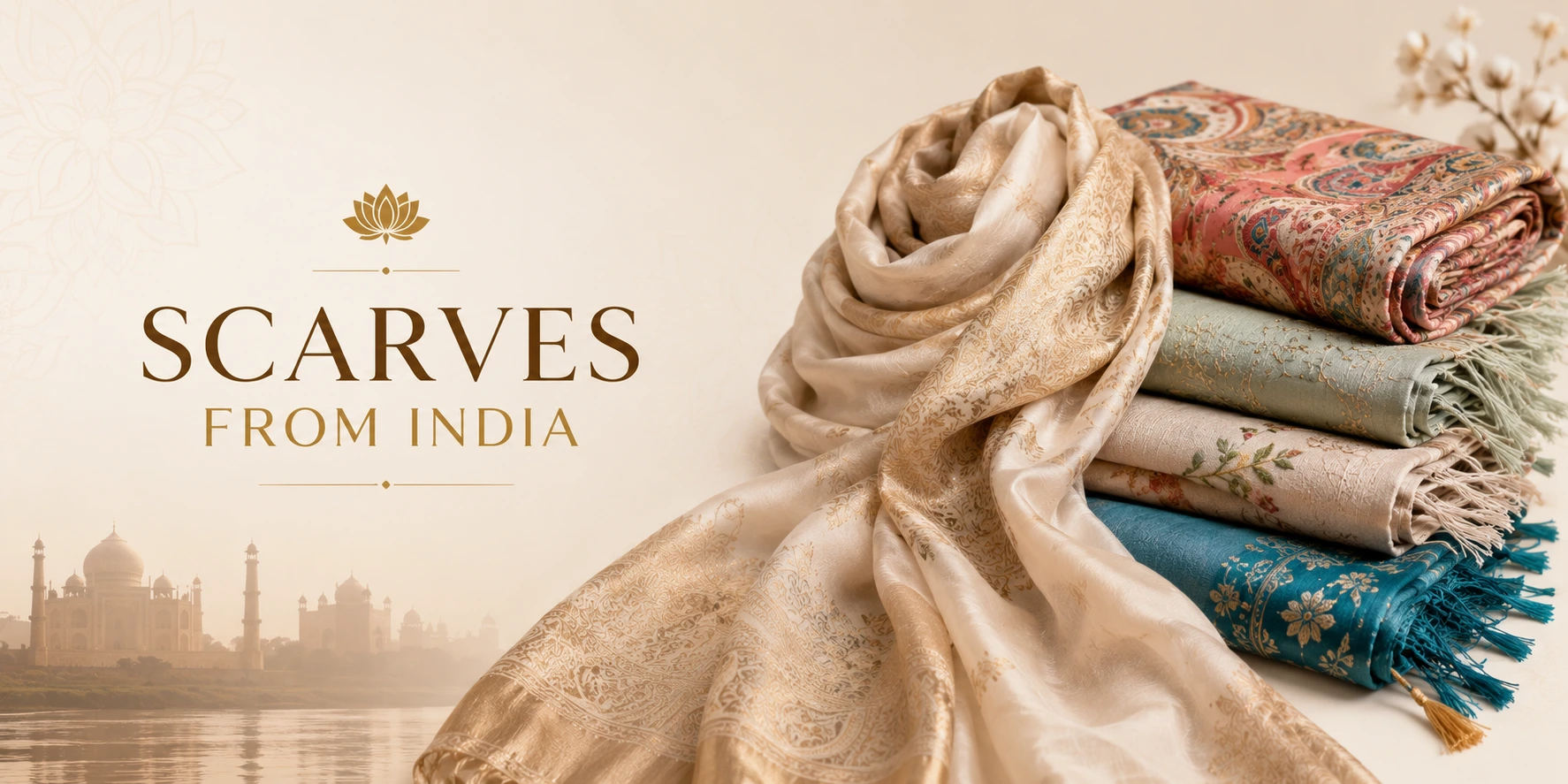
India has been making scarves for centuries. And not just one kind. Silk from Varanasi. Pashmina from Kashmir. Block-printed cotton from Jaipur. The range is extraordinary.
But if you are a buyer, a fashion brand, or simply someone researching where quality scarves actually come from, the real question is: why does India keep coming up as the go-to sourcing origin?
This guide answers that directly. You will learn what makes Indian pure silk scarves distinctive, how India compares to China as a silk source, which regions produce which scarf types, and what to check before placing a wholesale order. By the end, you will have a clear picture of why global buyers consistently choose India, and what makes that choice worth making.
India’s Scarf-Making Heritage: Why Origin Matters for Quality
Think of it like wine. You can grow grapes anywhere. But Burgundy and Bordeaux mean something specific. The soil, the climate, the generations of knowledge. Indian scarf-making works the same way.
Different regions in India specialise in different craft traditions. And each one has built decades, sometimes centuries, of concentrated expertise.
Kashmir is where pashmina and fine wool shawls come from. The region sits at high altitude, surrounded by the Himalayan range, and has been producing some of the world’s most sought-after woven textiles for over 500 years. The craft is generational. Techniques are passed from parents to children, refined over time, not learned in a six-week factory training.
Varanasi, in Uttar Pradesh, is India’s silk weaving capital. Banarasi silk sarees and scarves are globally recognised for their rich texture, intricate brocade work, and that distinctive weight and sheen that mass-market silk simply does not deliver. The looms here have been running since the Mughal era.
Jaipur, in Rajasthan, is the home of block-printed cotton scarves. The block printing tradition uses hand-carved wooden blocks and natural dyes. Every piece carries a subtle variation. That is not a defect. It is the point.
And Delhi serves as the design, coordination, and export hub. It connects regional manufacturing clusters to international buyers and gives brands a single point of contact for multi-product sourcing.
So when someone asks “where are Indian scarves traditionally made?” the honest answer is: everywhere, and each place does something different remarkably well.
These are sometimes called dupattas, stoles, phulkari, or pashmina depending on the region and technique. The words reflect how deep the craft runs. This is not a generic textile industry. It is a geography of specialisation.
Pure Silk Scarves from India: What Makes Them Worth Buying
Let’s talk about silk specifically. Because this is where Indian manufacturing truly earns its reputation.
India is the only country in the world that produces all four main varieties of silk: Mulberry, Tussar, Eri, and Muga. That is not a marketing claim. It is a geographic and biological fact. No other country can say the same.
Mulberry silk is the most commercially produced variety. It is smooth, lustrous, and drapes beautifully. It is what most buyers picture when they think “pure silk scarf.” Tussar is wilder, more textured, with a natural gold tone. Eri is softer and warmer, often used for blended scarves. Muga, grown exclusively in Assam, is possibly the rarest commercial silk in the world. It has a natural golden sheen that deepens over time with wear.
Quality markers to look for in pure silk scarves from India:
When buyers ask “how do you tell if a scarf is real silk?”, there are a few reliable signals. Pure silk feels cool to the touch initially and warms up as you wear it. It has a natural sheen that shifts with light direction. The burn test is definitive: pure silk burns like hair, produces a fine ash, and smells faintly of singed protein. Synthetic alternatives melt, ball up, or smell of chemicals.
For wholesale buyers, look at edge finishing and weave consistency. A quality Indian silk scarf will have clean rolled or stitched edges, even weave density, and consistent colour across the piece. Uneven tension in the weave is a flag.
One trend worth noting for fashion retail buyers: pure silk scarves for hair are having a significant moment. Customers are increasingly aware that silk’s smooth surface reduces friction, prevents hair breakage, and retains moisture. India’s silk scarf production is well-positioned to serve this growing category, particularly in the premium and gifting segments.
India vs China: Which Is the Better Source for Silk Scarves?
This is the question buyers are quietly researching. And almost no editorial content handles it honestly. So let’s do that here.
China is the world’s largest silk producer by volume. Full stop. It accounts for roughly 70-80% of global raw silk production. It has a massive, mature, and highly efficient silk manufacturing ecosystem. If you need large volumes at low cost, China has infrastructure advantages that are hard to argue with.
India is the world’s second largest silk producer. But the meaningful distinction is not about volume. It is about variety and positioning.
India produces all four main silk types. China predominantly produces Mulberry silk. That matters to buyers who want to differentiate their product range or offer something with genuine provenance and story.
Indian silk, particularly Muga and Tussar, occupies the premium and craft segment of the market. It is sought after by buyers who need a quality story, not just a material. Banarasi silk has GI (Geographical Indication) protection in India, which means it carries verifiable regional authenticity, similar to how Champagne can only come from the Champagne region of France.
Chinese silk dominates mass-market and mid-range volume production. Indian silk competes differently. It is positioned on artisan heritage, variety, and design capability.
The honest answer to “which is better”? It depends on what you are buying for. If you need high-volume, price-optimised commodity silk scarves, China has advantages. If you need premium silk with craft provenance, design differentiation, and material variety, India is the stronger choice.
Both can be right. They serve different buyer needs.
Beyond Silk: The Full Range of Indian Scarves Worth Buying
Silk gets the most attention. But limiting your scarf sourcing view to silk alone means missing a significant part of what Indian manufacturers do well.
| Scarf Type | Key Region | Material | Best For |
|---|---|---|---|
| Pashmina / Wool | Kashmir | Fine Himalayan wool | Luxury winter scarves, boutique brands |
| Block-Printed Cotton | Jaipur, Gujarat | Cotton, natural dyes | Bohemian, artisan, summer retail |
| Embroidered | Lucknow, Kashmir | Silk, wool, cotton base | Premium gifting, fashion retail |
| Blended Stoles | Delhi, Varanasi | Silk-wool, silk-cotton | Versatile mid-range retail |
Are pashmina scarves from India? Yes. Authentic pashmina comes from the Changthangi goat, which lives in the high-altitude plateaus of Ladakh and the Himalayan region of India and Nepal. The fibre is combed from the undercoat of the goat, not sheared. It is extraordinarily fine, measuring 12-16 microns in diameter, compared to around 20 microns for fine Merino wool. Genuine Indian pashmina has GI protection. If a “pashmina” scarf is priced suspiciously low, it almost certainly contains synthetic fibre blends.
The history of the Indian scarf is long. Woven shawls from the Kashmir Valley were documented as gifts exchanged between Mughal emperors and foreign dignitaries in the 16th century. European traders in the 17th and 18th centuries brought Kashmir shawls back to Europe, where they sparked a fashion movement so significant that French manufacturers in Paisley attempted to replicate the patterns. The Paisley motif you see on scarves globally today? It originates from Kashmiri buta, the teardrop boteh pattern.
That is the kind of design heritage you are working with when you source from India.
Why Global Buyers and Brands Choose Indian Scarf Manufacturers
Craft heritage is the emotional reason. Here are the practical ones.
Material diversity: No other country offers as many scarf-worthy fibres in a single geography. Silk, pashmina, fine wool, cotton, and blends are all available from Indian manufacturers. For a brand looking to build a cohesive scarf range across seasons, India can serve the entire product matrix.
Design and craft capability: Embroidery, block printing, woven brocade, digital printing on silk. All of these are available in-house or within close sourcing proximity through established clusters. This matters enormously for brands that want design involvement, not just commodity production.
Competitive wholesale pricing relative to European manufacturers: Indian pricing is not always the lowest globally. But relative to comparable quality from European manufacturing, it is significantly more accessible. For premium and mid-premium brands, this creates a strong quality-to-cost ratio.
Private label and custom production flexibility: Indian manufacturers, particularly in Delhi’s export clusters, are highly experienced with private label production. Custom labels, bespoke packaging, specific colour matching, and minimum order quantity negotiation are all standard parts of the conversation.
Export infrastructure: India’s textile export industry has decades of documentation, compliance, and logistics experience behind it. GST handling, export certifications, quality inspection processes, and international shipping coordination are embedded in how established manufacturers operate.
For brands looking to source silk scarves for ladies or build a full premium scarf range, India offers the combination of quality, variety, and sourcing reliability that keeps buyers returning. Manufacturers with long track records, like those based in Delhi’s Okhla export hub, bring decades of export experience to every order.
What to Look for When Buying Scarves from India
You have decided to source from India. Good. Now the practical part.
1. Verify pure silk or pure wool claims.
Ask for the Silk Mark certification for pure silk products. This is issued by the Central Silk Board of India and is the official authentication mark. For pashmina, the Woolmark or GI certification is the benchmark. If a supplier cannot provide documentation, treat the material claim with caution.
2. Assess weave and finish quality.
Request a physical sample before committing to production quantities. Run your fingers across the weave. Look for evenness. Hold the scarf to light and check for density consistency. A high-quality silk scarf should have no visible weave irregularities or thin patches.
3. Check edge and fringe finishing.
This is where quality shortcuts show up fast. Rolled edges should be tight and even. Fringe should be cut cleanly and secured at the base. Loose threads at the hem are a flag. Check that embroidery or print does not bleed to the reverse where it is not intended to.
4. Evaluate colour consistency and colourfastness.
Check colour against multiple samples from the same batch. Variation between pieces in the same production run is a quality control issue. For colourfastness, ask for the wash test standard the manufacturer uses. Silk that bleeds significantly in the first wash is not production-ready.
5. Clarify MOQ and the sampling process.
Established Indian export manufacturers will typically have defined minimum order quantities per style or colour. Understand these upfront. A good supplier will offer a proper sampling process before bulk production, not just photos.
6. Review export documentation capability.
For international buyers, verify the manufacturer’s export documentation process. GST clearance, certificate of origin, material composition declarations, and quality inspection reports should all be standard. Any hesitation here is worth noting.
FAQs
What country is famous for silk scarves?
China and India are the two countries most associated with silk scarf production globally. China leads in volume. India leads in variety, producing all four main silk types, and is particularly known for premium and artisan silk scarves from regions like Varanasi.
Where are Indian scarves traditionally made?
Different regions specialise in different products. Kashmir is known for pashmina and fine wool. Varanasi produces Banarasi silk. Jaipur is the centre for block-printed cotton scarves. Lucknow is associated with chikankari embroidery. Delhi serves as the export and design coordination hub.
What are those Indian scarves called?
Indian scarves go by several names depending on the type and region. Pashmina refers to fine Kashmir wool scarves. Stoles are long draping scarves often made in silk or blended fabric. Dupattas are a traditional long scarf worn in South Asian fashion. Phulkari refers to embroidered scarves from Punjab.
What is the history of the Indian scarf?
Indian scarf-making has roots going back over 500 years, particularly in Kashmir, where pashmina shawls were exchanged as royal gifts during the Mughal period. Kashmiri shawls reached Europe in the 17th and 18th centuries and directly influenced Western fashion, giving rise to the Paisley motif now seen globally.
Is silk from India or China?
Both countries produce silk, but they serve different market segments. China produces the largest volume of raw silk globally, predominantly Mulberry silk. India is the world’s second largest silk producer and the only country that produces all four main silk varieties: Mulberry, Tussar, Eri, and Muga.
What is the rank of India in silk?
India is the world’s second largest producer of silk after China. It is also the world’s largest consumer of silk. Uniquely, India is the only country that produces all four commercially recognised silk varieties.
Are pashmina scarves from India?
Yes. Authentic pashmina originates from the Changthangi goat found in the Himalayan region, primarily Ladakh in India and the high-altitude plateaus of Nepal. The fibre is extraordinarily fine at 12-16 microns. Genuine Indian pashmina carries GI protection. Much of what is sold as “pashmina” commercially contains synthetic blends.
How do you tell if a scarf is real silk?
The burn test is the most reliable method: pure silk burns like hair, leaves a crushable ash, and smells of singed protein. Synthetic fibres melt and ball up. For buyers, the Silk Mark certification from India’s Central Silk Board is the formal authentication marker. Visual cues include a shifting sheen under directional light and a cool-to-touch feel.
What brand makes the best scarves?
For wholesale buyers, the more relevant question is what makes a manufacturer reliable. Look for long export track records, documented quality certifications, a clear sampling process, and experience with your specific product category. Brands are built on reliable manufacturers, not the other way around.
Conclusion
India’s combination of craft heritage, material variety, design capability, and export experience makes it one of the world’s most reliable sourcing origins for scarves. Whether you are building a premium pure silk range, a luxury pashmina collection, or a diverse seasonal scarf programme, India offers the breadth and the depth to support it.
The quality and provenance are there. The manufacturing infrastructure is there. And for brands that want to source scarves they can stand behind, Indian manufacturers offer exactly that.
If you are looking to source pure silk or premium scarves from India for your brand or retail range, get in touch with Bright Star to discuss your requirements. Explore the scarves range or contact the team directly to start the conversation.