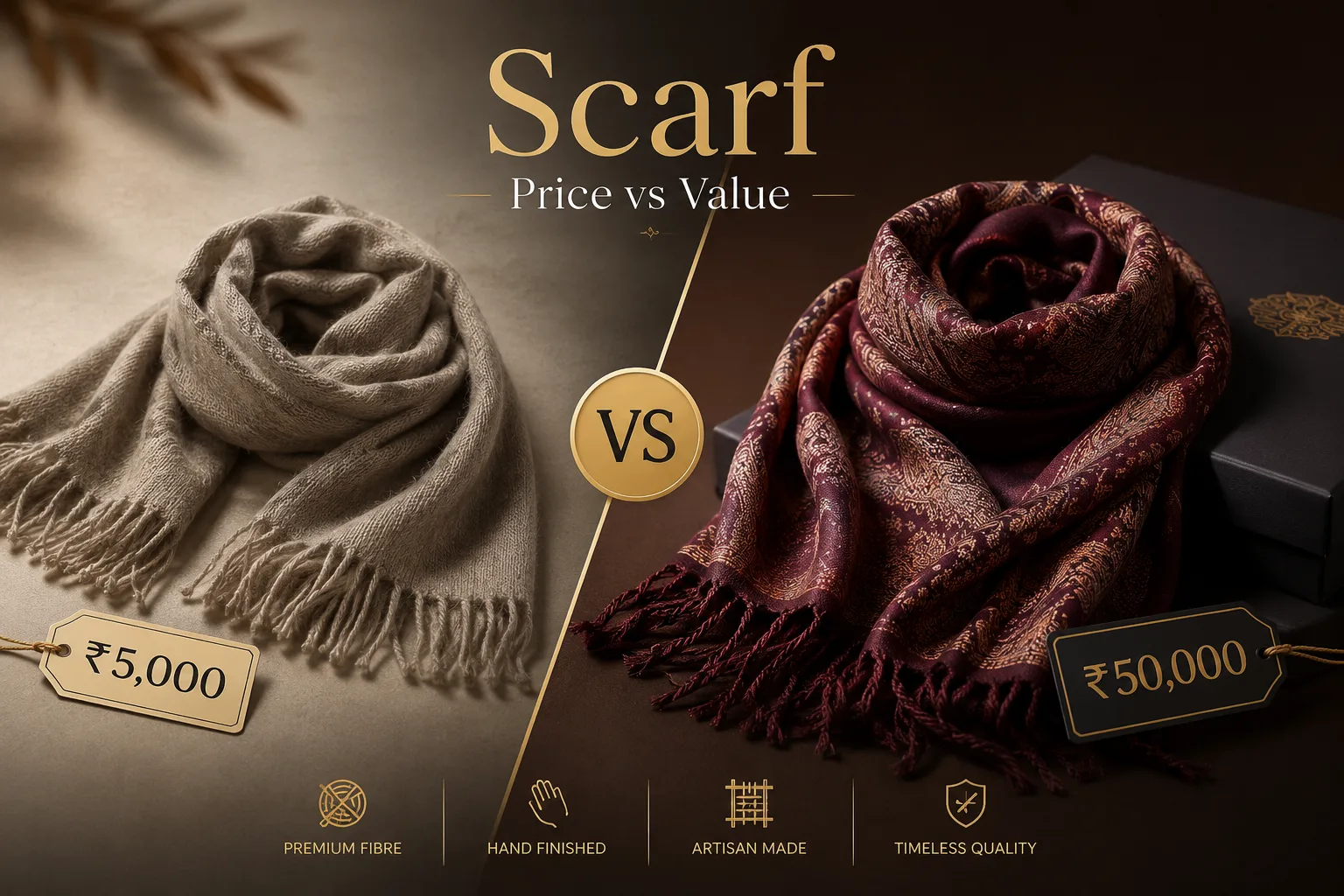
Two scarves sit on a shelf. Same size, same colour, roughly the same look. One is priced at ₹5,000, the other at ₹50,000. A glance tells you almost nothing about why. Even a careful look often does not explain it. So what actually justifies a ten times price gap between two pieces of fabric that appear so similar?
We manufacture scarves, shawls, and stoles at Bright Star for wholesale and private label brands around the world, so we spend most of our week answering this exact question. The answer is not simply “brand” or “quality” or “materials”, although all three matter. The real breakdown is more useful, more measurable, and more honest than any of those single-word explanations.
This guide walks through where every rupee actually goes in a scarf, from raw fibre to retail floor, so you can shop or source with your eyes open.
The Simple Answer (Which is Not Simple)
There are only four things that meaningfully change between a ₹5,000 scarf and a ₹50,000 scarf: the fibre, the construction, the finishing, and the distribution model. Brand story is powerful, but it usually sits on top of one of these four factors, not next to them.
The rest of this guide breaks each pillar down at both price points, so you can see exactly what the extra 45,000 rupees is buying.
What Goes Into a ₹5,000 Scarf
At this price point, the manufacturer is working with tight margins and mass-market expectations. Corners are cut, but not always where you might expect.
Fibre Choice
A ₹5,000 scarf rarely contains long-fibre cashmere or high-grade silk. The most common inputs are:
- Acrylic, polyester, or viscose blends
- Short-fibre wool, often under 30 mm
- Mixed-origin cashmere, blended down with wool or synthetics
- Cotton or linen for warmer climates
These fibres are functional and can look attractive, but they wear differently. Expect visible pilling, colour fade after washing, and a shorter usable lifespan.
Manufacturing
Production at this tier is fully mechanised. Automated looms weave the fabric, industrial cutters shape it, and machine sewing finishes the seams. A single scarf can move from raw yarn to packaged product in under an hour.
Finishing
Hems are machine-stitched, prints are digitally transferred, and any embellishment is applied by machine. There is no hand-finishing, no hand-rolled edge, and no time-intensive quality control on individual pieces.
Distribution and Margins
A large share of the retail price at this tier goes to distribution: warehouse costs, e-commerce fees, marketplace commissions, and retailer margin. The actual product cost at the factory gate is often a small fraction of the shelf price.
What Goes Into a ₹50,000 Scarf
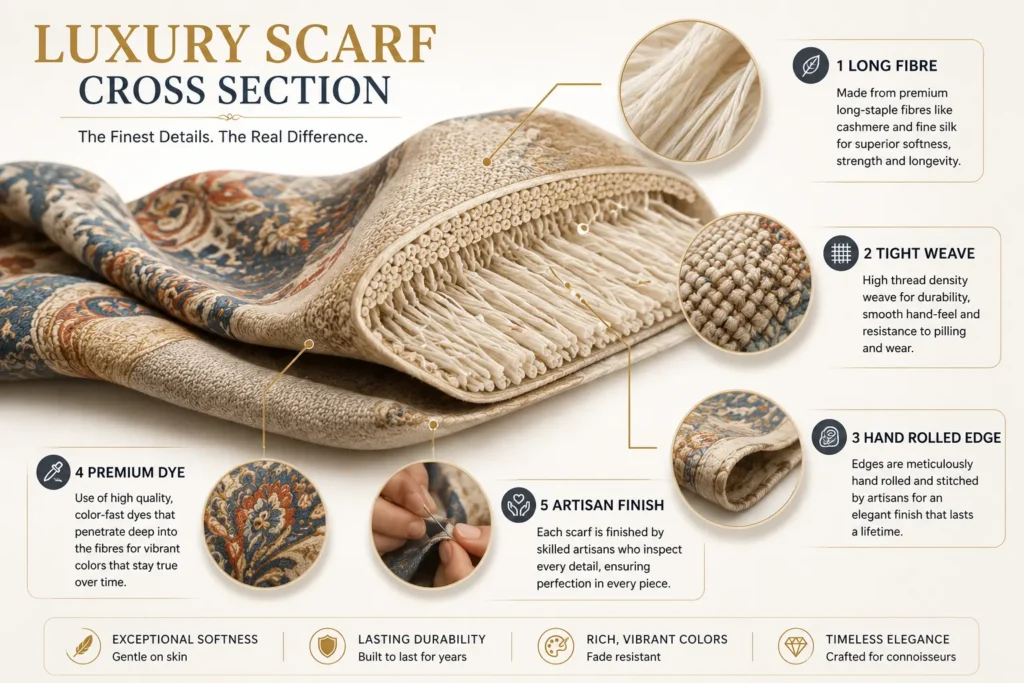
At this price, the maths flips. The raw material and craft time make up a much larger share of the cost, and the brand carries most of the rest.
Fibre Choice
The fibre alone can account for 15 to 25 percent of the final cost. Common inputs include:
- Long-fibre cashmere from Mongolia, Kashmir, or Nepal, 36 mm and above
- Silk twill in 14 to 19 momme, sometimes hand-woven
- Fine merino wool at 17.5 microns or less
- Rare fibres such as pashmina, vicuña, or hand-spun tussar silk
These fibres cost significantly more per kilogram, and the mills that supply them are limited in number.
Manufacturing
Production often involves handloom weaving, hand-block printing, or artisan techniques that cannot be automated. A single scarf can take a day, a week, or even a month to complete, depending on the technique.
Finishing
Hems at this tier are hand-rolled, which alone can take 30 to 45 minutes per scarf. Prints are often applied through flat-bed screen printing, one screen per colour, using up to 40 or more screens for a complex design. Every piece is checked individually for defects.
Brand, Design, and Story
This is where the largest single cost bucket lives. Design royalties, archive maintenance, boutique real estate, marketing campaigns, and packaging together often account for 40 to 50 percent of the retail price.
Side by Side: Where Your Money Goes
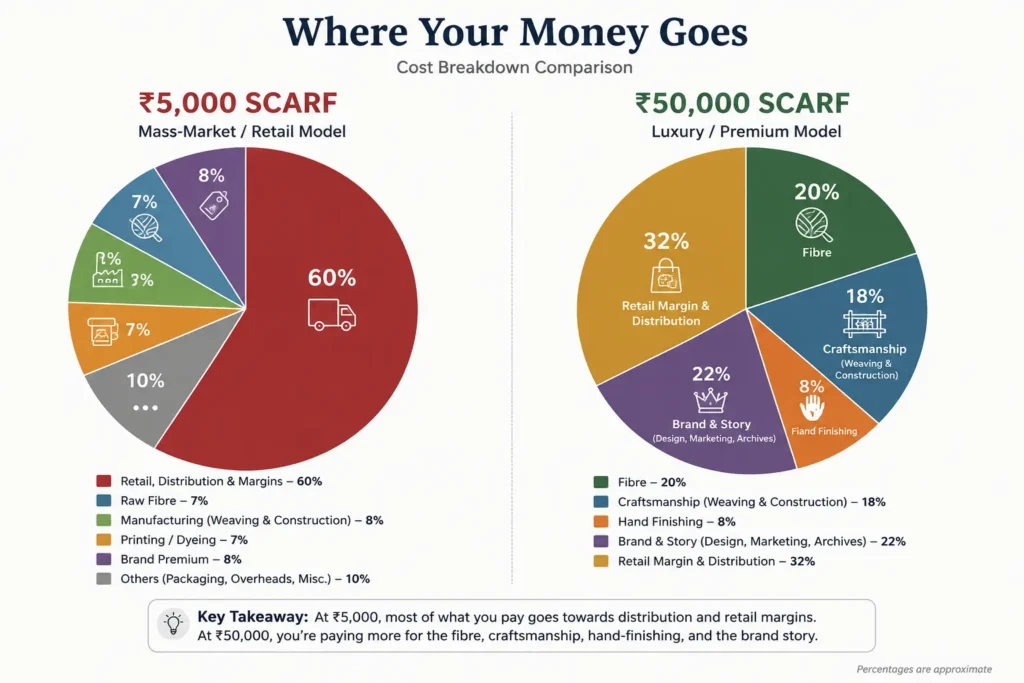
Here is roughly how each rupee gets allocated at both price points.
| Cost Component | ₹5,000 Scarf | ₹50,000 Scarf |
| Raw fibre | 5 to 8 percent | 15 to 25 percent |
| Weaving and construction | 5 to 10 percent | 15 to 20 percent |
| Printing or dyeing | 5 to 8 percent | 10 to 15 percent |
| Hand-finishing | Minimal or none | 5 to 10 percent |
| Design and archives | 2 to 5 percent | 5 to 10 percent |
| Retail, distribution, and margins | 55 to 65 percent | 25 to 35 percent |
| Brand premium | 5 to 10 percent | 15 to 25 percent |
A useful takeaway: a large share of the ₹5,000 scarf goes to distribution, not fabric. And a large share of the ₹50,000 scarf goes to brand and story, not fabric either.
Where the Real Value Lives
Both extremes have their place. But most buyers, whether individuals or brands, will find the best value somewhere in the middle, and that middle is usually accessed through direct sourcing rather than retail.
A scarf that costs a manufacturer ₹2,500 to produce, made with real cashmere or silk, hand-finished, and quality-checked, is often sold at retail for ₹25,000 or more. The same scarf at wholesale costs a fraction of that, which is why private label brands can price competitively and still command healthy margins.
What Bright Star Delivers as a Direct Manufacturer
Bright Star has been producing scarves, shawls, stoles, and home textiles from India since 1950. Because we operate at the manufacturing level, buyers get the raw quality and hand-finishing associated with ₹50,000 scarves without the retail multiplier stacked on top.
Here is what direct sourcing through Bright Star gives you:
- Choice of fibre grade: Silk twill in 12 to 19 momme, long-fibre cashmere at 36 mm and above, fine wool, and pashmina blends
- Choice of construction: Handloom weaving, screen printing, digital printing, and hand-block techniques
- Choice of finishing: Machine hems for mass-market lines, hand-rolled hems for premium collections
- Full traceability: Origin, mill, and fibre grade documented per order
- Custom design and private label: Colours, prints, packaging, and labelling built around your brand
- Flexible minimums: From boutique runs of 500 pieces to large export orders
You can explore the full range on our stoles manufacturing page and companion collections in shawls, throws, and cushion covers.
What to Look For at Each Price Tier
If you are buying at retail rather than sourcing at wholesale, here is a rough guide to what should reasonably be included at each price point.
₹1,000 to ₹5,000
Expect synthetic blends, machine finishing, and short lifespans. Suitable for seasonal fashion but not investment pieces.
₹5,000 to ₹15,000
Expect real wool or cotton, some cashmere content, machine construction with occasional hand touches, and reasonable durability across a couple of seasons.
₹15,000 to ₹30,000
Expect genuine long-fibre cashmere, silk twill, or fine wool blends, better construction, and hand-finished edges on some pieces.
₹30,000 and above
Expect the finest fibres, hand-finishing throughout, verified origin, artist-designed prints, and long-term durability that easily lasts a decade.
For Brands and Retailers: How to Choose Your Price Point
If you are building your own scarf line, the right price point is a function of your target margin, your customer, and your brand story. A few practical rules apply:
- Set the fibre grade first: The fibre determines the ceiling for pricing and quality claims
- Match construction to volume: Handloom pieces cannot scale like machine-woven ones
- Choose finishing based on channel: Hand-rolled hems justify premium retail; machine hems fit fast-turn e-commerce
- Document everything: Origin, mill, and fibre certification enable premium pricing later
- Plan for lead time: Premium production requires 8 to 12 weeks; fast production runs in 3 to 4 weeks
The right partner supports both ends of this spectrum, which is where a diversified manufacturer becomes more useful than a single-tier factory.
Ready to Source at Your Price Point?
Whether your brand sits at ₹5,000, ₹50,000, or somewhere in between, the fibre, construction, and finishing decisions are yours to make. As a direct manufacturer, Bright Star can build scarves at any of those tiers without the retail multiplier stacked on top.
Explore Bright Star’s full range at bright-star.co.in or reach out for a wholesale quote tailored to your next collection.
Frequently Asked Questions
Why do some scarves cost ten times more than others?
The price gap between a ₹5,000 and ₹50,000 scarf comes from four factors: fibre grade, construction method, hand-finishing, and brand or distribution overhead. Retail margins amplify each factor significantly across the tiers.
Are expensive scarves always of better quality?
Not always. A large share of expensive scarves reflects brand premium and retail overhead rather than fabric quality. Direct-from-manufacturer sourcing often delivers the same fibre and finishing at a much lower cost.
Can a ₹5,000 scarf ever be good quality?
Yes, a ₹5,000 scarf can be genuinely good if the brand sources smartly and skips heavy retail markups. Look for real wool or cotton content, clean stitching, and honest fibre labelling on the tag.
What is the cheapest real cashmere scarf you can buy?
Genuine long-fibre cashmere scarves rarely retail for less than around ₹8,000 to ₹10,000 without cutting corners on fibre length. Anything much cheaper likely contains blended, short-fibre, or mislabeled cashmere content instead.
Why do luxury scarves have hand-rolled hems?
Hand-rolled hems take 30 to 45 minutes per scarf and give the edge a soft, three-dimensional finish that machines cannot replicate. This craftsmanship is a reliable signal of premium construction quality.
What is the highest cost in a luxury scarf?
For most luxury scarves, the highest single cost is brand and distribution overhead, not the fabric itself. This includes marketing, boutique real estate, packaging, and retail margin stacked across the supply chain.
Is it better to buy from a brand or a manufacturer directly?
For individual buyers, brands provide design and retail experience. For businesses building a scarf line, buying direct from a manufacturer like Bright Star delivers premium quality without the luxury retail price multiplier.
What minimum order does Bright Star accept for custom scarves?
Bright Star supports flexible minimum orders for genuine buyers, typically starting from around 500 pieces. Both boutique brands and larger retailers can source scarves matched to their scale, budget, and quality tier.
How long does premium scarf production take?
Premium scarf production at Bright Star, including sampling, printing approval, hand-finishing, and quality control, typically takes 8 to 12 weeks. Faster machine-finished production runs can be completed in 3 to 4 weeks.
Do Bright Star scarves qualify as premium retail products?
Yes, Bright Star scarves are manufactured to standards used by premium retailers, boutiques, and private label brands globally. Long-fibre cashmere, hand-rolled hems, and traceable sourcing all meet international luxury retail expectations.