
You check into a five-star hotel, drop your bag and sink into the sofa. The cushion behind your back is plump, heavy and perfectly square. It holds its shape when you lean on it and bounces back the moment you stand up. At home, your cushions slump within weeks and look tired within a year.
The difference is not magic, and it is not just a nicer fabric. Behind every hotel cushion sits a set of specifications, safety standards, spare stock and replacement cycles that most guests never imagine. Add it all up and a single luxury hotel cushion can cost several times more than the one on your sofa, and close to ten times more once you count its full working life.
The Short Answer: Why Hotel Cushions Feel Different
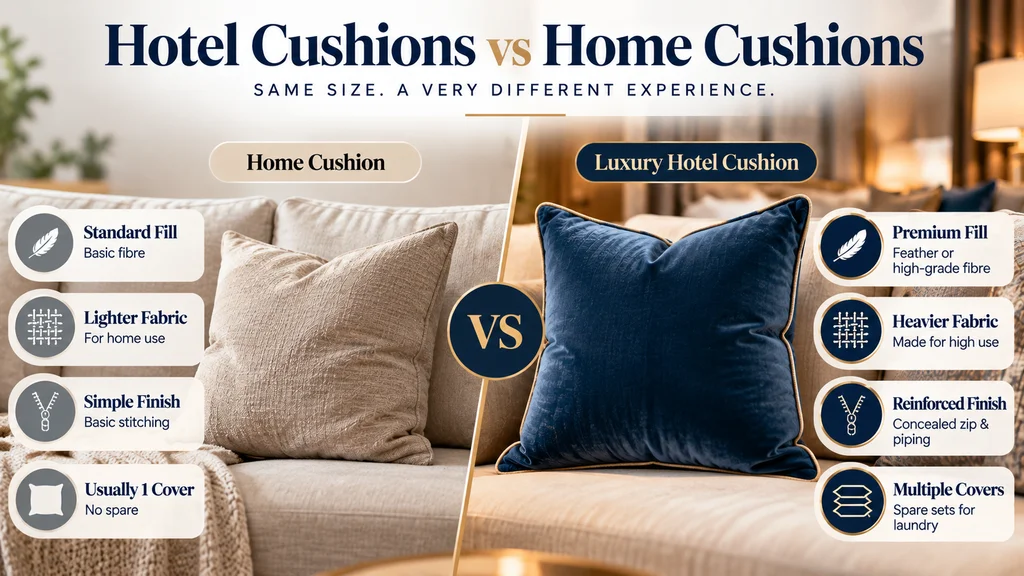
Hotel cushions feel different because they are specified for performance, not just looks. The key differences are:
- Oversized, high-quality inserts, usually feather and down blends, filled to a size larger than the cover
- Heavier, tighter fabrics chosen to survive constant use and commercial laundering
- Construction details such as concealed zips, reinforced seams, and piping that holds the edge
- Fire safety compliance required for public and commercial spaces in many countries
- Multiple spare covers for every cushion, so one is always clean and ready
Each of these adds cost. Together, they explain why a hotel cushion feels firmer, looks sharper, and lasts far longer.
The Secret Is Inside: Fill and Insert Size
The One-Size-Up Rule
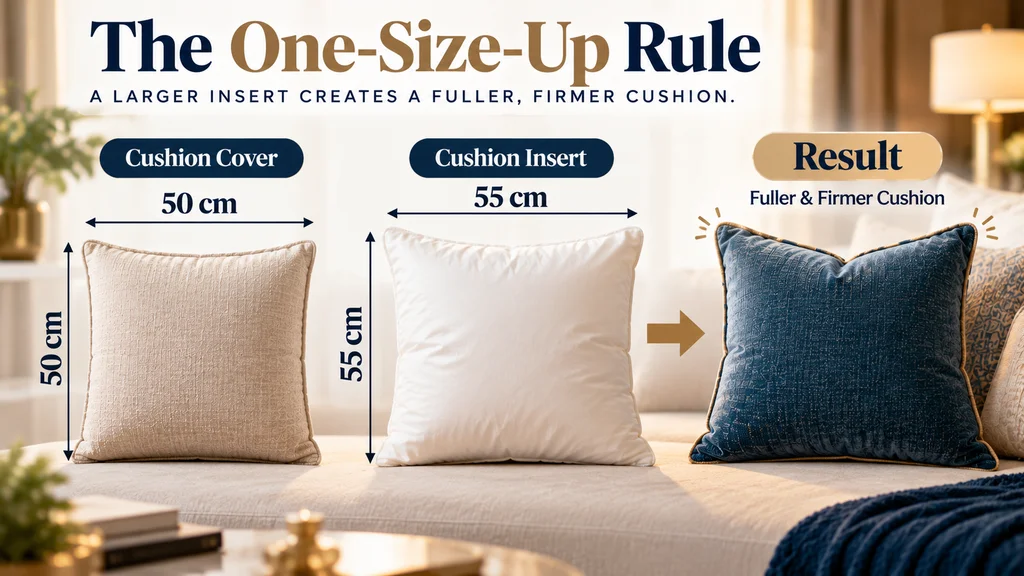
The single biggest reason hotel cushions look full is a simple trick: the insert is larger than the cover. A 50 x 50 cm cover is commonly filled with a 55 x 55 cm insert. The extra volume pushes into the corners, creates a firm, rounded face, and gives that satisfying plumpness.
Most retail cushions do the opposite. To save cost, the insert is the same size as the cover or slightly smaller, and the cushion starts to look flat almost immediately.
Feather, Down or Fibre?
Hotels choose fill based on feel, maintenance and budget.
| Fill type | Feel | Durability | Typical use |
|---|---|---|---|
| Feather and down blend | Heavy, luxurious, slumps then plumps back | Long life with regular plumping | Luxury suites, lounges |
| Duck feather | Firm and weighty | Good, may poke through thin fabric | Upscale rooms, sofas |
| Hollow fibre or cluster fibre | Light, springy, uniform | Moderate, can flatten over time | Mid-scale hotels, allergy-friendly rooms |
| Foam core wrapped in fibre | Crisp, structured | Very good shape retention | Seating cushions, banquettes |
Many luxury properties use feather and down blends for decorative cushions because they mould around the body and recover after plumping. Allergy-friendly rooms often switch to premium fibre fills that imitate the feel without natural down.
Fill Weight Matters
Two inserts of the same size can feel completely different depending on how much fill they contain. Hotel specifications typically call for generous fill weights, which is why their cushions feel heavy when you pick them up. A lightweight cushion is usually a sign of reduced fill.
The Cover: Fabric Built for Hundreds of Guests
Weight and Weave
Hotel cushion covers face far more use than anything at home. Hundreds of guests lean, sit and sleep against them each year. That is why specifiers favour:
- Heavier fabrics, often mid to heavyweight cottons, linen blends, velvets and jacquards
- Tight weaves that resist snagging, pilling and seam slippage
- Solution or high-fastness dyes that hold colour through repeated commercial washes
- Stable fibres and blends that keep their size after laundering
Abrasion Ratings
In contract textiles, durability is measured. The Martindale test rubs fabric repeatedly until it shows wear, and results are quoted in rub counts. Domestic upholstery fabric is often rated in the region of 10,000 to 20,000 rubs, while fabric intended for heavy commercial use is commonly specified at 30,000 rubs or more.
Decorative cushions do not always need full upholstery ratings, but luxury hotels often choose fabrics well above domestic levels to keep covers looking new for longer.
Construction Details You Never Notice
- Concealed zips so covers can be removed for laundering without looking cheap
- Overlocked and double-stitched seams that survive industrial washing
- Piping or flanged edges to keep a crisp outline
- Generous seam allowances so seams do not split under a firmly stuffed insert
Each detail costs a little more in labour, and each one quietly extends the life of the cushion.
The Safety Layer Most Guests Never See
Hotels are public buildings, and soft furnishings fall under fire safety rules in many markets. In the UK, for example, contract furnishings are commonly tested against BS 5852, and specific hospitality requirements vary by country, venue type and local regulation.
Meeting these rules can involve:
- Inherently flame retardant fabrics or treated fabrics
- Compliant fillings and interliners
- Third-party testing and documentation for each fabric and fill combination
That testing and paperwork adds cost before a single cushion reaches a room, and it is completely invisible to the guest.
The Hidden Math: Par Levels and Replacement Cycles
Here is where the real multiplier appears. A hotel never buys just one cover per cushion.
Par Levels
Housekeeping teams plan textiles in “par” levels, meaning the number of sets held for every item in use. For cushions, a property might hold:
- One set in the room
- One set in the laundry
- One set on the shelf as reserve
That means three covers for every single cushion, plus spares for stains, damage and losses.
Replacement Cycles
Even durable covers wear out under commercial laundering. Many hotels replace decorative covers every few years and refresh the entire scheme during a soft renovation, often regardless of condition, to keep the interior on brand.
The Illustrative Cost Comparison
The figures below are simplified, illustrative estimates for a 50 x 50 cm decorative cushion over five years. Real costs vary widely by brand, country and specification.
| Cost element | Typical home cushion | Luxury hotel cushion |
|---|---|---|
| Cover | ₹700 | ₹1,500 |
| Number of covers held | 1 | 3 |
| Insert | ₹500 (same size fibre) | ₹1,800 (oversized feather and down) |
| Fire safety testing and treatment, allocated | ₹0 | ₹300 |
| Custom design and colour matching, allocated | ₹0 | ₹400 |
| Replacement covers over five years | ₹0 | ₹3,000 |
| Commercial laundering over five years | Negligible | ₹2,500 |
| Approximate five-year total | ₹1,200 | ₹12,500 |
On this illustrative model, the hotel spends more than ten times as much on one cushion as a typical homeowner, and the guest sees only the cushion on the bed.
Cushions as Brand Identity
For a hotel, cushions are one of the cheapest ways to express a brand. Walls, carpets and furniture change rarely. Cushions can be updated quickly and introduce colour, pattern and local character.
- Custom jacquards and prints often carry hotel motifs, local crafts or architectural patterns
- Colour palettes tie rooms, lobbies and restaurants together
- Seasonal refreshes keep repeat guests noticing something new
- Consistent dye lots ensure a cushion in room 101 matches one in room 1201
That consistency is harder than it sounds. Matching colour across production lots, fabrics and reorders requires disciplined dyeing and quality control, and it is one more reason hotel textiles cost more than off-the-shelf retail.
How to Get the Hotel Cushion Feel at Home
Guests who fall in love with hotel cushions can recreate most of the effect without the hotel budget.
- Size up the insert. Use an insert 5 cm larger than the cover in each direction.
- Choose feather and down or premium cluster fibre over standard hollow fibre.
- Pick heavier cover fabrics such as linen blends, velvet, jacquard or heavy cotton.
- Look for concealed zips and neat, reinforced seams.
- Plump daily by pressing the sides together and fluffing the corners.
- Keep a spare cover so you can wash without leaving the sofa bare.
- Stick to a palette of two or three colours for that calm, styled look.
What Hospitality and Retail Buyers Should Specify
For buyers sourcing cushions for hotels, serviced apartments or premium retail, the hotel approach offers a clear specification checklist.
- Confirm fabric weight, weave and abrasion performance for the intended use
- Specify fill type, fill weight and insert oversizing
- Request fire safety compliance suitable for the destination market
- Plan par levels and order spare covers in the same production lot
- Agree colour tolerance and approval samples before bulk production
- Check laundering instructions and shrinkage results on finished covers
An experienced Cushion Covers Manufacturer India can build covers to these specifications, from woven jacquards to printed and embroidered designs. Bright Star’s decorative cushions collection shows the range of constructions and finishes available, while hotel groups wanting signature motifs can develop exclusive designs through custom and private label development.
Buyers planning orders can compare practical details in this guide to cushion cover MOQs, sizes and sample timelines, and see how fabric, print and fill choices shape cost in this breakdown of cushion cover margin decisions. Many hospitality schemes also pair cushions with coordinated throws from a specialist Throws Manufacturer India, keeping colour and texture consistent across the room.
Conclusion
The cushion on a luxury hotel sofa looks effortless, but it is the product of careful specification. Oversized inserts, heavier fabrics, reinforced construction, fire safety compliance, spare covers, and planned replacement all add up, and over its working life a single cushion can cost around ten times what a guest might guess. The good news is that the most important secrets- a bigger insert, better fill, and heavier fabric- work just as well at home.
Frequently Asked Questions
Why do hotel cushions feel so plump?
Hotels typically use inserts one size larger than the cover, often feather and down blends with generous fill weight. The oversized insert pushes into the corners and creates a full, firm shape.
What fill do luxury hotels use in cushions?
Many luxury hotels use feather and down blends for decorative cushions. Allergy-friendly rooms often use premium cluster fibre, while seating cushions may use foam cores wrapped in fibre for structure.
What size insert should I use for a 50 cm cushion cover?
A 55 x 55 cm insert is a common choice for a 50 x 50 cm cover. Going one size up fills the corners and gives the plump, hotel-style look that lasts longer.
Why do hotel cushions cost more than home cushions?
They use heavier fabrics, better fills, reinforced construction and fire safety compliance. Hotels also hold several spare covers per cushion and replace them regularly, which multiplies the total cost.
How many cushion covers does a hotel keep per cushion?
Many hotels follow a par system of about three sets: one in the room, one in the laundry and one in reserve, plus extra spares for stains, damage and losses.
Do hotel cushions need to be fire retardant?
In many countries, soft furnishings in hotels must meet fire safety rules for public spaces, such as BS 5852 testing in the UK. Exact requirements vary by country, venue and local regulation.
What fabrics are best for hotel cushion covers?
Heavier cottons, linen blends, velvets and jacquards are popular because they resist wear and wash well. Tight weaves, stable fibres and high colourfastness help covers survive commercial laundering.
How often do hotels replace cushion covers?
Many hotels replace decorative cushion covers every few years, depending on wear and laundering. Covers are also often changed during soft renovations to refresh the look and keep interiors on brand.
How can I make my cushions look like hotel cushions?
Use an insert a size larger than the cover, choose feather and down or premium fibre fill, pick heavier fabrics, and plump cushions daily. Keep to a simple, consistent colour palette.
Why do cheap cushions go flat so quickly?
Budget cushions often use lightweight hollow fibre in an insert the same size as, or smaller than, the cover. With little fill to begin with, they compress quickly and rarely recover.