This is not a forecast. It is a shift already underway on shipping lanes right now.
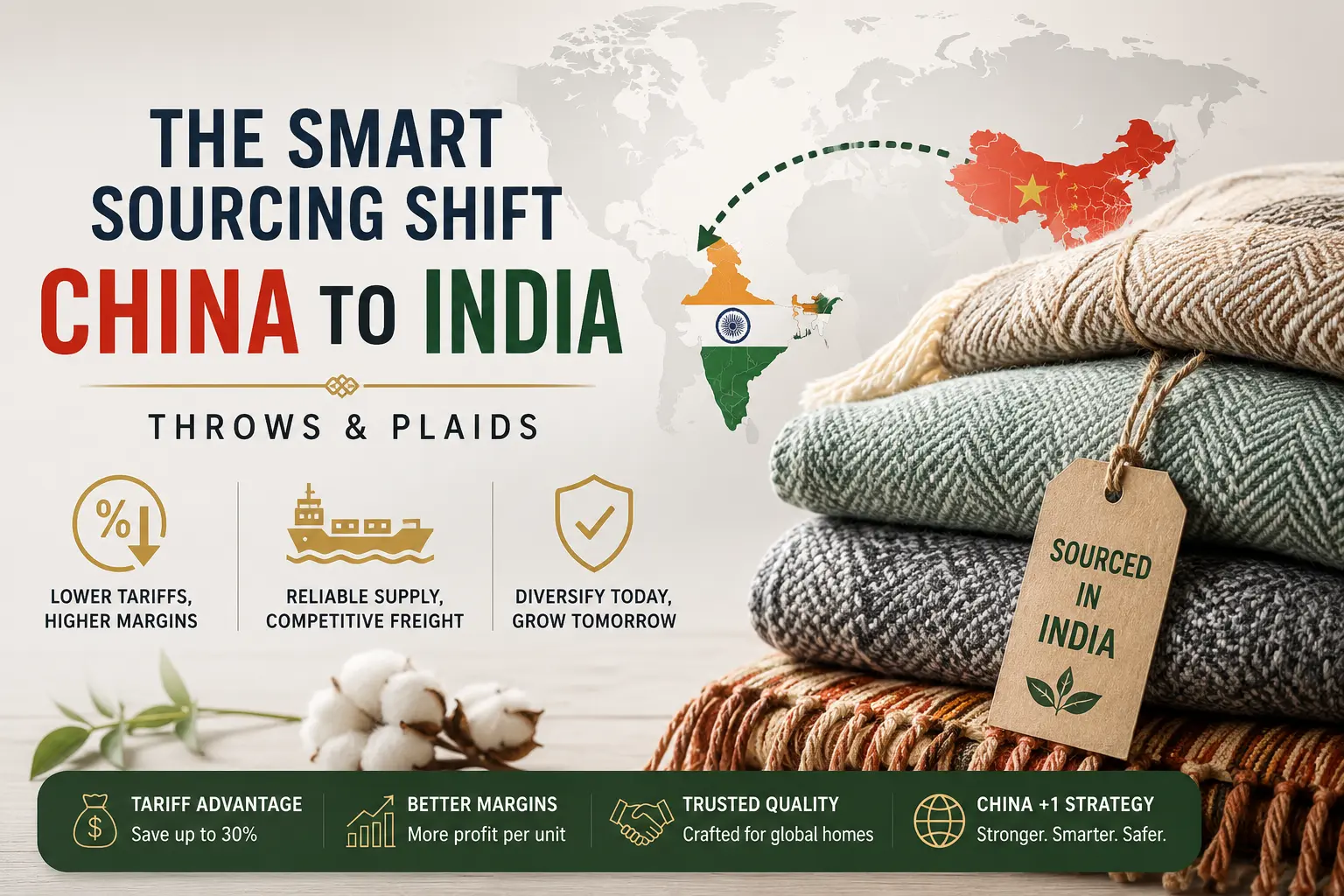
Every quarter of 2026 has brought fresh data showing US and European home retailers pulling their throws and plaids sourcing away from China and moving it to India. The reasons are specific and measurable. A 30 to 50 percent tariff exposure on Chinese-origin home textiles versus a 19 percent equivalent on Indian shipments. An EU trade deal that now taxes Chinese imports at a flat 15 percent while Indian goods sit under standard MFN rates. And a China Plus One sourcing strategy that has moved from a boardroom slogan to a live purchasing policy at most major home textile buyers.
This blog explains what is happening, why it is happening in 2026 specifically, and what the tariff, freight, and margin math actually looks like for a home retailer weighing the shift from a Chinese to an Indian throws and plaids manufacturer.
The 2026 Tariff Math That Started This
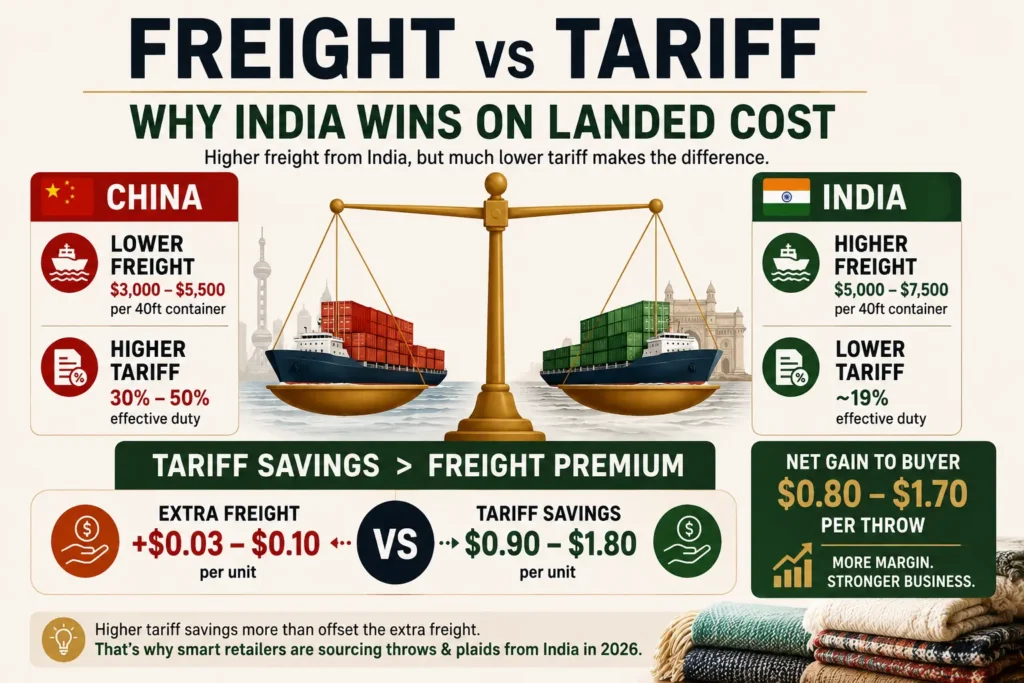
The tariff differential is the single largest driver of the current sourcing shift. As of mid-2026, Chinese home textile shipments to the United States face a stacked duty structure that includes the standard MFN rate (typically 9 percent for textiles), Section 301 tariffs from the 2018 trade action (7.5 to 25 percent on most home textile categories), and the new Section 301 forced-labor tariff that replaced the earlier Section 122 surcharge in July 2026.
Combined, most Chinese-origin throws, plaids, and cushion covers now land in the US at a total effective duty of 30 to 50 percent depending on classification. India, by comparison, sits in the 10 percent tier of the Section 301 forced-labor tariff, giving Indian exporters a 7 to 8 percentage point tariff advantage versus China at minimum, and up to 30 percentage points on some categories.
The European picture is similar. Under the EU-US trade agreement effective July 1, 2026, EU-origin goods pay a 15 percent all-inclusive tariff into the US. Chinese-origin imports into the EU itself now face anti-dumping and countervailing duty layers on multiple synthetic and blended fabric categories. Indian imports into the EU move under standard GSP and MFN rates that remain broadly competitive.
What US and EU Buyers Are Actually Paying Under 2026 Tariff Rules
Here is the comparison every home retailer sourcing manager has on a spreadsheet right now.
| Origin | 2026 Total US Duty on Home Textiles | 40ft Container Freight to US East Coast | Sourcing Trajectory |
|---|---|---|---|
| China | 30 to 50 percent (MFN + Section 301 stacked) | $4,200 to $7,200 | Contracting |
| Vietnam | About 22 percent (MFN + 12.5 percent forced-labor tier) | Similar to India | Stable |
| India | About 19 percent (MFN + 10 percent forced-labor tier) | $5,000 to $7,500 | Expanding rapidly |
| Bangladesh | About 19 percent (MFN + 10 percent forced-labor tier) | Similar to India | Expanding in apparel |
Numbers are indicative averages for HTS Chapters 50 to 63 covering woven fabrics, made-ups, and home textiles. Actual rates vary by exact classification, yarn content, and any product-specific safeguard duties.
The Freight Question Buyers Ask First
The most common objection raised inside sourcing meetings is freight. Yes, shipping a 40-foot container from India to the US costs $500 to $1,500 more than the equivalent Chinese container. Nhava Sheva or Mundra to the US East Coast currently runs $5,000 to $7,500 per 40-foot high-cube in non-peak weeks. The comparable Shanghai to New York or Los Angeles rate runs $3,000 to $5,500.
That freight gap sounds significant until you convert it into per-unit cost. A 40-foot container fits roughly 15,000 to 20,000 wholesale throws depending on packaging density. That means the extra $500 to $1,500 works out to $0.03 to $0.10 per unit.
The tariff difference on the same throw, at 15 to 30 percentage points on a $6 FOB price, saves $0.90 to $1.80 per unit. Net margin gain to the buyer, after absorbing the freight uplift, sits at $0.80 to $1.70 per throw.
Sample Landed Cost: One Wool Throw From Two Origins
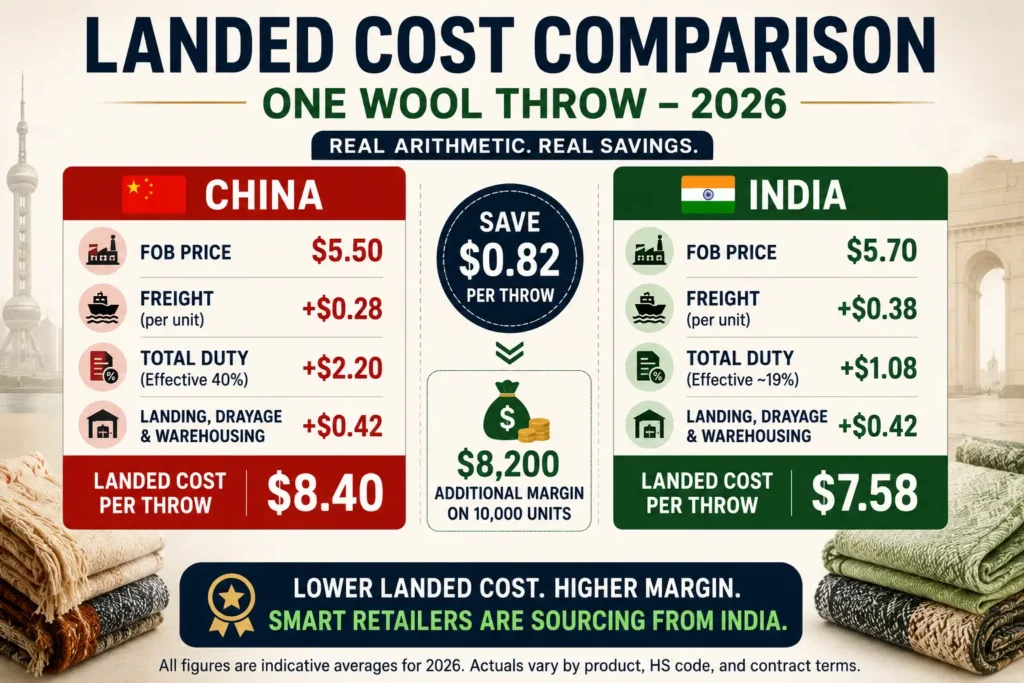
Real arithmetic, not theoretical. All figures indicative and averaged across 2026 quotes.
Wool throw from China, FOB $5.50
- Freight allocation per unit: $0.28
- US total duty at 40 percent effective: $2.20
- Landing, drayage, warehousing: $0.42
- Landed cost: $8.40 per unit
Wool throw from India, FOB $5.70
- Freight allocation per unit: $0.38
- US total duty at 19 percent effective: $1.08
- Landing, drayage, warehousing: $0.42
- Landed cost: $7.58 per unit
Net saving on the Indian throw: $0.82 per unit, or roughly 9.8 percent lower landed cost. On a 10,000-unit programme, that is $8,200 of additional margin. On a full container run of 15,000 units, the saving crosses $12,000.
Sustainability, UFLPA, and the ESG Layer
Tariff arithmetic alone does not explain the pace of the shift. The second driver is the Uyghur Forced Labor Prevention Act (UFLPA), which since 2022 has placed a rebuttable presumption of forced labor on any goods containing cotton or components sourced from China’s Xinjiang region.
Home textiles are heavily affected because China’s Xinjiang produces roughly 90 percent of the country’s cotton. Every Chinese cotton throw, plaid, or cushion cover shipment to the US requires documentary evidence proving the cotton is not sourced from Xinjiang. Detention rates at US Customs remain high through 2026, and the reputational cost of a delayed or seized shipment now weighs heavily on buyer decisions.
India offers a cleaner traceability story. The country’s own cotton belt across Gujarat, Maharashtra, and Andhra Pradesh supplies the bulk of Indian cotton yarn used in home textile manufacturing. Certifications commonly held by serious Indian home textile mills include GOTS (organic cotton), BSCI, Sedex, OEKO-TEX Standard 100, and GRS (recycled content). For a home retailer building ESG commitments into their brand, India’s supply chain paperwork is significantly easier to present to boards, investors, and increasingly regulated retail buyers.
The China Plus One Playbook Home Retailers Are Following
China Plus One is no longer an optional strategy. It is an embedded procurement practice at most major home textile buyers through 2026. Confederation of Indian Industry data pegs Indian textile exports at a 9 to 10 percent CAGR trajectory, with roughly USD 16 billion of that growth attributable directly to China Plus One diversification.
For US and European home retailers, the playbook typically follows a pattern:
- Shift 20 to 30 percent of a legacy Chinese sourcing basket to India in the first year
- Focus initial moves on categories where India already has depth: cotton throws, wool throws, printed cushion covers, jacquard plaids
- Maintain Chinese sourcing for categories India cannot yet match at commercial MOQ (some synthetic-heavy items, polyester technical throws)
- Consolidate with fewer, larger Indian suppliers to build supplier authority
- Add a China Plus One certification requirement to new supplier onboarding
The result is that Indian throws and plaids manufacturers who have export infrastructure, certifications, and consistent quality are absorbing a disproportionate share of the rebalanced spend.
What US and European Buyers Are Ordering First From India
Not all home textile categories move at the same pace. From what is visible in current buyer briefs, the categories moving fastest to India are:
- Cotton throws: Handloom, block-printed, and jacquard variants for entry to mid retail
- Wool throws and plaids: Merino, lambswool, and blends for winter home retail
- Coordinated cushion covers: Sold alongside throws for range consolidation
- Kantha and hand-stitched throws: Boutique and artisanal retail
- Recycled cotton throws: GRS-certified for ESG-committed retailers
- Woven jacquard throws: Damask, herringbone, and buffalo check patterns
The Bright Star throws and plaids programme, coordinated with the decorative cushion covers range and companion scarves and shawls, consolidates the exact category basket that most US and EU home buyers are now shifting from Chinese suppliers.
How to Structure the Move to India: Six Practical Steps
For a home retailer starting the shift, the sequence that works:
- Audit your current Chinese basket by category and volume. Identify the categories where the tariff differential most affects margin.
- Get parallel quotes from two or three Indian suppliers on the same specification. Sample lead time is typically 30 to 45 days.
- Start with a pilot order of 3,000 to 5,000 units across two or three SKUs. Prove the operational flow before scaling.
- Build local insert sourcing for cushion covers. Ship covers only from India to protect freight economics.
- Consolidate freight into full containers. Half-full containers eliminate the tariff advantage.
- Add certification requirements upfront. Specify OEKO-TEX, GOTS, or GRS at the brief stage, not the audit stage.
Buyers who follow this sequence typically place their first bulk Indian order within 90 to 120 days of starting the process and complete a full sourcing rebalance within 12 to 18 months.
Working with Bright Star
Bright Star has manufactured throws, cushion covers, scarves, and shawls from India since 1950. Three generations of family experience across weaving, printing, finishing, and export documentation means the mill can absorb Chinese-origin volumes without stretching quality or lead time.
For US and EU home retailers running an active China Plus One programme, Bright Star’s in-house Custom Design and Private Label capability covers full sampling, certification, and margin costing in the first seven days. A first quote against a current Chinese spec typically lands within a week of a brief being shared with the Bright Star team.
Frequently Asked Questions
Why are US retailers shifting throws sourcing from China to India in 2026?
The 2026 US tariff on Chinese home textiles now runs 30 to 50 percent, versus roughly 19 percent for Indian imports. That 15 to 30 percentage point gap makes India materially cheaper on landed cost across the throws and plaids category.
What is the current US tariff on throws imported from India?
Indian home textiles entering the US pay the standard 9 percent MFN rate plus the 10 percent Section 301 forced-labor tariff, giving a total effective duty of about 19 percent as of mid-2026 for most throw and plaid categories.
Is shipping from India more expensive than shipping from China?
Yes, marginally. A 40-foot container from India to the US East Coast currently runs $5,000 to $7,500 versus $4,200 to $7,200 from China. The per-unit freight gap of $0.03 to $0.10 is easily offset by tariff savings.
What is the China Plus One sourcing strategy?
China Plus One is a procurement policy that requires retailers to reduce China concentration by moving 20 to 30 percent of sourcing to alternative countries. India, Vietnam, and Bangladesh are the three primary beneficiary destinations across textiles.
How does the UFLPA affect Chinese cotton throws?
The Uyghur Forced Labor Prevention Act requires importers to prove that Chinese cotton products do not contain Xinjiang-origin cotton. Chinese cotton throws face frequent US Customs detentions in 2026, adding cost, delay, and reputational risk to Chinese sourcing.
What certifications should an Indian throws and plaids manufacturer offer?
Standard certifications include GOTS for organic cotton, OEKO-TEX Standard 100 for chemical safety, GRS for recycled content, and BSCI or Sedex for social compliance. Serious export mills carry three or more of these at minimum.
What is the minimum order quantity for wholesale throws from India?
Standard MOQs for wholesale throws from India are 500 to 1,000 pieces per design and colourway. Jacquard woven throws often need 1,000 pieces minimum per design to amortise loom setup costs across the run.
How long does it take to shift a throws programme from China to India?
A pilot order of 3,000 to 5,000 units typically takes 90 to 120 days from first brief to container handover. A full sourcing rebalance across a home textile basket usually completes within 12 to 18 months.
Which home textile categories are moving from China to India fastest?
Cotton throws, wool throws and plaids, coordinated cushion covers, kantha throws, recycled cotton throws, and woven jacquard throws are the fastest-moving categories in the 2026 sourcing shift from Chinese to Indian home textile suppliers.
Does India have the capacity to absorb the volume moving out of China?
Yes, in home textile categories. Indian mills have added weaving, printing, and finishing capacity through 2024 to 2026 specifically to serve China Plus One demand. Confederation of Indian Industry data confirms the growth trajectory.