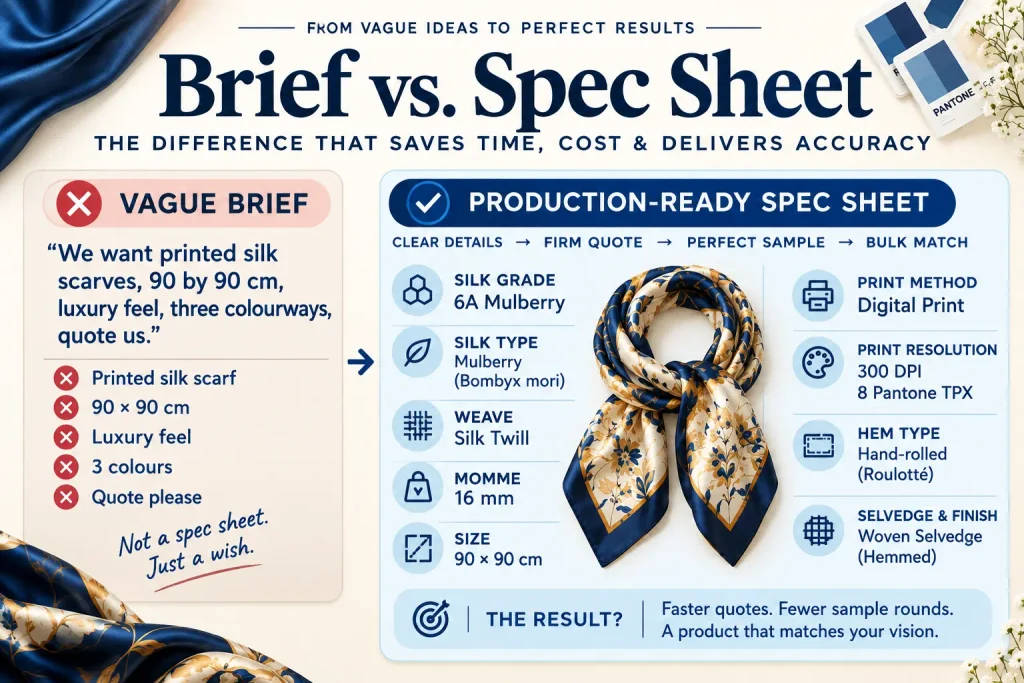
Every silk scarf brief a manufacturer in India receives starts the same way. “We want printed silk scarves, 90 by 90 cm, luxury feel, three colourways, quote us.” That is not a spec sheet. That is a wish. The quote that comes back is a range, the sample looks nothing like the reference, and the private label buyer spends the next four weeks explaining what they meant by “luxury feel.”
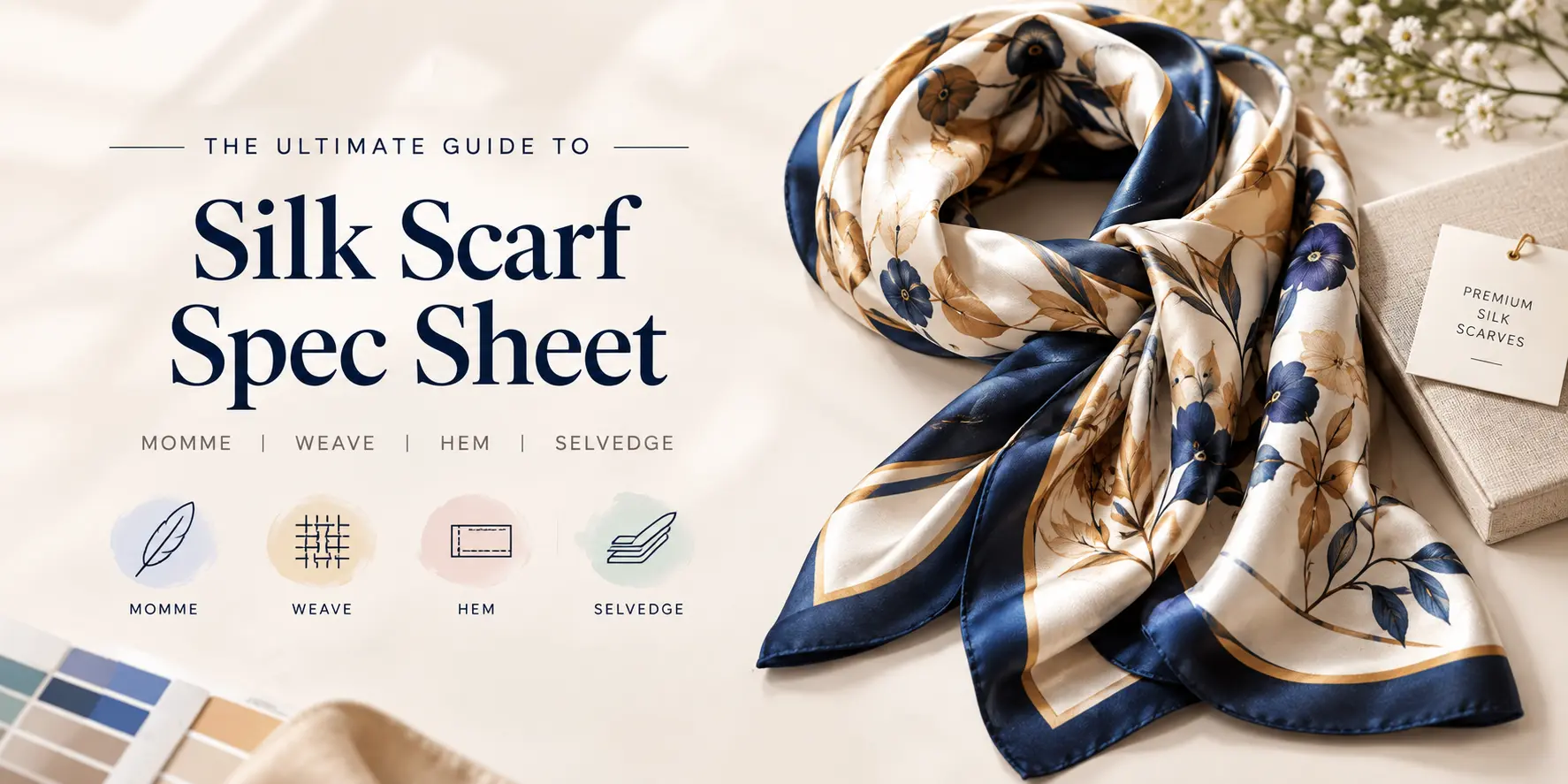
Meanwhile, the buyer who sends a real spec sheet gets a firm quote within 48 hours, a sample within three weeks, and a bulk that matches. The difference is nine specific fields on a single-page document. This is what those nine fields look like, filled in the way a silk scarves manufacturer in India actually wants to see them.
Why a Proper Spec Sheet Saves 40 Percent of Your Sampling Cycle
A silk scarf order that skips proper specification typically burns two or three extra sample rounds. Each round costs 12 to 18 days and $150 to $400 in sampling charges. Over a season, that is six weeks of avoidable delay and $600 to $1,200 of avoidable cost per programme.
A proper spec sheet also solves the disputed-sample problem. When the manufacturer receives your artwork alongside momme, weave, hem, print method, and colour Pantone codes, there is no room for interpretation. The sample either matches the spec or does not. When any of those fields are missing, the manufacturer fills the gap with an assumption, and the sample almost always looks different from what the buyer expected.
The Nine Fields Every Silk Scarf Spec Sheet Needs
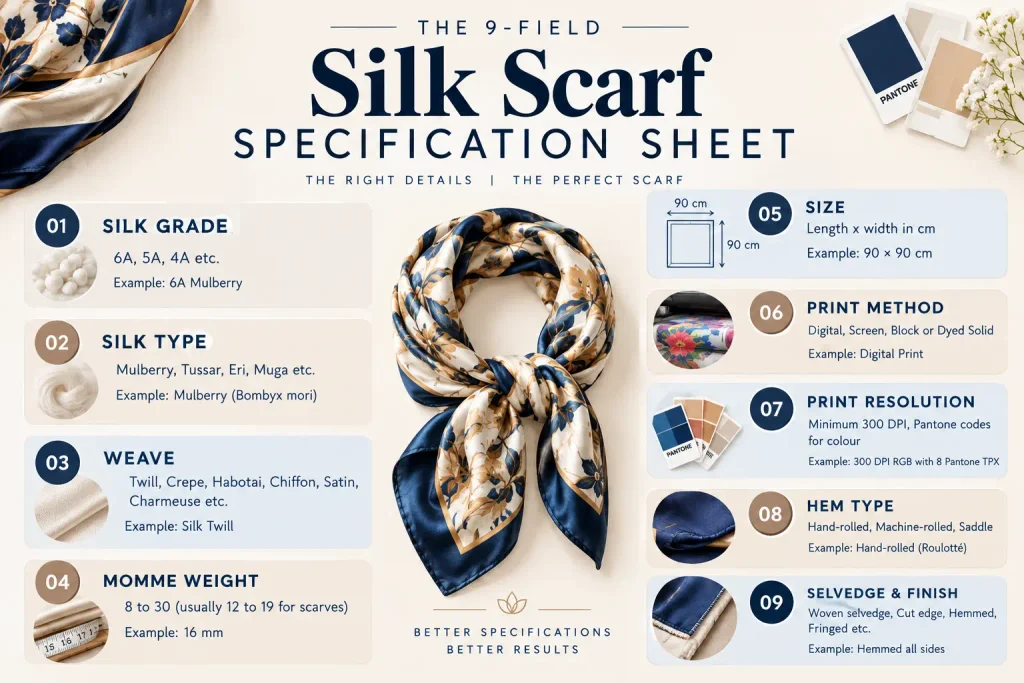
Here is the working spec sheet template used across serious silk scarf programmes.
| Field | What to Specify | Example |
|---|---|---|
| Silk grade | 6A, 5A, 4A | 6A mulberry |
| Silk type | Mulberry, tussar, eri, muga | Mulberry (Bombyx mori) |
| Weave | Twill, crepe, habotai, chiffon, satin, charmeuse | Silk twill |
| Momme weight | 8 to 30 (usually 12 to 19 for scarves) | 16 mm |
| Size | Length x width in cm | 90 x 90 cm |
| Print method | Digital, screen, block, or dyed solid | Digital print |
| Print resolution | Minimum 300 DPI, Pantone codes for colour | 300 DPI RGB with 8 Pantone TPX |
| Hem type | Hand-rolled, machine-rolled, saddle | Hand-rolled (roulotté) |
| Selvedge and finish | Woven selvedge, cut edge, hemmed, fringed | Hemmed all sides |
Every field on this table has a right and a wrong answer for your specific retail slot. The next sections explain the answer that suits which programme.
Momme Weight: The Single Most Important Number on the Sheet
Momme (pronounced “mummy”) is the standard silk weight unit. One momme equals 4.34 grams per square metre. A 16 momme silk scarf therefore weighs 69 GSM. A 19 momme scarf weighs 83 GSM. A 25 momme scarf weighs 108 GSM.
Momme is not thread count. It is fabric density measured by weight. For silk scarves, the standard bands are:
- 6 to 8 momme: Silk chiffon and gauze. Sheer, delicate, occasion wear only. Rarely used for daily-wear scarves.
- 10 to 12 momme: Lightweight silk. Budget end of the market. Feels fluid but light in the hand.
- 14 to 16 momme: Industry standard for quality silk twill scarves. Holds a knot cleanly, prints well, feels substantial without being heavy. Most global luxury silk houses use this range for their classic square scarves.
- 18 to 19 momme: Premium silk twill and silk satin. Perceptibly heavier, superior drape when knotted, longer service life.
- 22 to 30 momme: Ultra-premium silk satin and charmeuse. Rare for scarves. More common for silk pillowcases and pyjamas.
For most silk scarf briefs from US and EU private-label buyers, 14 to 16 momme silk twill is the specification that hits the retail sweet spot. Under 12 momme looks and feels cheap. Over 22 momme feels heavy and delivers no visible retail benefit at scarf size.
Silk Grade: 6A, 5A, 4A Explained
Silk grade is separate from momme. Grade measures the raw fibre quality; momme measures the fabric density. The two numbers combine to describe the actual silk you are buying.
Silk grading uses a letter-number system from 6A (highest) down to F (lowest). The commercial bands used across silk scarves are:
- 6A grade: Premium mulberry silk with fibre length above 1,000 metres. Highest lustre, longest uninterrupted filaments. Used by luxury silk houses.
- 5A grade: Professional-quality silk with slight variance in fibre length. Very high quality, suitable for premium retail. Most Indian silk scarf export mills use 5A as standard.
- 4A grade: Mid-tier silk with occasional short fibres. Acceptable for mid-market retail. Slightly less lustrous.
- 3A grade: Commercial silk. Adequate for entry-price silk scarves and promotional programmes.
- 2A and below: Utility grade. Not typically used for retail scarves.
A 16 momme silk scarf in 6A grade will look and feel visibly different from a 16 momme silk scarf in 3A grade. Both are “16 momme silk” on the label. Only the grade tells you which one you actually have.
Weave Type: Twill, Crepe, Habotai, Chiffon, Charmeuse
The weave decides how the silk behaves. Common silk scarf weaves and their character:
- Silk twill: Diagonal weave, most popular for scarves. Prints beautifully, holds a knot, has structural body. Standard 14 to 19 momme.
- Silk crepe (crepe de Chine): Slightly textured surface from twisted yarns. Elegant matte finish. Standard 12 to 16 momme.
- Silk habotai (China silk): Plain weave, very lightweight. Suits linings and lightweight scarves. Standard 8 to 14 momme.
- Silk chiffon: Sheer, gauzy, drapes fluidly. Occasion and evening scarves only. Standard 6 to 8 momme.
- Silk satin and charmeuse: Glossy face, matte back. Luxurious appearance, heavier. Standard 16 to 30 momme.
- Silk organza: Crisp, sheer, structured. Decorative use. Standard 4 to 6 momme.
For most private-label silk scarf programmes, silk twill at 14 to 16 momme is the default. Silk crepe suits sophisticated matte-finish designs. Silk satin is reserved for premium and luxury tiers where the sheen justifies the price.
Print Method and DPI: What Your Artwork File Must Contain
Three print methods dominate silk scarf production from India. Each one changes the spec sheet.
- Digital print: Best for complex artwork with many colours, photographic detail, and short runs (300 to 2,000 pieces). Sample cost typically $15 to $40 per design. Sample time 7 to 14 days.
- Screen print: Best for bold graphic designs with 2 to 8 flat colours. Sample cost is roughly $40 per colour. Sample time 10 to 15 days. Efficient for runs above 2,000 pieces.
- Block print: Traditional Indian hand technique, artisanal look. Suits boutique and heritage positioning.
Whichever method the spec calls for, the artwork file requirements are non-negotiable:
- Resolution: Minimum 300 DPI at final scarf size. For a 90 x 90 cm scarf, that means approximately 10,600 x 10,600 pixels.
- File format: TIFF, PDF, or AI. JPG is acceptable for reference only.
- Colour space: RGB or CMYK; specify which one.
- Colour codes: Pantone TPX, TPG, or TCX values for every design colour. Screen colours alone are not enough for reliable matching in bulk.
- Bleed area: 1 to 1.5 cm extra on every side to accommodate hem loss.
Missing any of these five turns the print quote into a range instead of a firm number. Send them all, and the manufacturer can commit to specific colour match and reproduction quality before sampling starts.
Hem Type: Hand-Rolled vs Machine, and Which Suits Which Retail
Hem is where luxury programmes and mass programmes visibly separate. Three options exist:
- Hand-rolled (roulotté): The edge is folded inward and stitched by hand around the perimeter. A 90 x 90 cm scarf takes an artisan 40 to 60 minutes. Adds ₹150 to ₹400 per unit. Standard for luxury silk scarves.
- Machine rolled: A high-speed rolled-hem machine folds and stitches the edge in one pass. Adds ₹15 to ₹40 per unit. Standard for mid-market and volume programmes.
- Overlock or serged: A serger machine binds the raw edge with thread. Adds ₹8 to ₹20 per unit. Standard for promotional and entry-price silk scarves.
The retail rule of thumb: if the shopper will pay $80 or more at retail, hand-rolled hems are worth the cost because the buyer will notice and touch the edge. Under $50 retail, machine or serged edges are the right choice because the target shopper is not paying for artisan handwork.
Selvedge and Edge Finish: The Detail Nobody Specifies But Everyone Notices
Selvedge is the loom-woven edge of the fabric. On a scarf, selvedge shows up in three ways:
- Woven selvedge preserved: For rectangular stoles, the original selvedge along the long sides is the cleanest finish and needs no hemming. Standard for premium stoles.
- Cut edge, hemmed: For square scarves, all four sides are cut from the fabric roll and hemmed. Most common finish across silk scarves.
- Cut edge, fringed: For stoles and shawls where fringe is part of the design. Fringe length is typically 3 to 10 cm, hand-knotted or hand-twisted.
The spec sheet should name all four sides individually if they differ. “Hemmed all sides” is different from “hemmed short sides, fringed long sides.” Ambiguity here creates the second-most-common sampling defect after colour match.
Size, Fringe, and Trim: The Final Fields
Standard silk scarf sizes from India:
- Square: 45 x 45, 60 x 60, 70 x 70, 80 x 80, 90 x 90 cm
- Long stole: 45 x 180, 70 x 180, 100 x 200 cm
- Bandana: 55 x 55 cm
Custom sizes are standard for private-label programmes. Specify tolerance (typically plus or minus 1 cm) so the manufacturer knows what “size” means in production.
Fringe, tassels, trim, and labels should each have their own line on the sheet. Do not assume the manufacturer will infer them from a reference image.
A Working Example: A Complete Silk Scarf Spec Sheet
Here is what a properly filled spec sheet looks like:
- Product: Printed silk scarf, women’s fashion accessory
- Silk grade: 6A mulberry (Bombyx mori)
- Weave: Silk twill
- Momme weight: 16 momme (69 GSM)
- Size: 90 x 90 cm plus or minus 1 cm
- Print method: Digital print
- Artwork: Provided as TIFF at 300 DPI, 10,600 x 10,600 pixels, RGB, 8 Pantone TPX codes attached
- Hem: Hand-rolled (roulotté), all four sides, matching thread colour
- Selvedge: Cut edge, hemmed
- Fringe: None
- Care label: Silk, dry clean only, printed care symbols
- Brand label: Woven damask brand label, sewn to one corner underside
- Packaging: Individual tissue wrap, branded box, 12 pieces per master carton
- Order quantity: 1,000 pieces per design, 3 colourways
- Certifications: OEKO-TEX Standard 100
A silk scarves manufacturer in India receiving this spec sheet can quote within 48 hours and start sampling within a week. That is the value of specification discipline.
For custom private-label programmes, working with a manufacturer offering full Custom Design and Private Label infrastructure across silk prints and woven jacquards shortens the entire cycle further.
Working with Bright Star
Bright Star has manufactured silk scarves, stoles, and shawls from India since 1950. Three generations of family experience means the mill accepts complete spec sheets, runs sampling against specification, and ships bulk that matches on the first attempt.
Whether the brief is 500 pieces of 16 momme silk twill for boutique private label or 20,000 pieces of digitally printed silk crepe for a global luxury programme, the Bright Star team quotes against the scarves and shawls range using the nine-field spec sheet approach above.
Frequently Asked Questions
What is momme in silk scarves?
Momme is the standard silk weight unit; one momme equals 4.34 grams per square metre. For silk scarves, 14 to 19 momme is the industry sweet spot for quality, drape, and durability at retail.
What is the best momme weight for a silk scarf?
14 to 16 momme silk twill is the industry standard for quality silk scarves. It holds a knot cleanly, prints well, and feels substantial without being heavy. Anything under 12 momme feels cheap at retail.
What silk grade should a private-label brand order?
5A grade mulberry silk is standard for premium retail. 6A grade is used for luxury programmes. 3A to 4A grade fits mid-market and promotional silk scarves at lower price points.
What is the difference between hand-rolled and machine hems?
Hand-rolled hems are stitched manually and add ₹150 to ₹400 per scarf, standard for luxury retail. Machine hems use high-speed rolled-hem machines, cost ₹15 to ₹40 per scarf, and suit mid-market.
What resolution should silk scarf artwork be?
300 DPI at final scarf size is the industry minimum for digital and screen-printed silk scarves. A 90 x 90 cm scarf needs about 10,600 x 10,600 pixels in TIFF, PDF, or AI format.
What is silk twill and why is it used for scarves?
Silk twill is a diagonal weave that combines strength, drape, and clean print reproduction. It holds knots cleanly and prints with sharp colour definition, which makes it the standard weave for printed silk scarves.
What are the standard sizes for silk scarves from India?
Standard silk scarf sizes are 60 x 60, 70 x 70, and 90 x 90 cm squares, with 70 x 180 and 100 x 200 cm stoles. Custom sizes ship regularly for private label.
What certifications should a silk scarves manufacturer in India offer?
OEKO-TEX Standard 100 for chemical safety is standard. Silk Mark certification confirms genuine silk content. GOTS and GRS apply where organic or recycled fibre blends are used in the programme.
Should I use RGB or CMYK for silk scarf artwork files?
Either works if specified upfront. RGB reproduces vivid colours better on digital prints; CMYK is more predictable for screen printing. Pantone TPX or TCX codes for every colour prevent bulk colour mismatches.
What is the MOQ for custom printed silk scarves from India?
The standard MOQ for custom printed silk scarves from India is 300 to 500 pieces per design and colourway. Complex jacquard silk designs or luxury 6A programmes may require a minimum of 500 to 800.