Every home retail buyer sourcing cushion covers from India gets a quote sheet that lists prices per SKU. What that quote sheet rarely shows is the four or five decisions behind each number, and how each one moves the retail margin at the other end of the container.
The result is predictable. A range that looked healthy at ₹350 FOB lands at a 42 percent margin instead of the 58 percent the merchandising plan assumed. Not because the manufacturer overcharged. Because nobody explained where the margin actually leaks.
This blog is the margin math a cushion covers manufacturer in India would show you across the table if you asked the right questions before signing off. Fabric, print, fill, closure, and trim, with real wholesale numbers, real landed costs, and the retail arithmetic that decides whether the range makes money or ties up shelf space.
Why Margin Math Rarely Makes It Into Cushion Cover Blogs
Most cushion cover blogs are lookbooks. They talk about trends, colour stories, styling ideas, and Instagram-friendly bedroom shots. What they do not talk about is that a single cushion cover has between eight and twelve costable variables, and each one moves your margin by two to five points.
For a home retailer running seasonal drops, that add-up matters. A five-point margin swing across a 10,000-unit order is the difference between funding next quarter’s photography and cancelling it.
The Three Decisions That Move Your Margin the Most
Every cushion cover costed in India starts with three decisions in this order:
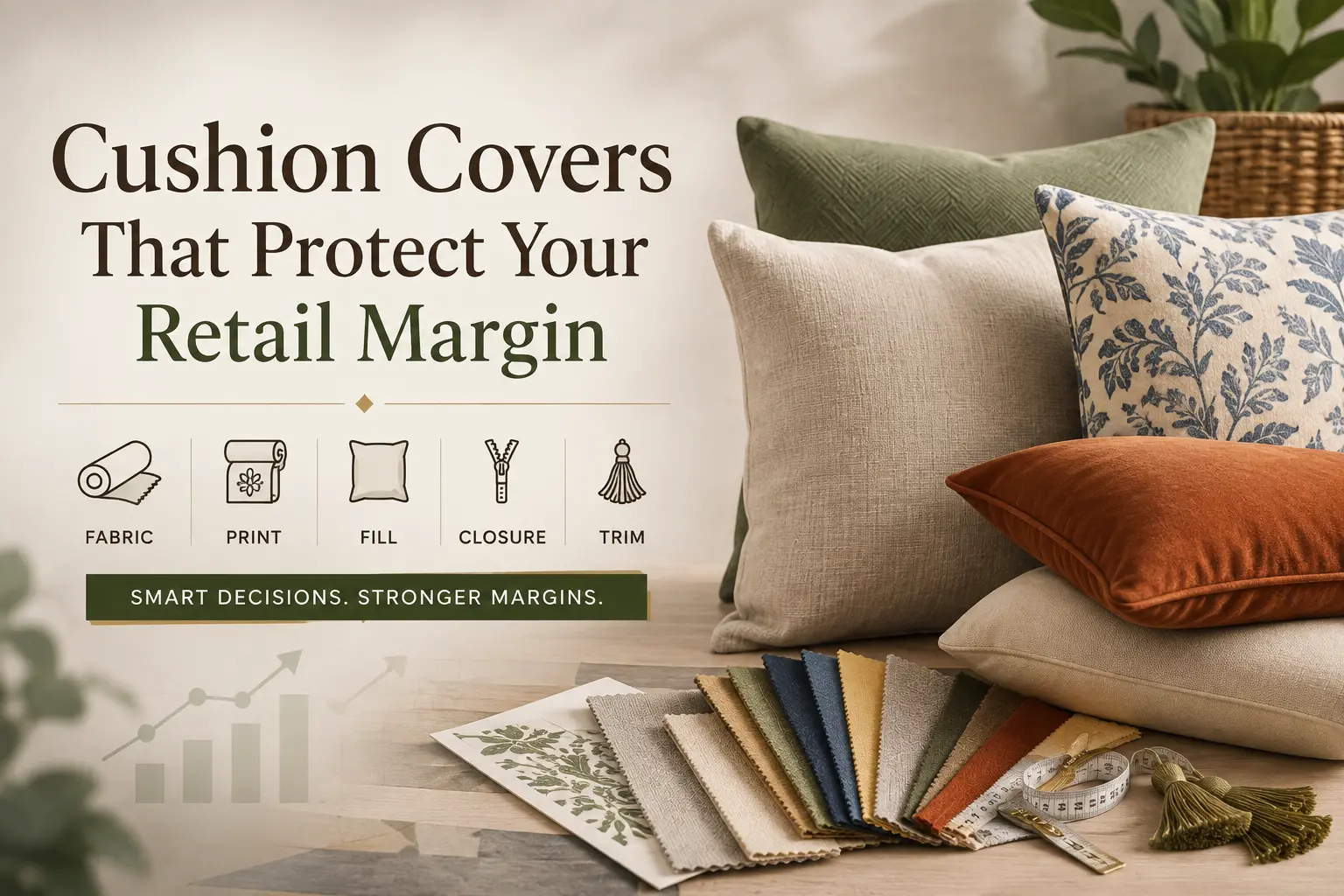
- Fabric: The single biggest line item, usually 40 to 60 percent of the FOB price
- Print, dye, or weave method: Determines pattern possibility and adds 5 to 30 percent to the base
- Fill and closure specification: Decides whether the cover ships as a cover only or with an insert, and how it fastens
Get these three right and the smaller decisions (piping, tassels, labels, packaging) become fine-tuning. Get them wrong, and no amount of post-order optimisation recovers the lost margin.
Fabric: The Biggest Line Item on Your Cost Sheet
Fabric drives everything else. A standard 45 x 45 cm cushion cover uses roughly 0.5 metres of 137 cm width fabric for a front-back construction. The fabric spend on that half metre determines how much room the manufacturer has for everything that follows.
Common fabric options and typical wholesale ranges from India:
| Fabric | Cost per Metre (₹) | Best For | Retail Positioning |
|---|---|---|---|
| Cotton canvas | 150 to 350 | Printed programmes, casual home | Entry to mid retail |
| Linen | 300 to 800 | Natural-textured, neutral tones | Mid to premium retail |
| Cotton velvet | 400 to 900 | Rich colours, jewel tones | Premium retail |
| Wool blend | 500 to 1,200 | Textured winter home | Premium seasonal |
| Silk dupion | 600 to 1,500 | Luxury decorative | Luxury retail |
| Woven jacquard | 400 to 2,000 | Figured patterns, damasks | Premium to luxury |
| Handloom cotton | 250 to 700 | Artisanal positioning | Mid to premium |
Fabric decisions typically consume 40 to 60 percent of the finished cushion cover’s FOB cost. Which is why upgrading from cotton canvas to linen without rethinking the retail price often kills margin before the range even leaves the mill.
Print, Dye, or Weave: What Each Method Does to Your Landed Cost
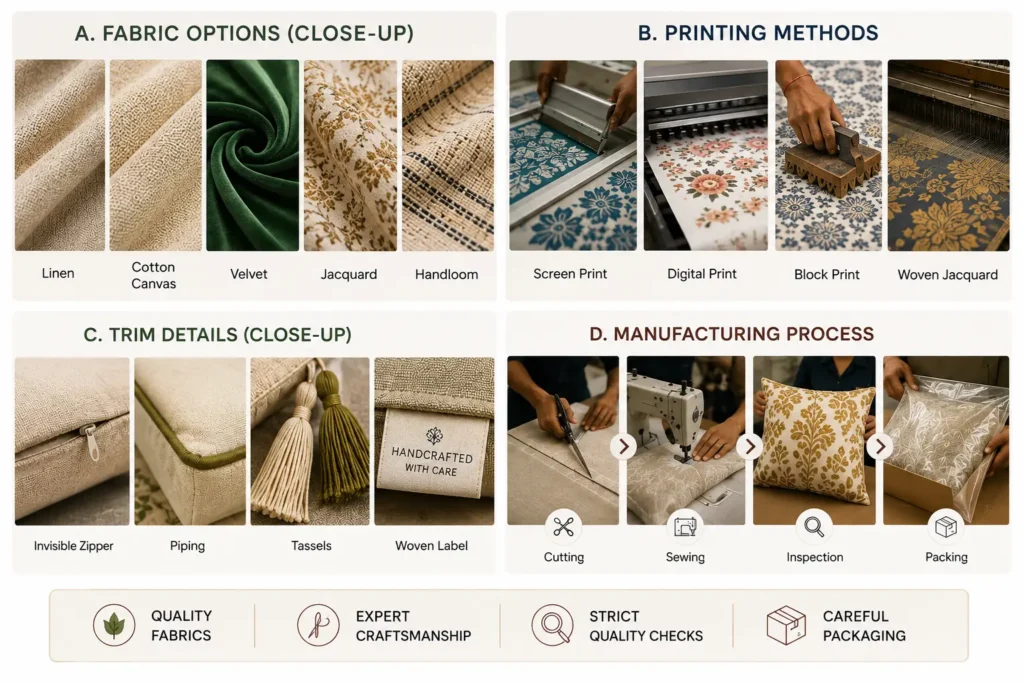
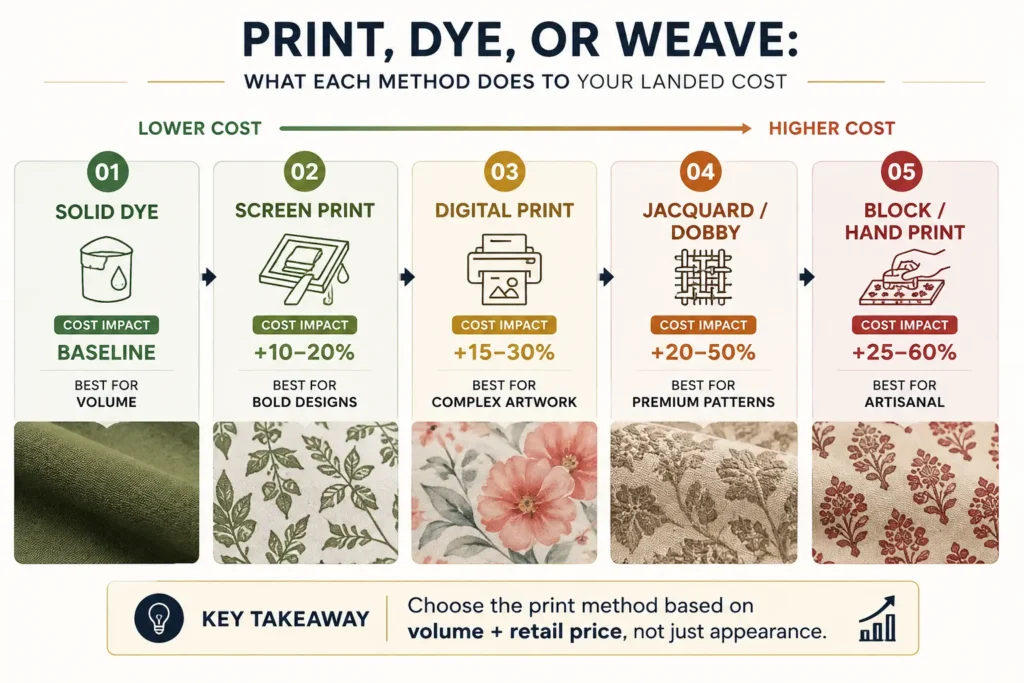
Once fabric is chosen, the pattern decision decides the next layer of cost. Four methods dominate.
- Solid dyed: No pattern; single colour throughout. Baseline cost, fastest production, cleanest for volume.
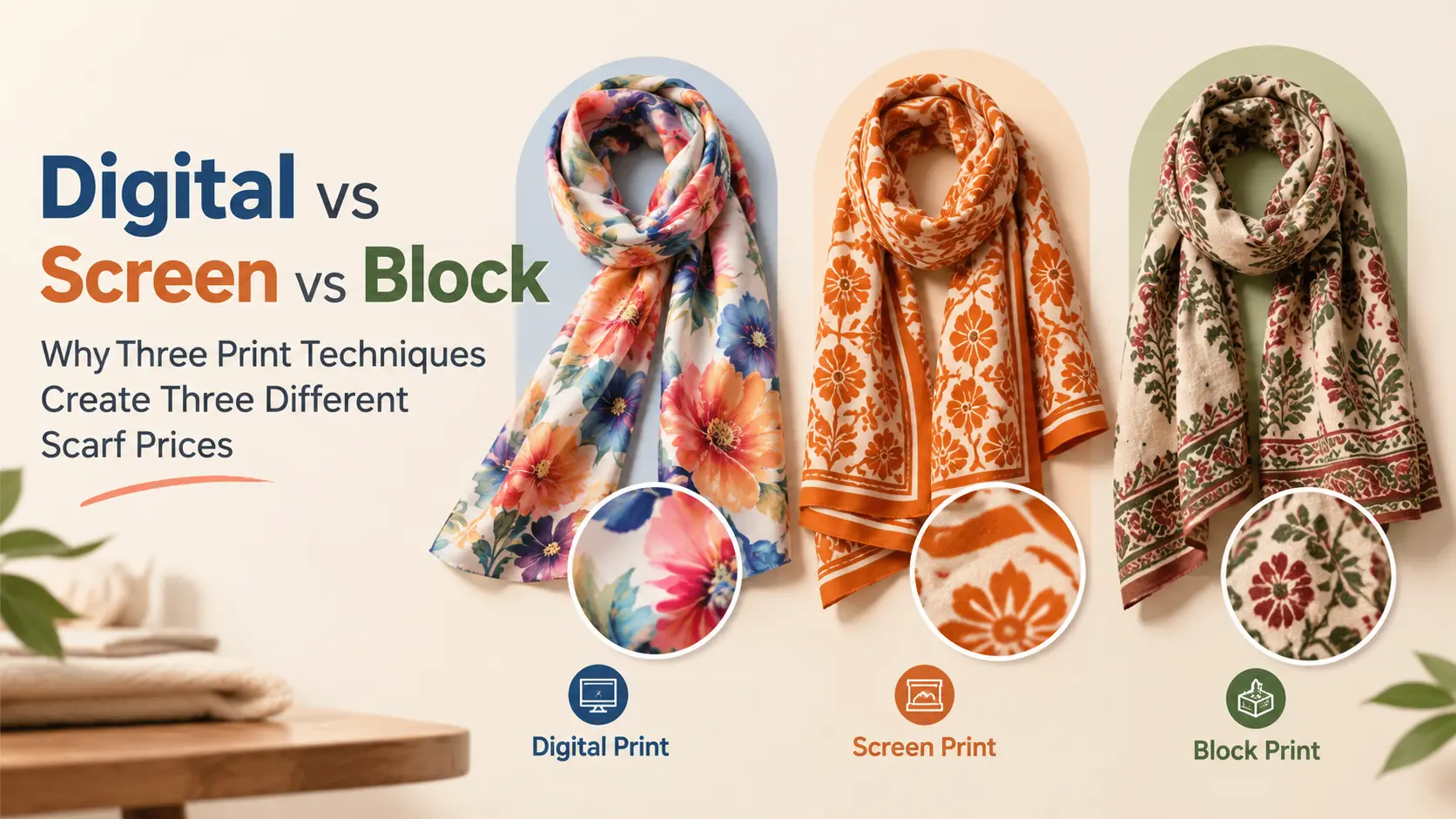
- Digital print: Photographic or complex artwork. Adds 15 to 30 percent to fabric cost. Best for short runs of 300 to 2,000 pieces.
- Screen print: Traditional method, best for two to six colours in bold graphic designs. Adds 10 to 20 percent. Efficient at higher volumes above 2,000.
- Woven jacquard or dobby: Pattern is built into the weave itself. Adds 20 to 50 percent to base cost. Best for figured designs, damasks, and premium positioning.
- Block print or hand embellishment: Adds 25 to 60 percent depending on complexity. Artisanal positioning at premium retail only.
The mistake buyers frequently make is choosing digital print for high-volume programmes where screen print would have delivered the same visual at 15 percent lower cost. Or specifying jacquard when the retail slot only supports a printed price point.
Fill and Insert: The Question Most Buyers Answer Wrong
Export cushion covers from India ship as covers only by default. That is the industry standard for two reasons: inserts inflate shipping volume dramatically, and most retailers prefer to source inserts locally to control quality and returns.
Here is what changes the equation:
- Cover only (no insert): Standard export. Cheapest freight per unit. Buyer sources inserts locally.
- With polyester fibre insert: Adds ₹100 to 200 per unit. Adds 200 to 300 percent to shipping volume.
- With feather-down insert: Adds ₹250 to 500 per unit. Freight impact similar to poly.
- With high-density foam insert: Adds ₹150 to 300 per unit. Usually only for outdoor or structured cushions.
The margin math almost always favours cover-only shipping paired with a local insert supplier at destination. A retailer paying ₹450 landed for a cushion cover plus ₹120 for a locally sourced insert ends up with better margin than paying ₹700 landed for the same cover shipped with an insert from India.
Exceptions are boutique retailers ordering under 500 units per SKU, where the operational overhead of local insert sourcing outweighs the freight saving. For those buyers, insert-included cushions can make sense.
Closure, Piping, and Trim: The Small Additions That Compound
Individually small, collectively significant. A single cushion cover might add three or four of these:
- Envelope back closure: No added cost. Standard for entry retail.
- Standard zipper: Adds ₹15 to 30. Standard for mid retail.
- Invisible zipper: Adds ₹25 to 50. Preferred for premium.
- Button closure (front or back): Adds ₹40 to 100. Adds design signal for boutique retail.
- Piping around edges: Adds ₹30 to 80. Structural upgrade signal.
- Tassels or pompoms: Adds ₹50 to 150. Decorative uplift for premium positioning.
- Embroidered brand label: Adds ₹10 to 25. Standard for private label programmes.
Stack piping, invisible zipper, tassels, and an embroidered label on a mid-tier cushion and you have added ₹150 to 300 to the base cost before the fabric decision. Which is manageable if the retail price supports it, and a margin killer if it does not.
Sample Margin Math: Three Cushion Cover Programmes Costed Out
Here is the arithmetic that most quote sheets skip. All figures are indicative and vary by season, volume, and specification.
Programme A: Entry Retail Cotton Print
- Fabric: Cotton canvas at ₹200 per metre, 0.5 metre used = ₹100
- Print: Screen print, 3 colours = ₹40 uplift
- Cover construction, hem, envelope back = ₹60
- Labelling and packaging = ₹20
- FOB India: ₹220 (~$2.30)
- Landed cost US East Coast: ₹380 (~$4.00)
- Wholesale to retailer: $8 to $10
- Retail price: $20 to $24
- Retail margin: 58 to 65 percent
Programme B: Mid-Tier Linen with Trim
- Fabric: Linen at ₹500 per metre, 0.5 metre = ₹250
- Solid dyed, no print = ₹0 uplift
- Piping around edges = ₹50
- Invisible zipper = ₹35
- Cover construction, hem = ₹70
- Labelling and packaging = ₹25
- FOB India: ₹430 (~$4.50)
- Landed cost US East Coast: ₹690 (~$7.30)
- Wholesale to retailer: $14 to $18
- Retail price: $38 to $48
- Retail margin: 60 to 66 percent
Programme C: Premium Woven Jacquard
- Fabric: Woven jacquard at ₹1,200 per metre, 0.5 metre = ₹600
- Weave includes pattern = ₹0 print uplift
- Invisible zipper = ₹40
- Piping = ₹60
- Embroidered brand label = ₹20
- Cover construction, hem = ₹80
- Labelling and packaging = ₹30
- FOB India: ₹830 (~$8.70)
- Landed cost US East Coast: ₹1,250 (~$13.20)
- Wholesale to retailer: $26 to $32
- Retail price: $75 to $95
- Retail margin: 65 to 72 percent
Notice the pattern. Higher-tier programmes hold slightly better retail margin because the fabric-to-total-cost ratio drops and the retail price supports the added specification.
Where Retailers Most Commonly Lose Margin
Six leaks show up repeatedly across cushion cover programmes:
- Over-specifying fill in the export cover. Shipping inserts from India rarely improves margin.
- Choosing digital print for high-volume programmes. Screen print is often 15 percent cheaper at scale.
- Adding piping, tassels, and premium closures to entry-tier cushions. The retail price cannot absorb it.
- Under-ordering. MOQs of 300 to 500 per SKU are optimal; 100-piece orders add 20 to 30 percent per unit.
- Ignoring freight consolidation. Half-full containers destroy landed cost.
- Not amortising sampling costs across the season. Absorbing sampling into one small order kills margin on that order.
How to Structure a Bulk Order That Protects Margin
Practical rules across the decorative cushion covers programme:
- Consolidate three to six SKUs into a single container run for freight efficiency
- Standardise on one closure type per collection to save trim costs
- Match fabric tier to retail price band; do not mix
- Ship cover only unless retail model requires insert included
- Order 500 to 1,000 pieces per SKU as the MOQ sweet spot
- Repeat winning designs in larger runs to amortise setup cost
Consolidating a home textile buy across cushions, throws, and coordinated scarves from the scarves and shawls collection further improves per-container freight economics.
Working with Bright Star
Bright Star has been manufacturing cushion covers, throws, scarves, and shawls from India since 1950. Three generations of family experience across fabric sourcing, weaving, printing, and finishing means the mill can cost your programme accurately at the brief stage, not surprise you at the bulk stage.
For private label programmes with custom fabric, print, or trim development, in-house Custom Design and Private Label capability covers full sampling and margin costing in the first seven days. Reach out through the Bright Star team with a brief, and the first quote arrives with full margin math attached.
Frequently Asked Questions
What is the wholesale price range for cushion covers from India?
Wholesale FOB cushion cover prices from India range from ₹120 to ₹2,500 per piece depending on fabric, print method, size, and trim. Standard 45 cm covers usually sit between ₹200 and ₹800.
What is the minimum order quantity for cushion covers?
Standard MOQs are 300 to 500 pieces per design and colourway. Complex jacquard or embellished cushions often need 500 to 800 pieces minimum to amortise loom or embroidery setup costs.
Do cushion covers ship with inserts from India?
By default, no. Export cushion covers from India ship as covers only to reduce freight volume. Buyers can order inserts included, but freight cost typically wipes out the per-unit savings versus local insert sourcing.
Which fabric gives the best margin at mid-tier retail?
Linen and cotton velvet offer the strongest margin at mid-tier retail. Both support retail prices of $30 to $60 while landing at FOB costs of ₹350 to ₹550, protecting 60 to 65 percent retail margin.
What is the difference between digital and screen printing for cushion covers?
Digital print handles complex artwork and short runs efficiently but costs 15 to 30 percent above solid. Screen print works best for bold two- to six-colour designs at volumes above 2,000 pieces per SKU.
Can I get custom-sized cushion covers manufactured from India?
Yes. Custom sizes from 30 x 30 cm through 60 x 60 cm are standard, with lumbar and floor cushions produced regularly. Custom sizes typically add three to five days to the sampling cycle.
What closure options are available for wholesale cushion covers?
Standard closure options include envelope back, standard zipper, invisible zipper, and button closure. Envelope is cheapest; invisible zipper is preferred for premium retail; buttons signal boutique positioning at moderate cost uplift.
What certifications should a cushion cover manufacturer in India offer?
Standard certifications include OEKO-TEX for chemical safety, GOTS for organic cotton, and GRS for recycled content. Some buyers additionally request BSCI or Sedex social compliance audits before placing bulk orders.
How does freight impact cushion cover landed cost?
Freight typically adds 40 to 80 percent to FOB cost depending on shipping mode and container fill. Full-container sea freight offers the best per unit rate; less-than-container loads sharply erode margin at destination.
What is the typical lead time for a custom cushion cover order?
Custom cushion cover orders typically run 70 to 90 days from brief to container handover. Printed programmes run faster at 70 to 80 days; jacquard and embellished programmes need the full 90-day cycle.