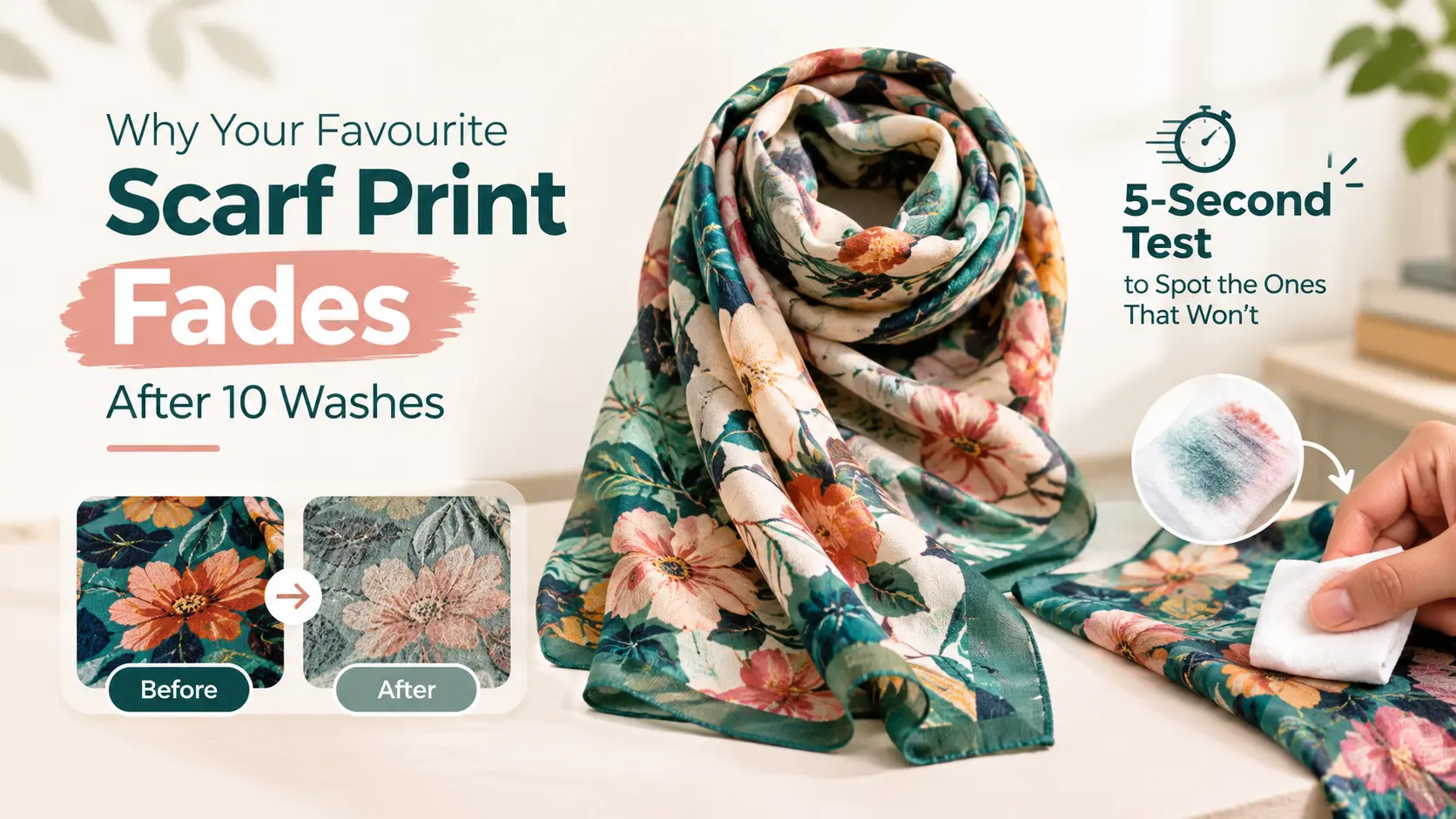
You bought the scarf because of the print. Maybe it was a deep emerald paisley or a soft watercolour floral that looked perfect with your winter coat. Ten washes later, the emerald has turned dull sage, the edges look chalky and your white shirt has a faint green shadow on the collar.
That fade is not bad luck, and it is rarely your washing machine’s fault. It almost always starts at the factory, with decisions about dye, fixation and finishing that a shopper never sees. The good news is that a faded scarf usually gives itself away before you buy it, if you know where to look.
The Short Answer: Why Printed Scarves Fade
Printed scarves fade because the colour was never fully locked into the fibre. The most common causes are:
- The wrong dye for the fabric, so colour sits on the surface instead of bonding inside the fibre
- Incomplete fixation, where the printed fabric was not steamed or cured long enough
- Poor washing off, which leaves loose dye on the fabric that bleeds out in your first few washes
- Heavy pigment prints with weak binder, which crack and rub away over time
- Harsh care at home, such as hot water, strong detergent and direct sunlight drying
A well-made printed scarf can keep its colour for years. A poorly made one starts losing it from the very first rinse.
How Colour Gets Into a Scarf (And Why Some Prints Never Stick)
Every printed scarf goes through the same basic journey: colour is printed onto fabric, fixed with heat or steam, then washed to remove anything that did not bond. Fading begins when any one of those three stages is rushed.
Dye Versus Pigment
There are two broad ways to colour a printed scarf, and they behave very differently in the wash.
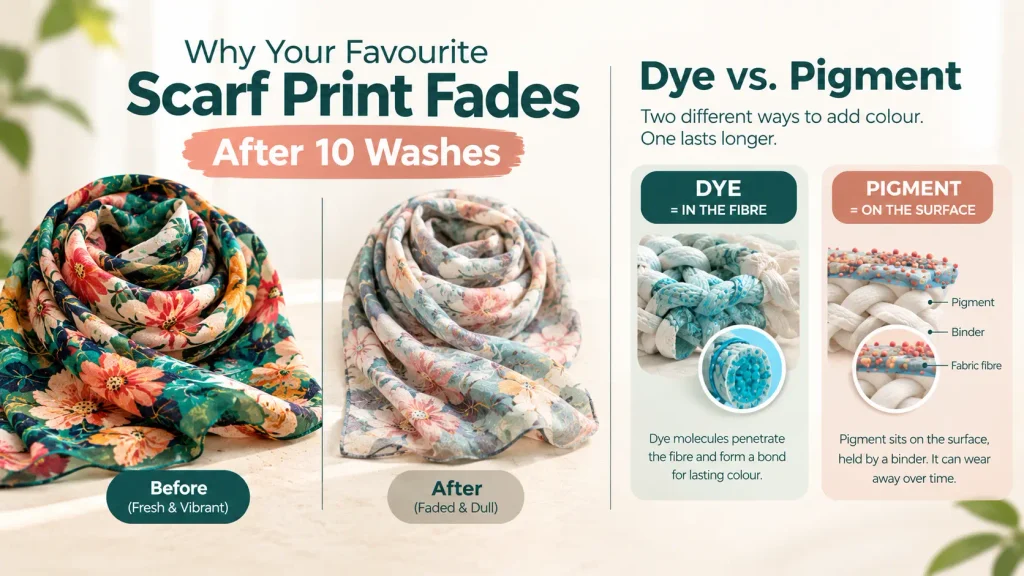
- Dyes (reactive, acid or disperse) penetrate the fibre and form a chemical or molecular bond with it. When matched correctly to the fabric, they hold colour extremely well.
- Pigments do not bond with fibre at all. They sit on the surface, glued in place by a binder. Pigment prints are cheaper and faster to produce, but the colour wears away as the binder breaks down.
Pigment printing is not automatically bad. Good binders and proper curing can give pigment prints respectable wash fastness. The problem is that low-cost production often cuts corners exactly here.
Matching Dye to Fibre
Each fibre accepts only certain dye families. Use the wrong one and the colour never truly attaches.
| Fabric | Correct dye type | What happens when it is wrong |
|---|---|---|
| Viscose, modal, cotton, linen | Reactive dyes | Colour washes out quickly and bleeds onto other clothes |
| Silk, wool | Acid dyes | Dull, uneven colour that fades with each wash |
| Polyester | Disperse dyes | Patchy colour and poor rub resistance |
| Blends (e.g. viscose wool) | Combination or carefully chosen dye | One fibre holds colour, the other fades, so the print looks washed out |
An experienced Printed Scarves Manufacturer India buyers rely on will choose the dye system based on the base fabric before a single sample is printed. That one decision does more for colour life than anything you can do at home.
The Four Factory Shortcuts Behind a Faded Scarf
When a scarf fades fast, one or more of these shortcuts is usually responsible.
1. Short Steaming or Curing
After printing, reactive and acid dyes need controlled steaming to bond with the fibre. Pigment prints need heat curing to set the binder. Cutting this time saves energy and speeds up output, but leaves a large share of the colour only loosely attached.
2. Skipped or Rushed Washing Off
Even a perfect print leaves some unfixed dye on the surface. A proper factory removes it with several rinses and a soaping wash. Skip this and the excess dye leaves during your first washes instead, taking brightness with it and staining everything nearby.
3. Cheap Pigment Binders
Low-grade binders soften, crack and wash away. The print starts looking chalky, especially along folds and the parts of the scarf that rub against your coat collar.
4. No Colourfastness Testing
Export-grade manufacturers test printed fabric against international standards such as ISO 105-C06 for washing and ISO 105-X12 for rubbing. Results are graded on a grey scale from 1 to 5, where 5 means no visible change. Many budget scarves are never tested at all.
The 5-Second Test to Spot a Scarf That Won’t Fade
You do not need a lab to judge a print. In a shop or the moment a parcel arrives, try this quick rub test.
How to Do It
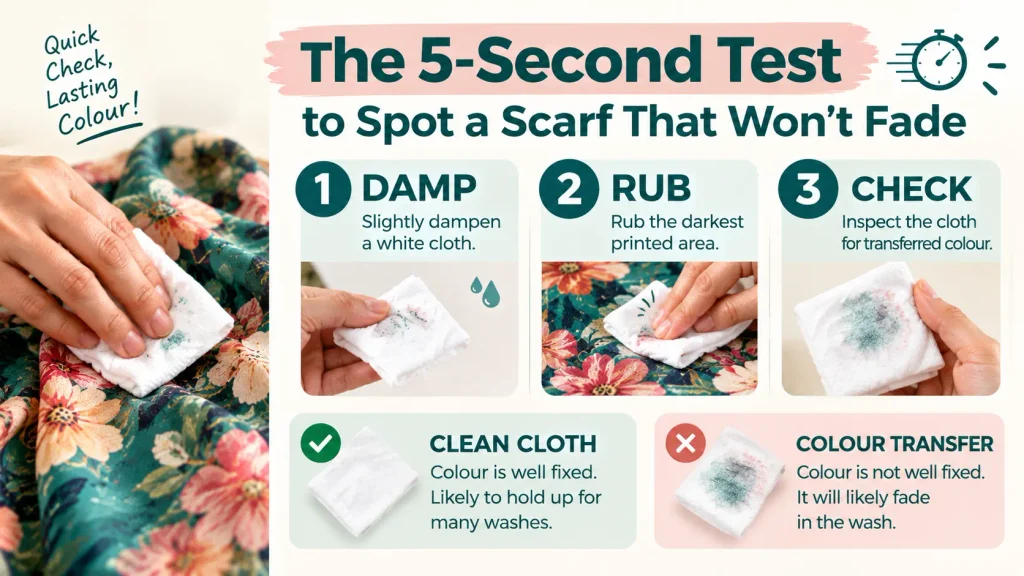
- Take a clean white tissue or white cotton cloth and dampen it slightly.
- Press it firmly onto the darkest, most saturated colour in the print.
- Rub back and forth about ten times with moderate pressure.
- Check the tissue.
How to Read the Result
| What you see on the tissue | What it means |
|---|---|
| Completely clean | Colour is well fixed. Likely to hold up for many washes. |
| Faint tint you can barely see | Acceptable. Wash the first few times separately. |
| Clear visible colour | Loose dye on the surface. Expect fading and bleeding. |
| Heavy colour or flakes | Poor fixation or weak pigment binder. The print will fade fast. |
This is a simplified version of the crocking test that textile labs use, and it reveals the most common cause of early fading: loose, unfixed colour.
Three Extra Checks That Take Seconds
- Flip it over. A dye-based print usually shows clear colour on the reverse, especially on lightweight viscose and silk. A white or very pale reverse on thin fabric often signals a surface print.
- Feel the print. Dye prints keep the fabric’s natural softness. A stiff, slightly rubbery or plasticky layer where the colour sits suggests heavy pigment.
- Read the label. Care labels that insist on dry cleaning only for a simple viscose scarf can be a warning that the colour is not stable in water.
Which Fabrics Hold Printed Colour Best?
Fabric choice affects how a print ages almost as much as dye choice.
- Viscose and modal: Take reactive dyes beautifully, giving bright, deep colour. Well-fixed prints last, but these fibres weaken when wet, so gentle washing matters.
- Silk: Holds acid dye prints with remarkable clarity. Sensitive to sunlight and harsh detergent, which cause gradual fading.
- Wool and wool blends: Absorb colour deeply and usually show strong wash fastness. Hot water causes shrinking and felting long before the print fails.
- Cotton and linen: Reliable with reactive dyes. Dark shades may lose slight depth over many washes.
- Polyester: Disperse dyes give excellent wash fastness, though the handfeel is less luxurious.
Lightweight summer printed scarves in viscose and modal need especially careful fixation because they are washed more often. Heavier winter printed scarves in wool blends are washed less but face more friction from coats and bags.
Does Digital or Screen Printing Fade Faster?
Neither technique automatically fades faster. What matters is the ink chemistry and the finishing.
- Digital reactive or acid prints bond inside the fibre and hold colour very well when properly steamed and washed.
- Digital pigment prints are quicker to produce but rely on binder, so they can lose depth sooner.
- Screen prints with reactive or acid paste offer excellent colour depth and durability, particularly on wool.
- Discharge and pigment screen prints depend heavily on correct curing.
In short, a carefully finished digital print will outlast a rushed screen print, and the reverse is equally true.
How to Make Any Printed Scarf Last Longer
Even a well-made scarf benefits from gentle care. These habits slow fading noticeably.
- Wash in cold water, ideally below 30°C, to protect both dye and fibre.
- Use a mild, pH-neutral detergent made for delicates or wool. Avoid bleach and optical brighteners.
- Wash dark prints alone for the first two or three washes.
- Turn the scarf inside out or use a mesh laundry bag to reduce friction.
- Never wring or twist. Press water out gently with a towel.
- Dry flat in the shade. Direct sunlight is one of the biggest causes of gradual fading, especially on silk.
- Store folded away from light, not hanging in a sunny wardrobe corner.
- Steam rather than hot iron where possible, and always iron on the reverse.
What Good Manufacturers Do Differently
Colour that lasts is built in during production. Reputable exporters treat colourfastness as a quality checkpoint rather than an afterthought.
- Match dye systems to each fibre and blend before sampling
- Control steaming time, temperature and humidity for every batch
- Wash off printed fabric thoroughly until rinse water runs clear
- Test wash, rub and light fastness against buyer and international standards
- Check every production lot against the approved sample
Bright Star applies these checks across its in-house factory capabilities, with testing and compliance processes outlined under its quality and compliance standards. For retailers sourcing from an established Scarf Manufacturer India, asking for colourfastness test reports is one of the simplest ways to protect customers from disappointing fades.
Conclusion
A fading scarf print is a factory story, not a laundry accident. The right dye for the fibre, proper steaming, thorough washing off, and real colourfastness testing decide whether a print stays vivid for years. A damp white tissue and five seconds of rubbing will tell you most of what you need to know before you buy, and gentle cold washing will do the rest.
Frequently Asked Questions
Why do printed scarves fade after washing?
Most fading comes from colour that was never fully fixed to the fibre. Wrong dye choice, short steaming, poor washing off, and weak pigment binders leave loose colour that leaves with every wash.
How can I tell if a scarf will fade before buying it?
Rub a slightly damp white tissue firmly over the darkest colour about ten times. A clean tissue suggests well-fixed colour, while visible colour transfer means the print will likely fade and bleed.
Do silk scarf prints fade?
Well-printed silk holds colour beautifully, but silk is sensitive to sunlight, hot water and harsh detergents. Wash gently in cool water, dry flat in shade and store away from direct light.
Is digital printing less durable than screen printing?
Not necessarily. Digital prints using reactive or acid dyes bond inside the fibre and last very well. Durability depends on ink type, steaming and washing off far more than the printing technique itself.
What is colourfastness in scarves?
Colourfastness measures how well a fabric keeps its colour during washing, rubbing, and light exposure. Labs grade it from 1 to 5 under standards such as ISO 105-C06, where 5 means no change.
Why does my scarf stain other clothes?
Staining happens when unfixed dye remains on the fabric because the factory skipped or rushed the washing-off stage. Wash the scarf alone in cold water until the rinse water runs clear.
Can I stop a scarf print from fading?
You cannot fix poor factory dyeing, but you can slow fading. Wash cold with mild detergent, avoid wringing, dry flat in the shade, and keep the scarf away from sunlight during storage.
Does vinegar or salt set colour in a printed scarf?
Home remedies like vinegar or salt have little effect on properly dyed fabric and cannot replace factory fixation. A mild detergent, cold water and gentle handling protect colour far more reliably.
Which scarf fabric holds print colour the longest?
Polyester with disperse dyes offers the strongest wash fastness. Among natural fibres, well-dyed wool and viscose hold colour very well, provided the fabric is washed gently and dried away from sunlight.
Why does the back of my printed scarf look white?
A pale reverse on thin fabric often means the colour sits on the surface, typical of heavy pigment prints. On thicker wool scarves, a lighter reverse can be normal even with good dye penetration.