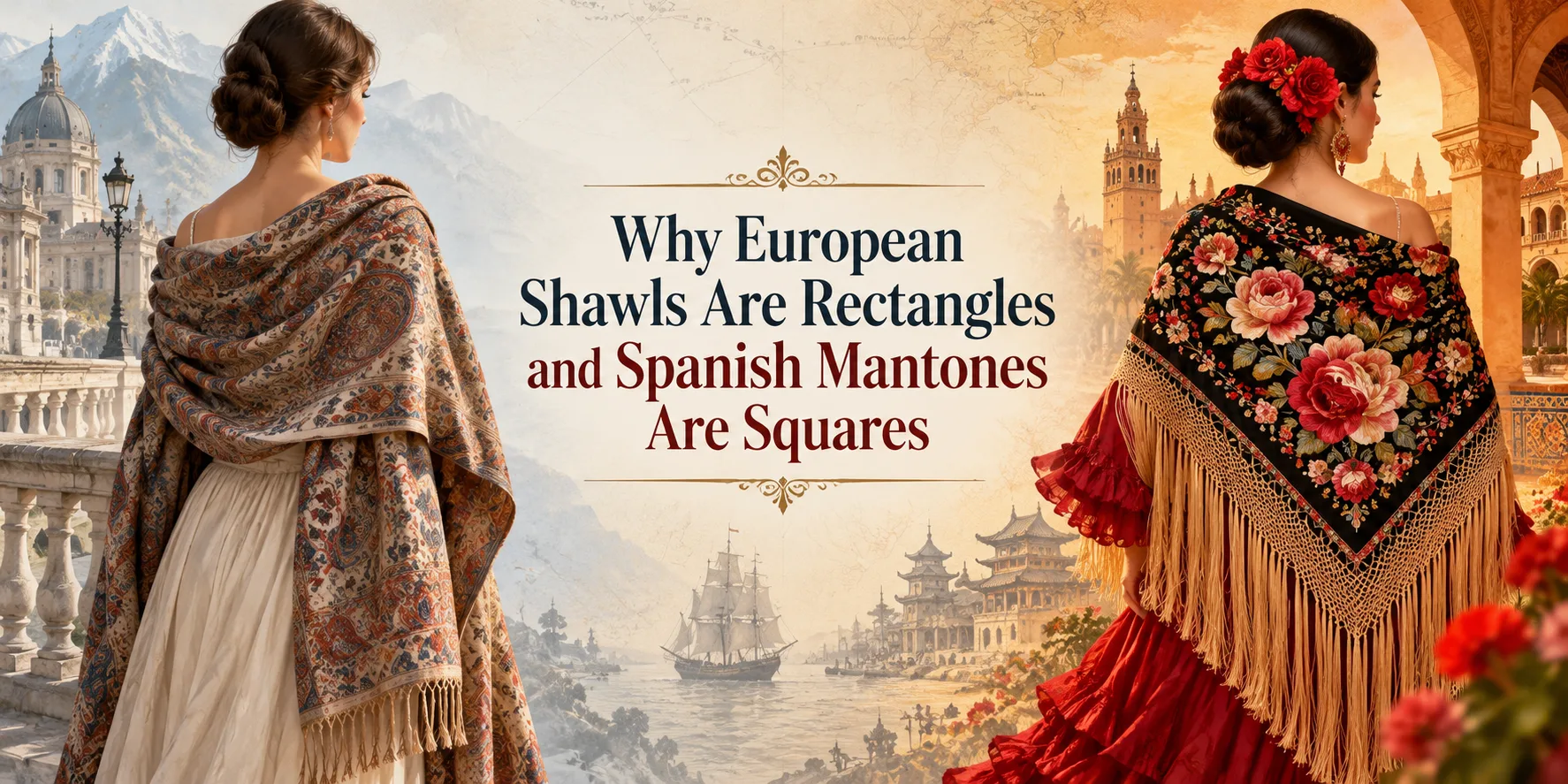
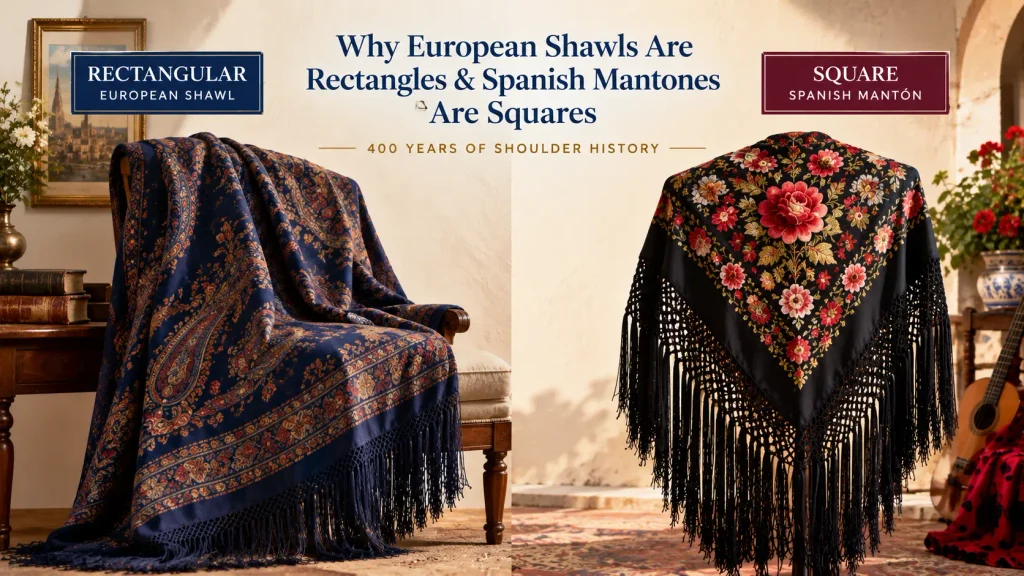
Lay a classic European wool shawl next to a Spanish mantón and the difference is obvious before you notice colour, fabric or embroidery. One is long and rectangular, made to wrap. The other is a generous square with a curtain of silk fringe, made to be folded into a triangle and worn like a frame.
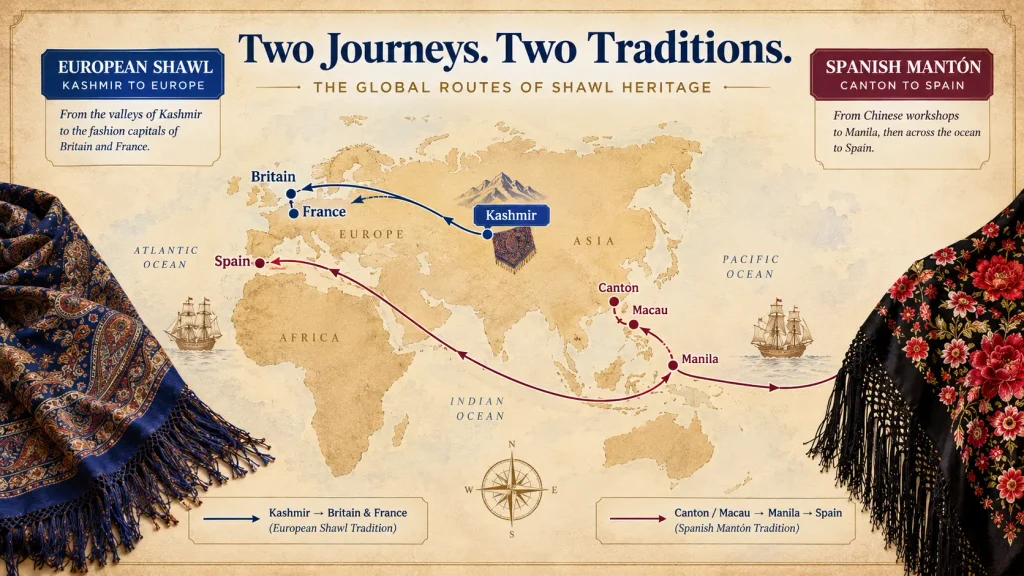
Neither shape is an accident. Each one is the result of trade routes, looms, dress silhouettes, and even dance. Follow the history back far enough, and both shapes lead to Asia: one to the valleys of Kashmir, the other to the embroidery workshops of southern China.
The Short Answer
European shawls became rectangles and Spanish mantones became squares because they came from different origins and served different jobs.
- European shawls descend largely from Kashmir shawls that reached Europe in the late 1700s. Their long, rectangular form suited the slim dresses of the early 1800s and the practical need to wrap up against cold weather.
- Spanish mantones descend from square, embroidered silk shawls made in Canton and Macau for export through Manila. Folded diagonally, the square shows off its embroidery and swinging fringe, which suited Andalusian fashion and, later, flamenco.
Shape followed purpose. A rectangle wraps and warms. A square, folded into a triangle, frames and displays.
Part One: How the Rectangle Came to Europe
Kashmir, Where It Started
Long before Europe wore shawls, Kashmir was weaving them. Under Mughal patronage from the 16th century onward, Kashmiri weavers produced exceptionally fine shawls from the underfleece of Himalayan goats, using a painstaking twill tapestry technique now known as kani weaving.
Kashmir actually made several shapes:
- Long shawls, rectangular pieces often sold in matched pairs
- Square shawls, sometimes called rumal, meaning handkerchief
- Narrow lengths worn as sashes or turbans
Rectangles dominated the export trade, and that choice shaped what Europe came to think a shawl should look like.
The Shawl Craze of the Late 1700s
Kashmir shawls began arriving in Britain and France in the second half of the 18th century, brought back by officials and traders of the East India Company. By the 1790s they were the most coveted accessory in fashionable society, and in France the Empress Joséphine became famous for her large collection.
The timing mattered. Neoclassical fashion had just swapped heavy layered gowns for light, high-waisted muslin dresses. Those dresses looked elegant but offered little warmth, and a long cashmere rectangle solved both problems at once. It could hang loosely from the elbows, wrap around the shoulders or drape across the back like a classical statue.
Europe Learns to Copy
Genuine Kashmir shawls were extraordinarily expensive, so European mills set out to imitate them. Weavers in Norwich, Edinburgh and above all the Scottish town of Paisley produced woven copies from the early 1800s. Lyon and Paris followed with luxurious versions on Jacquard looms.
The famous teardrop motif became so closely tied to the Scottish town that it is still called paisley in English. European looms reproduced the long rectangular format because that was what buyers expected from a “Kashmir style” shawl.
Where Squares Briefly Took Over
The story is not quite as tidy as the title suggests, and that is part of its interest. In the mid-19th century, wide crinoline skirts made dresses enormous. A short shawl looked lost against them, so fashion moved towards larger shawls, including big squares folded into triangles and long shawls folded double.
Then came the bustle in the 1870s, with its narrow front and sculpted back. Shawls hid that silhouette, and their great European era faded. When wraps returned in the 20th century as stoles, travel blankets, and evening shawls, the rectangle came back with them because it was the most practical shape for coats and modern movement.
Part Two: How the Square Came to Spain
Made in China, Named for Manila
The mantón de Manila is not originally Spanish, and it is not Filipino either. Its earliest forms were square silk shawls embroidered in workshops in Canton (today’s Guangzhou) and Macau, made specifically for export. They travelled to the Philippines and from there across the Pacific on Spanish galleons, before reaching Spain and the rest of Europe.
Because they arrived through Manila, Europeans named them after the port rather than the place they were made. Early examples carried Chinese motifs such as pagodas, figures, birds and bamboo, stitched in silk on a silk base.
Why Spain Fell in Love With the Square
Popularity surged in 19th-century Spain. Romantic era fashion favoured gowns that left the shoulders bare, and a large square of embroidered silk folded into a triangle was the ideal cover: decorative, light and easy to move in.
Over time, Spanish tastes reshaped the design:
- Chinese scenes gave way to large, dense roses, peonies and flowers
- Embroidery became more colourful and heavier
- Knotted fringes, a feature linked to Moorish influence in Spain, grew steadily longer
After Spain lost the Philippines in 1898, supply from Asia ended, and Seville became the leading centre of mantón production. Andalusian embroiderers have kept the craft alive ever since.
The Square as a Moving Frame
The square shape does something a rectangle cannot. Folded corner to corner, it forms a triangle with the point falling down the back and the embroidered field sitting across the shoulders. The fringe hangs from two long edges, so every step, turn or gesture sets it swinging.
That is why the mantón became central to flamenco. In dance, it is not just worn but handled: swirled, spun, and flicked around the body. A square gives the dancer both a large embroidered surface and a fringe that amplifies motion. A rectangle simply would not move the same way.
Rectangle vs Square at a Glance
| Feature | European Shawl | Spanish Mantón |
|---|---|---|
| Typical shape | Long rectangle | Large square |
| Main ancestor | Kashmir long shawl | Cantonese export silk shawl |
| Route to Europe | Via India and the East India Company | Via Manila on Spanish galleons |
| Traditional fibre | Wool, cashmere, later wool blends | Silk |
| Decoration | Woven pattern, paisley motif | Hand embroidery |
| Fringe | Short or moderate | Long, knotted silk fringe |
| How it is worn | Wrapped, draped or looped | Folded into a triangle |
| Original purpose | Warmth with elegance | Display and movement |
| Cultural home today | Everyday outerwear and evening wraps | Festivals, weddings and flamenco |
Five Forces That Decided the Shape
Looking across both histories, five factors explain why the two shapes split.
1. The Climate
Northern European winters reward a shape that wraps fully around the neck and body. Andalusia’s warmer weather allowed a shawl to be about decoration first and warmth second.
2. The Loom and the Technique
Woven patterns are easiest to produce in long lengths, so Kashmir and Paisley weavers naturally worked in rectangles. Embroidery, by contrast, starts on a finished piece of cloth, and a square gives the embroiderer a balanced field with a strong centre.
3. The Dress Silhouette
Slim Regency dresses suited long draped rectangles. Bare-shouldered Romantic gowns in Spain suited a folded triangle that sat neatly across the shoulders.
4. The Way It Moves
Rectangles hang. Folded squares swing. Spanish fashion and dance valued that swing, while northern fashion valued a clean drape.
5. The Trade Route
Each shape arrived with its own supply chain. Kashmir rectangles came through British and French trade with India. Cantonese squares came through Manila and the Spanish Pacific.
The Shapes That Prove the Rule
Shawl geography is full of fascinating exceptions that still follow the same logic of purpose:
- Shetland hap shawls are square, knitted for warmth and worn folded over the shoulders by working women in the Scottish islands.
- The Mexican rebozo is a long rectangle, used for carrying, wrapping and dressing up, and its design is thought to show influence from the same Manila shawl trade.
- The Andean ruana is essentially a large rectangle with a slit for the head, turning a shawl into a garment.
- Triangular shawls became popular in hand knitting because they give the look of a folded square with less material.
Each one confirms the pattern. People choose a rectangle when they need to wrap, carry, or layer, and a square or triangle when they want a framed, decorative shape across the shoulders.
What Shape History Means for Shawls Today
Modern wardrobes have borrowed from both traditions, and today’s collections reflect that mix.
- Rectangular shawls and stoles remain the everyday choice for coats, travel, and office wear because they wrap easily and layer well.
- Large squares are used for statement pieces, festival dressing and anything designed to be folded and shown off.
- Woven paisley and jacquard patterns carry the Kashmir and Paisley story into contemporary design.
- Printed florals with fringe often echo the mantón aesthetic without the weight of hand embroidery.
For retailers developing a collection, shape is a merchandising decision as much as a style one. An experienced Shawls Manufacturer India can produce the same design as a long wrap, a large square or a narrow stole, depending on how the end customer is expected to wear it.
The Kashmir connection runs deep at Bright Star, which began in 1950 as a Kashmir shawl emporium, as its three-generation heritage story explains. That legacy lives on in woven and jacquard shawls that carry traditional motifs like paisley, alongside printed scarves and shawls that reinterpret florals and heritage patterns for modern buyers. For shapes that turn a shawl into a garment, ruanas and capes continue the same wrap tradition in a wearable form.
Conclusion
The rectangle and the square tell two different stories about the same accessory. Europe’s long shawl came from Kashmir, built for warmth and graceful draping. Spain’s square mantón came from Canton by way of Manila, built to be folded, framed, and set in motion. Four centuries later, both shapes are still with us, and every shawl on a shop shelf carries a little of that history across its shoulders.
Frequently Asked Questions
Why are most European shawls rectangular?
They descend from long Kashmiri shawls imported in the late 1700s. Rectangles suited slim Regency dresses, wrapped well against cold weather, and were easy for Paisley and Lyon looms to reproduce.
Why is the Spanish mantón square?
The mantón began as a square embroidered silk shawl made in Canton for export. Folded into a triangle, the square shows off embroidery and long fringe, ideal for Spanish fashion and flamenco.
Why is it called a Manila shawl if it was made in China?
The shawls were made in Canton and Macau but shipped through Manila on Spanish galleons. Europeans named them after the port of departure rather than the workshops where they were embroidered.
When did shawls become fashionable in Europe?
Kashmir shawls became fashionable in Britain and France in the late 18th century. The craze peaked in the early and mid-19th century, then declined when bustle dresses arrived in the 1870s.
How is a Spanish mantón traditionally worn?
It is folded corner to corner into a triangle and placed over the shoulders, with the point down the back. The long knotted fringe falls along both edges and moves with every step.
Why did Spanish mantones get longer fringes?
Fringes grew longer through the late 19th and 20th centuries to emphasise movement as women walked or danced. In flamenco, a long fringe dramatically amplifies every turn and gesture of the dancer.
What is the connection between Kashmir shawls and paisley?
European mills copied Kashmir shawls to meet demand. The Scottish town of Paisley produced so many that the teardrop Kashmiri motif became known in English simply as paisley.
Did Kashmir only make rectangular shawls?
No. Kashmir weavers also produced square shawls called rumal and narrower lengths for sashes. Rectangular long shawls simply dominated the export trade, which shaped European expectations of the shawl.
Which shawl shape is most practical for everyday wear?
A rectangle is the most practical for daily use. It wraps around the neck, layers under coats and drapes easily over shoulders, while squares suit occasions where display matters more than warmth.
Are square shawls still made today?
Yes. Large squares are still made for festive wear, flamenco and statement styling. Many modern collections offer the same design in both square and rectangle formats to suit different customers.