

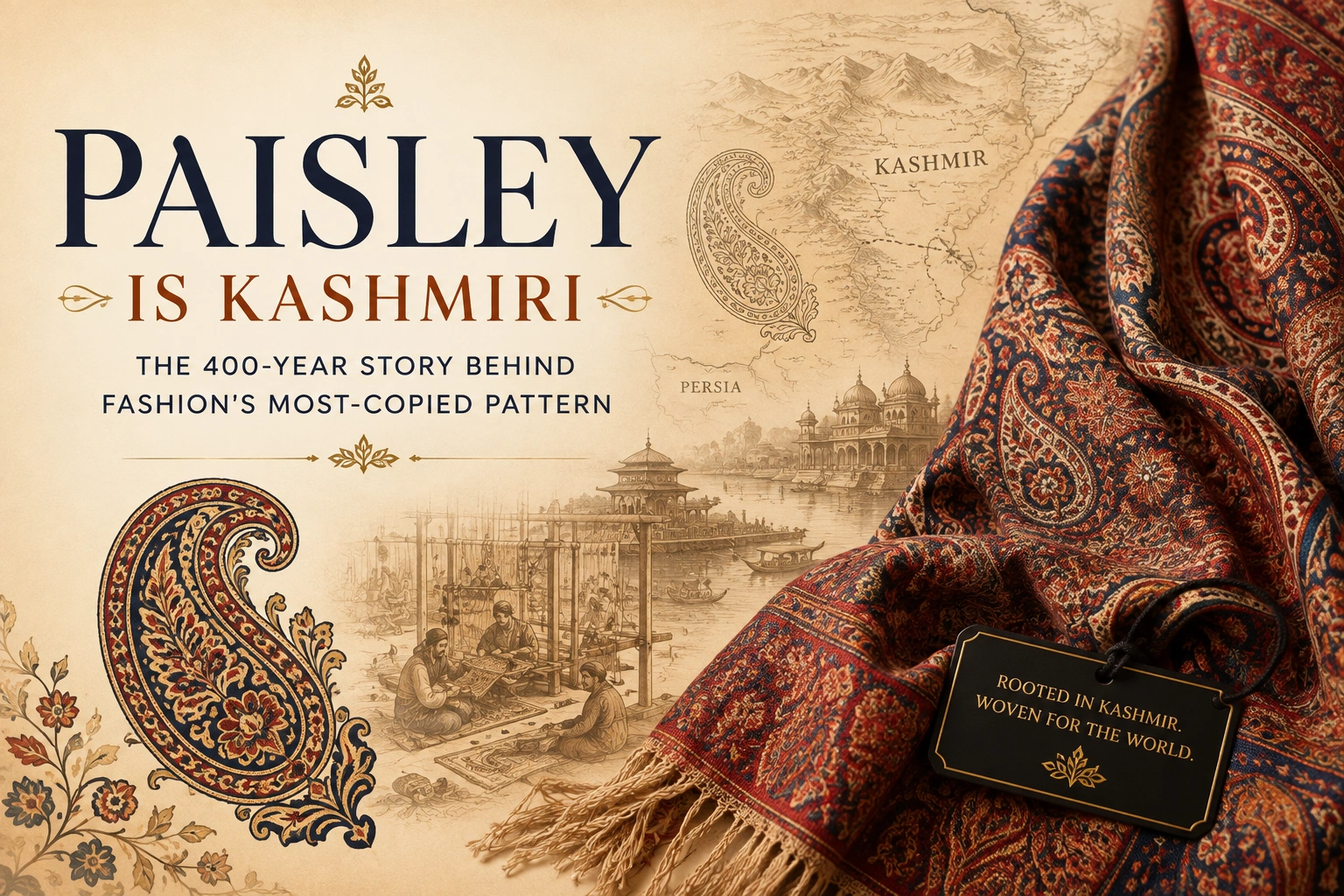
You have almost certainly worn a paisley print. You may own several scarves, ties, bandanas, blouses, cushion covers, or upholstery. The name feels vaguely Scottish, or English, or maybe French. It is on shelves in every high-street fashion store in the world, from fast fashion to luxury.
What almost nobody knows is that the swirling teardrop motif at the heart of the pattern is not Scottish, French, or English. It is Kashmiri. The design has been woven, dyed, and stitched by artisans in Kashmir for at least 400 years, and probably longer. The world simply renamed it in the 19th century after a Scottish mill town started mass-producing copies.
This is the full story of how a Kashmiri motif became fashion’s most-copied pattern, why the original still matters, and what buyers should know if they want the real thing.
What “Paisley” Actually Is
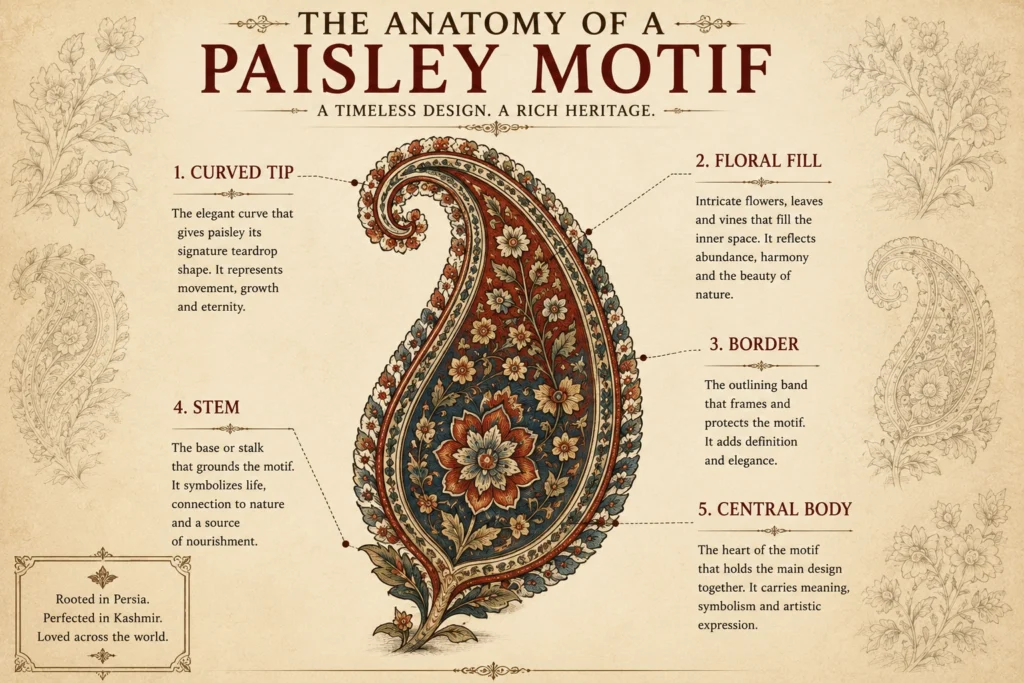
The motif that English speakers call paisley is known by several names in its regions of origin. In Persian, it is boteh, meaning “shrub” or “cluster of leaves”. In Kashmir and much of North India, it is buta, kalka, or ambi. In Azerbaijan, it is buta as well. Each of these names points back to the same shape: a curved, teardrop-like form with a bent tip and rich internal ornamentation.
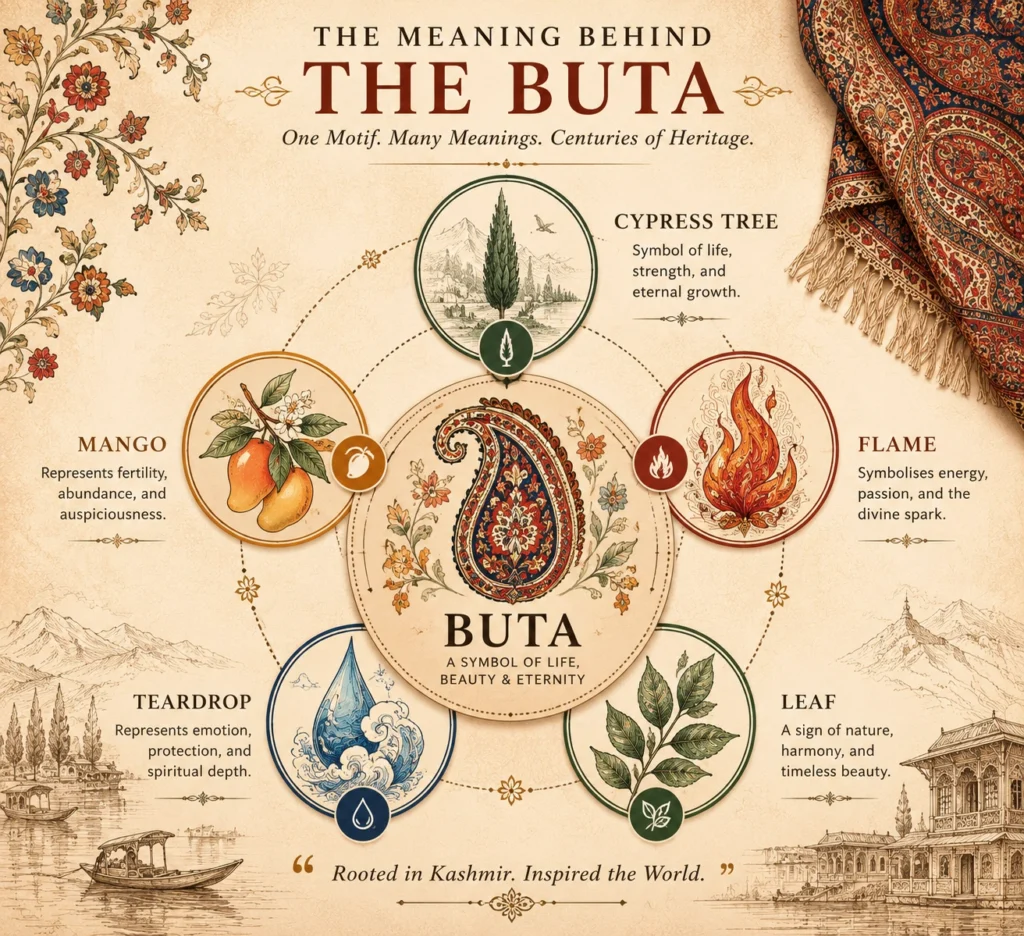
The symbolism varies by region and interpretation. Different traditions read it as:
- A stylised cypress tree, symbol of life and eternity
- A mango, one of the most auspicious fruits in South Asian culture
- A flame or a teardrop
- A pinecone or a leaf curling in the wind
Whatever its exact origin, the motif has carried spiritual, poetic, and decorative meaning across Persia, India, and Central Asia for centuries.
The Kashmiri Origin: How the Motif Was Born
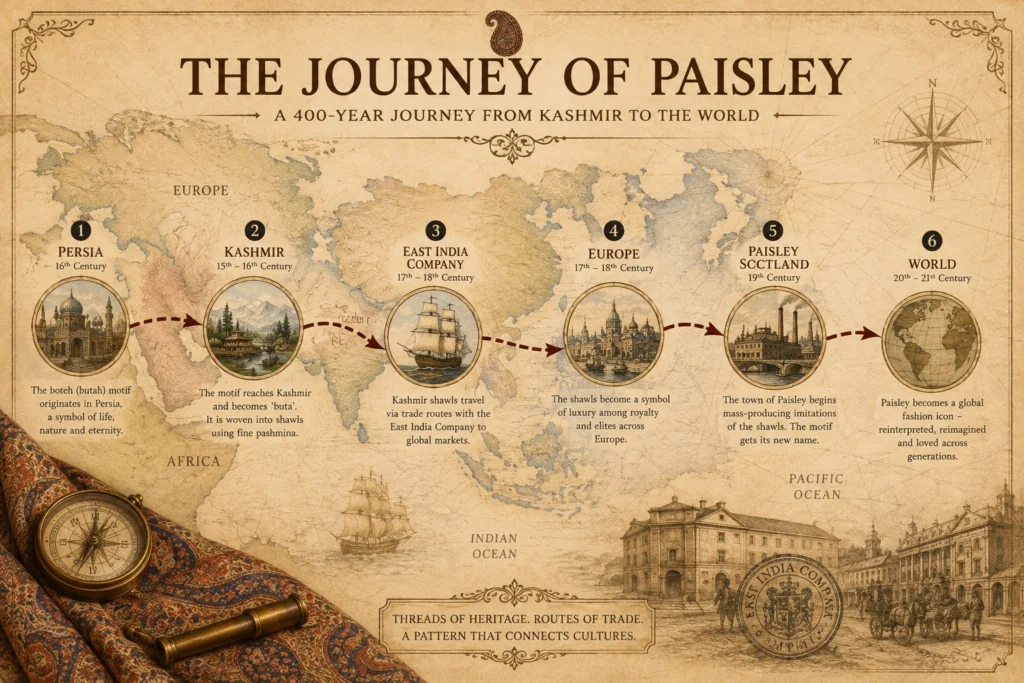
The buta became the signature motif of the Kashmir shawl during the Mughal era, from roughly the 15th century onwards. Kashmir was already famous for weaving fine wool from the pashmina goat, an animal native to the high plateaus of Ladakh and Tibet.
Under Mughal patronage, Kashmiri weavers refined two things at once: the pashmina cloth itself, and the buta motif that decorated it. The result was the kani shawl, a piece so intricate that a single shawl could take a team of weavers between 18 months and three years to complete. Each colour was inserted by hand using small wooden bobbins called kanis, following a coded pattern read out loud by a master weaver.
By the 17th century, the Kashmir shawl was considered one of the finest woven textiles in the world.
How the Kashmir Shawl Conquered Europe
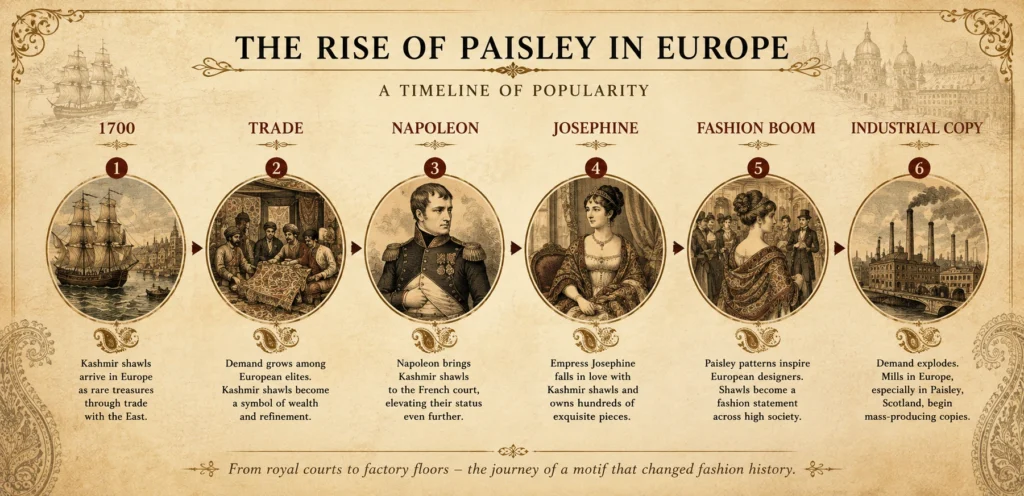
The Kashmir shawl reached Europe through 17th- and 18th-century trade with the East India Company and Central Asian merchants. It arrived first as a diplomatic gift, then as a status symbol, and finally as a full-blown fashion obsession.
Napoleon reportedly gifted Kashmir shawls to his wife, Empress Josephine, who is said to have owned hundreds. By the early 1800s, a genuine Kashmir shawl was one of the most expensive garments a European woman could own, sometimes costing the equivalent of a house. Demand far outstripped what Kashmiri weavers could produce.
That demand created a manufacturing opportunity that the industrialising West was uniquely positioned to seize.
The Paisley, Scotland Story: How the West Rebranded a Kashmiri Original
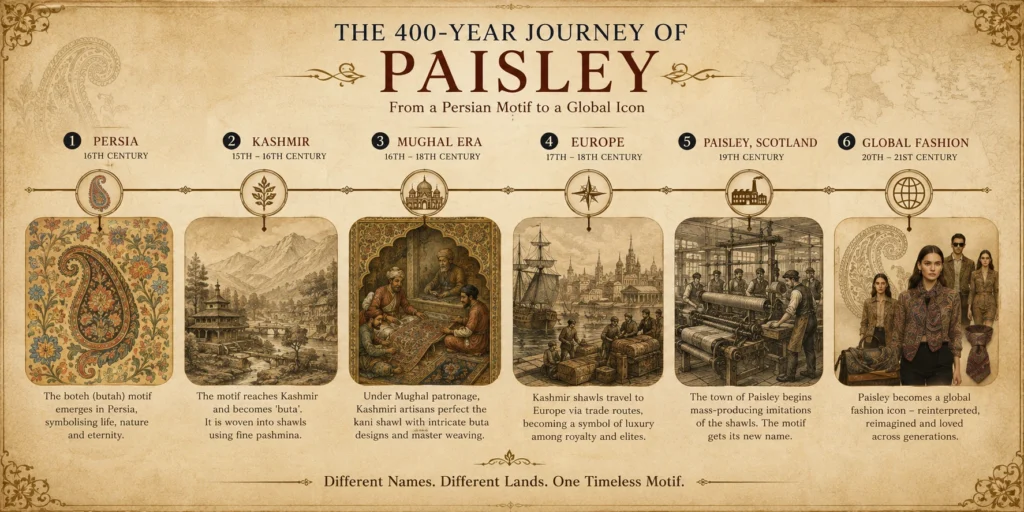
Several European mill towns began producing woven imitations of the Kashmir shawl in the early 19th century. The most successful of these was the town of Paisley, near Glasgow in Scotland.
Paisley’s weavers combined skilled labour with the newly introduced Jacquard loom, which used punched cards to automate complex patterns. What had taken Kashmiri weavers years by hand could now be produced in hours by machine. Paisley shawls flooded the European market at a fraction of the price of genuine Kashmir shawls.
The imitations were so ubiquitous that English speakers began calling the motif itself “paisley”, after the town, rather than by its Persian or Kashmiri names. The renaming stuck. Within a generation, an entire European vocabulary had been built around a motif whose origin had been quietly erased.
What Was Lost in the Translation
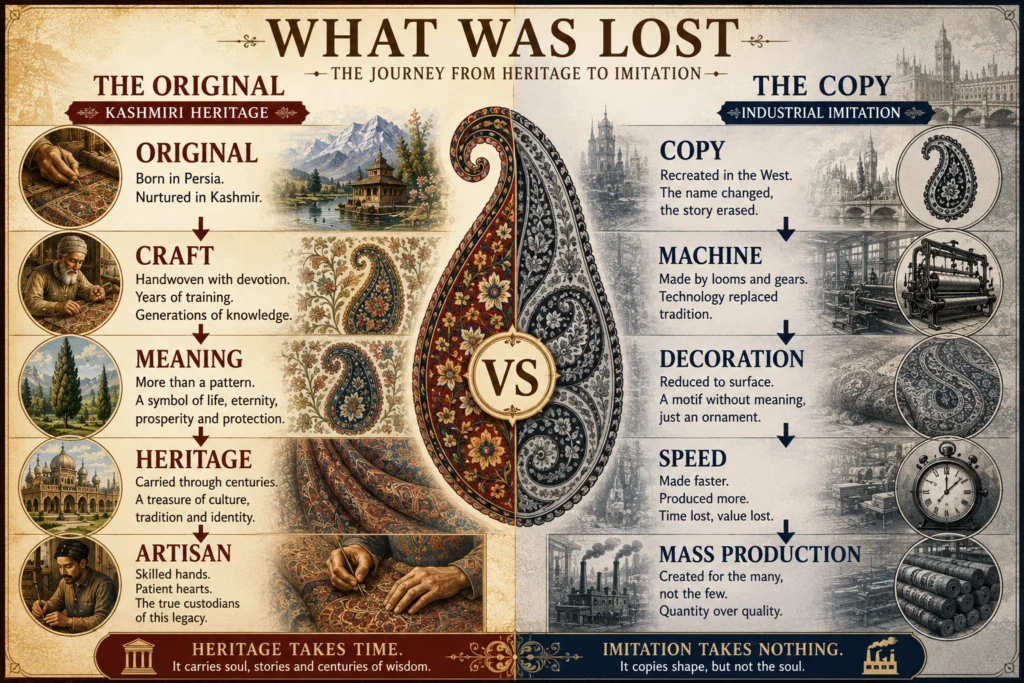
The Paisley shawls of Scotland were technical marvels, but they were not equivalent to the Kashmiri originals. A few things were quietly lost when the motif crossed hemispheres.
- Fibre: Scottish shawls used wool. Kashmiri originals used pashmina, warmer, softer, and rarer
- Technique: Kashmir kani weaving was and remains hand-executed. Paisley shawls were loom-mechanised
- Time: A kani shawl took 18 to 36 months. A Paisley shawl took a day
- Meaning: Kashmiri buta motifs carried regional symbolism. Paisley shawls treated them as decoration alone
- Attribution: Kashmiri weavers received no credit. The town of Paisley did
None of this makes the Scottish shawls valueless. It simply means the story of the pattern has been half-told for two centuries.
The Kani Shawl: The Original Paisley Piece
The kani shawl remains one of the most intricate handwoven textiles in the world, and it is still made in Kashmir today. Each shawl is woven on a wooden handloom, using a coded pattern called a talim that is read out loud by a lead weaver to a team working the kanis.
A single traditional kani shawl can involve:
- Thousands of individual colour inserts per row
- 12 to 36 months of continuous weaving
- Multiple weavers rotating in shifts to protect the pattern accuracy
- Pashmina yarn hand-spun from Ladakhi goat fleece
The finished piece is not a garment in the ordinary sense. It is a woven document of Kashmiri artistry.
Real Kashmiri Paisley vs Machine-Made Copy
Here is a quick comparison of what separates the genuine article from a mass-market print.
| Feature | Genuine Kashmiri Paisley | Machine-Made Paisley |
| Origin | Kashmir handloom | Global mill or digital print |
| Fibre | Pashmina, cashmere, or fine silk | Wool, cotton, viscose, polyester |
| Technique | Kani weaving or hand-block printing | Jacquard weaving or digital printing |
| Production time | Months to years | Minutes to hours |
| Motif detail | Coded talim, individually plotted | Repeat pattern, digitally rendered |
| Reversibility | Often reversible on kani weaves | Single-sided in most cases |
| Cultural attribution | Documented Kashmiri origin | Rarely documented |
| Price range | High, reflecting artisanship | Broad, often very low |
Why the Origin Story Matters Today
The last decade has seen a sharp rise in consumer interest in where products come from and who made them. Cultural attribution is no longer a niche academic concern. It is a purchasing criterion.
For scarves, shawls, and home textiles, that shift is playing out in three ways:
- Buyers are asking for verified Kashmiri, Persian, or South Asian origin on paisley pieces
- Brands are being asked to credit the motif’s origins in marketing and labelling
- Retail is beginning to distinguish between mass-market paisley and genuine kani or hand-block work
Getting this right is both an ethical position and a commercial one. Consumers who understand the story pay more for the genuine article.
Bright Star’s Kashmiri Heritage
Bright Star was founded in 1950 by a family that had been working with Kashmiri textiles for a long time before then. The original business was KCS Kashmir Shawl Emporium, named for the Kashmir shawl and the craftsmanship that made it famous. Three generations later, that heritage still shapes what we produce.
Today, Bright Star manufactures scarves, shawls, stoles, and home textiles for premium retailers, private label brands, and boutique importers across Europe, North America, Australia, and the Middle East. Paisley motifs, worked in pashmina, cashmere, silk, wool, and blends, remain one of the most-requested categories in our production book, and we work directly with Kashmiri artisans on the pieces that call for genuine kani or hand-block techniques.
Explore the full range of our shawl collection, and see companion collections in stoles, throws, and cushion covers.
For Brands and Buyers: How to Source Authentic Kashmiri Paisley
If you are building a scarf, shawl, or home textile line and want to include paisley, honestly, the sourcing checklist is straightforward.
- Ask about origin: Kashmir, Persian, or South Asian handloom vs machine mill
- Ask about technique: Kani weaving, hand-block printing, digital printing, or Jacquard
- Ask about fibre: Pashmina, cashmere, silk, wool, or blend
- Ask about time: Real handwoven pieces take months, not days
- Ask about attribution: Reputable manufacturers can name the region and technique
These questions filter out mislabelled stock within the first supplier conversation.
Ready to Source Paisley With Its Real Story Intact?
The paisley pattern belongs to Kashmir. Buyers, brands, and retailers who acknowledge that in their sourcing are not just doing the right thing culturally; they are also delivering a story worth paying more for. As a manufacturer with roots in Kashmir since 1950, Bright Star produces paisley scarves, shawls, and stoles across the full spectrum from authentic kani work to accessible machine-woven pieces.
Explore Bright Star’s full range at bright-star.co.in or reach out for a wholesale quote tailored to your next collection.
Frequently Asked Questions
Is the paisley pattern actually Kashmiri or Scottish?
The paisley pattern is Kashmiri and Persian in origin, known as the buta or boteh motif for centuries. It became “paisley” only after 19th-century Scottish mills mass-produced imitations of Kashmir shawls.
What does the paisley motif represent?
The paisley or buta motif is variously interpreted as a stylised cypress tree, a mango, a flame, or a teardrop. Its exact symbolism varies by region and tradition, but it carries deep cultural significance.
When did Paisley become popular in Europe?
Paisley became fashionable in Europe during the 18th and early 19th centuries, driven by imported Kashmir shawls. Napoleon’s wife, Empress Josephine, is said to have owned hundreds, cementing the pattern’s status among European aristocracy.
What is the difference between a kani shawl and a Paisley shawl?
A kani shawl is a handwoven Kashmiri piece using coded patterns and pashmina yarn, taking months to years to produce. A Paisley shawl is a Scottish machine-woven imitation of the Kashmiri original made from wool.
Why is the pattern called paisley?
The pattern is called paisley after the Scottish town of Paisley near Glasgow, which mass-produced imitation Kashmir shawls in the 19th century. The name replaced the original Persian and Kashmiri names in English-speaking countries.
Are kani shawls still made in Kashmir today?
Yes, kani shawls are still woven by hand in Kashmir today. A single traditional kani shawl can take 18 to 36 months to complete and involves thousands of individual colour inserts using small wooden bobbins.
How can I tell if a paisley scarf is an authentic Kashmiri?
Authentic Kashmiri paisley pieces are woven or hand-block printed on pashmina, cashmere, or silk with documented origin. They are often reversible and priced significantly higher than machine-printed alternatives from mass-market mills.
Is Paisley culturally appropriate to wear?
Wearing paisley is not appropriate in itself, since the motif has spread globally for centuries. What matters is attribution: crediting the pattern’s Kashmiri and Persian origins and supporting authentic sourcing where possible.
Can Bright Star produce authentic Kashmiri paisley scarves for my brand?
Yes, Bright Star manufactures paisley scarves, shawls, and stoles, including authentic Kashmiri techniques. Buyers can choose between handloom kani work, hand-block printing, and machine production depending on their retail tier and budget.
What is the minimum order for paisley scarves at Bright Star?
Minimum orders are flexible at Bright Star, typically starting from around 500 pieces. Boutique brands and larger retailers both receive matched production timelines, quality control, and origin documentation on every order.